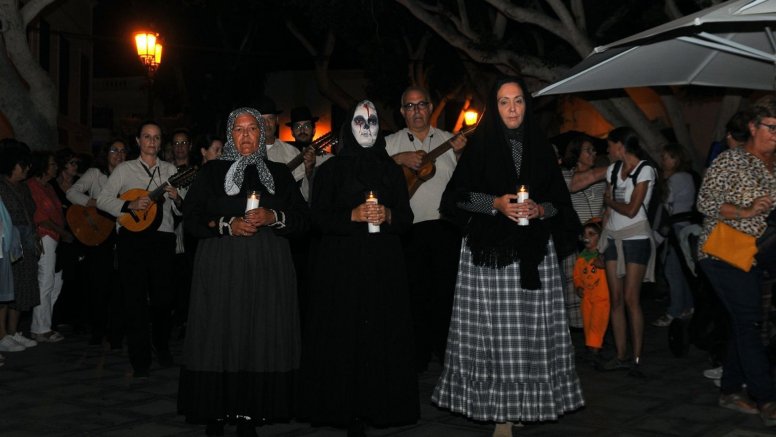
It is well known that on these dates, Halloween invades every corner of stores, schools, or supermarkets. This costume party with a taste of sweets, of Anglo-Saxon origin, has burst into our culture like a tsunami through films or trends. However, some time ago, the Canary Islands held their own celebration around All Saints' Day, called Noche de los Finaos.
The origin of this tradition can be traced back to some religious acts of the 15th century, when the so-called Masses of the Souls were celebrated, which evolved into other more pagan rituals.
The word "finao" comes to mean "end", that is, of that "who has ended his days." In Spain it is in disuse, but in areas such as Galicia or countries such as Brazil or Portugal it is still used.
Since the existence of humanity, deceased people have always been respected, which is why throughout history, rites, temples, or monuments have arisen to honor those who are no longer with us.
According to Carmen Morales, Doctor in Sociology and Political Science, "in 300 BC, the texts of the druids (Celtic priests) reflect that when the solstice approached, they thought that on the night of the 31st the time between the world of the living and the dead was shortened, and they celebrated it in cemeteries with meals and lit candles to guide the dead on their way." This festival was called Samhain and is associated with the origin of Halloween. In parallel, Christianization also created its own festivals in relation to the predominant evangelization at that time.
A tradition that was celebrated for two days
In the past, both October 31st and November 1st were holidays. "What they did on the night of the 31st was a family gathering and a vigil, staying up all night and lighting candles," says Morales.
Specifically, "they would light one on the night of the deceased, that is, for a deceased family member, and they would talk about these people who are no longer with us," the sociologist points out. "The night allowed for a lot, since they prayed, recited the rosary, and read the Bible," she continues.
Also, that night, the children would go out into the street and go to the houses knocking on the doors asking: "are there any saints?", to which people responded by giving the sweets of that time, such as bread, chestnuts, raisins or dried figs.
It was also celebrated with music from the Ranchos de Ánimas, the first musical groups in the Canary Islands. "On the night of the 31st, they stayed awake and went singing through all the houses, and on the 1st they only went out for a while, but they continue singing every day until February 2nd, the day of La Candelaria," she points out.
However, they only sing to the souls until December 13 with "monotonous and boring" chants, but from that day on, Saint Lucy's Day, they sang to Christmas, with more fun and cheerful music.
Hope Beyond Death
The tradition of the Finaos upholds the deep roots of the Canary Island festivities, but it also maintains the hope of life beyond death, remembering the deceased with affection and joy.
In Finaos, contrary to what one might think, life was celebrated with the family, and they told different stories of the deceased, eating products that were available during that time and drinking liquors or wines.
In many municipalities of Lanzarote and the rest of the Canary Islands, different activities are promoted in relation to the Finaos to preserve and disseminate this tradition that is part of our roots and ancestors, as well as organizations such as the Order of the Canarian Puppy of Lanzarote.
In the case of Carmen Morales, her work as a teacher also leads her to bring this tradition and other elements of Canarian culture to the youngest, to prevent them from disappearing.
Add La Voz de Lanzarote as a preferred Google source.
Stay informed with the latest current news.