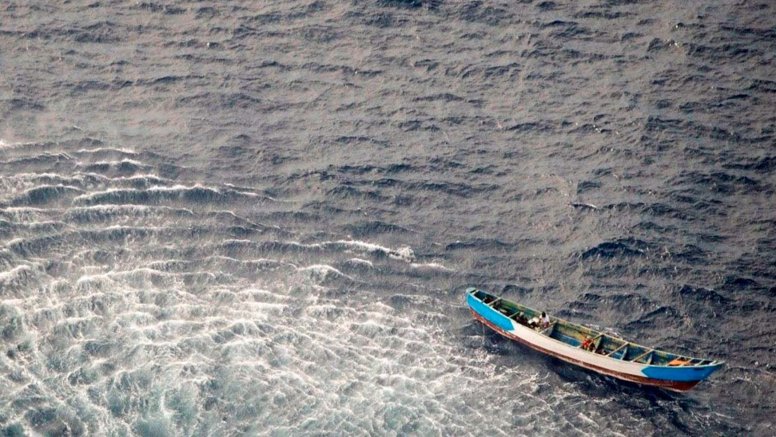
The Contentious Chamber of the Superior Court of Justice of the Canary Islands (TSJC) has rejected annulling the expulsion order of a convicted to six and a half years in prison for acting as pater of a cayuco in which there were at least four deaths and several disappearances in April 2021.
The accused requested that the January 2024 ruling be revoked in which a Contentious Court sided with the Government Sub-delegation in the Canary Islands that decreed his forced departure from Spain, which his lawyers at some point refer to as "return".
The cayuco arrived in El Hierro on April 4, 2021 in a boat 14 meters long and two meters wide, with 23 occupants of whom four died, compared to about fifty travelers who would have left Mauritania at the end of March.
Added to this is that the journey was carried out during the pandemic, with passengers crowded and without protective masks.
On March 16, the appellant was placed in pre-trial detention along with three other people who were also sentenced to 6 and a half years in prison each, of which four are as perpetrators of a crime against the rights of foreign citizens and another two and a half for reckless homicide and ten injured.
Sanction for citizens from outside the European Union
The ruling issued at the beginning of 2023 by the Tenerife Provincial Court considers it proven that the defendant was among the occupants of the boat, lacked documentation and was trying to enter Spain illegally, so a return order was issued.
The sanction is imposed on anyone who helps another person who is not from the European Union (EU) to enter this territory and is punishable by a fine of three to twelve months and four to eight years in prison, if the lives of people are endangered and cause serious injuries.
The ruling concludes that together with the other convicts and in connivance with the organizers of the trip who remained on land, the paters agreed to take charge of a boat in which all travelers lacked documentation to enter Spain.
Added to the precariousness of the cayuco is that after five days they ran out of gasoline and lost one of the engines with the consequent risk for the passengers until they were located.
Three unidentified deceased
The Justice at the time considered it proven that as a consequence of the harshness and lack of adequate conditions of the boat, four unidentified occupants died about three days before the rescue due to hypothermia.
The other migrants were also in a state described as "deplorable" to the point that they were about to die from dehydration and cold, requiring several of them to be admitted to a hospital.
For these reasons, it was considered that the appellant should be expelled from the country not only for the criminal conviction but also for lacking roots in Spain, given that he was arrested as soon as he arrived on the islands.
Add La Voz de Lanzarote as a preferred Google source.
Stay informed with the latest current news.