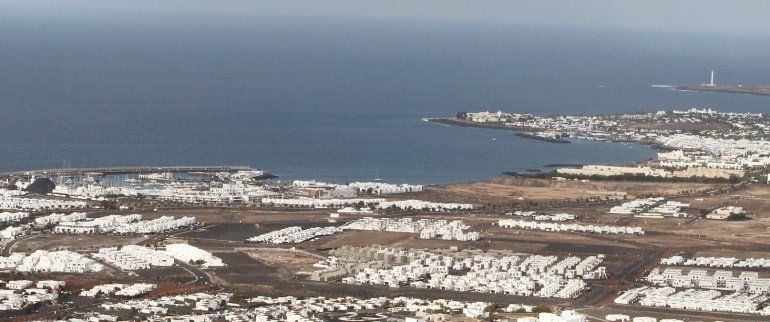
The Second Section of the Contentious-Administrative Chamber of the High Court of Justice of the Canary Islands has partially upheld an appeal by the Ministry of Agriculture, Fisheries and Food and has annulled part of the General Plan of Yaiza, specifically the part that affects the public maritime-terrestrial domain and its easement zones. The ruling, against which an appeal in cassation can still be lodged with the Supreme Court, implies taking the file back to the phase prior to the approval of the Plan to request a report from Costas, which was not incorporated at the time.
The absence of this "mandatory and binding" report was what led the State Attorney to file an appeal against the approval of the General Plan of Yaiza by the Government of the Canary Islands in 2014. In addition to the Ministry of Public Works and Transport, the City Council of Yaiza, Teide 10 SL, Yudaya, Desarrollos y Proyectos Playa Blanca, Club Lanzarote and Antonio Yeray Alvarado García were also involved in the lawsuit as co-defendants.
They all alleged that the report was requested but that the State Administration did not issue it within the established period of two months, so they claimed that its absence was due "exclusively" to the "lack of diligence" of Costas. However, after recounting the various requirements that the Government of the Canary Islands made to this body, the judgment of the TSJC concludes that there was "an evident confusion of the report actually requested", both due to the "lack of precision" of the requests, "in which different legal norms on which the request was based were indicated", and due to its "contradictory nature". In addition, it also warns that the Government did not send the Ministry the documents that it should have provided. In this regard, it emphasizes that since the first request, several changes were made to the text and that, despite the warnings from the central government, they did not send the document that "would be submitted for final approval".
"The two-month period had not elapsed"
To this, the judgment adds that the last request for a report was made on June 6 and 10, 2010 and that the approval by the Cotmac occurred on July 29, "so the two-month period had not elapsed" to which the defendants referred. "It is evident that the initial day of the calculation of the two-month period must refer to that date", emphasizes the TSJC, which points out that it was in that last request when the report actually required according to the Coasts Law was requested.
Along with this request, the regional Executive sent "certifications issued by the City Council of Yaiza regarding the approval and services" of several partial plans of Playa Blanca (Castillo del Águila, Montaña Roja, San Marcial del Rubicón, Las Coloradas and Costa Papagayo) and the Puerto Calero partial plan, so that the easement zone in those sectors would be reduced from 100 to 20 meters both in the land that was already considered urban before the 1988 law and in those that did not have that condition but had already been developed.
However, the Government of the Canary Islands ended up approving the Plan without waiting for a response from Costas, which has now led to the partial annulment of the document. In this regard, the judgment states that "the omission of a report is cause for nullity by full right", although it adds that in this case "it must also be considered that such omission must entail the annulment of the procedure and its replacement at the appropriate time so that such lack can be remedied by issuing the aforementioned report". "Weighing both statements, in this case the nullity that we declare does not affect the entirety of the challenged General Plan, but only the part that affects the public maritime-terrestrial domain and its easement zones, in order to request and issue the report provided for in artº 117.2 of the Coasts Law", specifies the TSJC.
Along with this lawsuit from Costas, the General Plan of Yaiza faced a cascade of appeals from both developers and associations, many of which are still pending resolution. Now, both its partial annulment and the result of other judgments that have yet to be handed down could affect not only the planning of the municipality, but also the process initiated by the Consistory to try to legalize the hotels that were built outside the law.
Add La Voz de Lanzarote as a preferred Google source.
Stay informed with the latest current news.