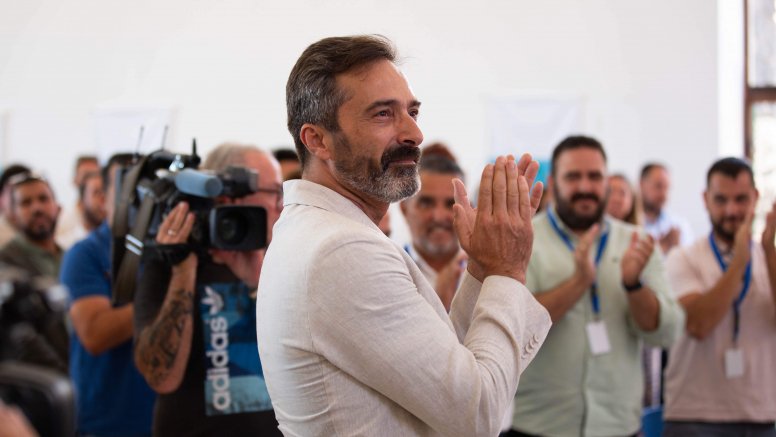
The island secretary of the Canarian Coalition in Lanzarote and non-elected senator for the Autonomous Community of the Canary Islands, Pedro San Ginés, has refused to appear next week before the Senate to defend himself against the procedure initiated by the Supreme Court to suspend his immunity and be able to open oral proceedings against him.
Last July, the High Court requested the Upper House to initiate the request to be able to prosecute the former president of the Cabildo of Lanzarote for the crimes of false testimony and false accusation, since as a person with jurisdiction he cannot be tried without this procedure.
San Ginés was summoned for next Tuesday, September 16, but has declined to appear before the Senate and has preferred to consider the procedure concluded. In a letter addressed to the Upper House, he has asked that they continue processing the request and has stated that his objective is "to clarify" his possible innocence, "without the shadow of doubt that usually surrounds any criminal process."
The High Court maintains an open judicial case against the senator for the alleged commission of crimes of false testimony and false accusation. The jurisdiction is the only thing that separates San Ginés from sitting in the dock for his complaint filed against Carlos Espino, Antonio González and José Manuel Páez for the contracts between the Tourist Centers and González's company, Climafrical.
San Ginés, being president of the Cabildo of Lanzarote, went to the Civil Guard barracks one Wednesday at 10:30 p.m. to report alleged irregularities in the contracting of the Centers and gave way to a judicial investigation against the Lanzarote businessman that lasted a decade and ended up being dismissed. Antonio González died in April 2020, waiting for his final dismissal.
An appearance before the Senate
The appearance of the leader of the Canarian Coalition in Lanzarote was scheduled within the period that the Senate has to respond to the request of the High Court, which is 60 days after its presentation to the Upper House, because the months of July and August do not count. Next Tuesday, September 16, at 1:30 p.m., he was scheduled to be given a hearing so that he could defend why his immunity should not be suspended.
According to the information published by the Senate, on that same day the Committee must be formed, composed of a group of senators who will study and prepare the report that supports or rejects said suspension. Usually, the vast majority of requests are answered positively by suspending the immunity of the person with jurisdiction.
After claiming the background and testimony of San Ginés, the Senate has 30 days to issue an opinion and must include it in the agenda of the first ordinary plenary session.
According to the Spanish Constitution, deputies and senators cannot be charged or prosecuted until they have the authorization of the corresponding Chamber, regardless of whether the crime was committed before becoming a person with jurisdiction. Therefore, the Supreme Court presented a request to the Senate to request that the senator lose his immunity and can thus be judged.
It should be remembered that this is the only case that remains open in the Supreme Court against him after the Criminal Chamber dismissed the investigation for the hiring of his friend and lawyer Ignacio Calatayud during the insolvency phase of Inalsa. San Ginés was investigated for up to six crimes. Among them, fraud against the administration, prevarication, influence peddling, misappropriation and professional disloyalty.
Initially, the Supreme Court had also dismissed this case for false accusation and false testimony, but the judicial body admitted the appeals of the Prosecutor's Office and the private prosecution and gave the order to resume it. In addition, the investigating judge pointed out that its dismissal was "hasty" and that there are "sufficient indications" that he could have committed both crimes.
The High Court recalled in a writing within the framework of this case that "the immunity of deputies and senators is not and cannot be understood as a personal privilege."
What facts are attributed to him?
The High Court indicates that San Ginés, being then president of the Cabildo of Lanzarote and of the Exterior Promotion company of Lanzarote of the Art, Culture and Tourism Centers, appeared before the dependencies of the Central Operative Unit (UCO) of the Civil Guard of Costa Teguise on Wednesday, November 11, 2009 at 10:30 p.m. San Ginés appeared at the Benemérita barracks to present the aforementioned complaint.
The Supreme Court explains that this appearance "was made within the framework" of another investigation promoted by Espino, which gave rise to the largest corruption case in the Canary Islands, the Unión case.
San Ginés testified again in 2011, this time as a witness and not as a complainant, since the Art, Culture and Tourism Centers subsequently filed a complaint against Espino for the same contracts of the Centers with Climafrical. After the last statement of San Ginés, the case was provisionally dismissed and then definitively in 2019.
The daughter of Antonio González, owner of Climafrical, who was indebted due to the judicial process derived from the complaint of San Ginés and died before seeing the final dismissal of the case against him, filed a complaint against San Ginés for these events, understanding that he had falsely denounced his father and then had testified falsely before the court on several occasions. The Court had already ordered the opening of oral proceedings when San Ginés was appointed by designation of the Parliament of the Canary Islands, at the initiative of the Canarian Coalition.
In a resolution last April, the High Court stated that "there is an undeniable evidentiary basis" against San Ginés. In addition, he added that these indications "are far from being labeled as extravagant or arbitrary."
Add La Voz de Lanzarote as a preferred Google source.
Stay informed with the latest current news.