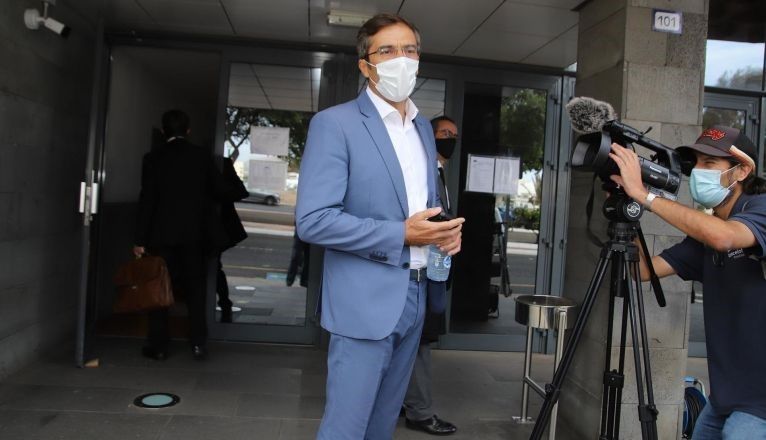
“The judicial investigation must continue and the criminal case must remain open.” That is what the First Section of the Provincial Court of Las Palmas has ordered, thus rejecting the appeal filed by the defense of Pedro San Ginés, who requested the dismissal of the new proceedings in which he has been charged for a year. “It cannot be ruled out, far from it, that he may have committed a crime of perjury in a criminal case,” the Court emphasizes, which also imposes on San Ginés the payment of the costs generated.
What is being investigated in this procedure is whether the former president of the Cabildo “maliciously misrepresented the truth” in the case in which he was the plaintiff and witness, against the former councilor of the Tourist Centers, Carlos Espino, and against several businessmen, and which ended up being definitively dismissed. As a result of that ruling, the daughter of one of the affected businessmen denounced alleged crimes of false accusation by San Ginés, as well as perjury in the statements he made as a witness in that proceeding.
In its ruling, the Court points out that there are indications that the former president of the Cabildo and current councilor of CC in the opposition could have “distorted reality”, both in the lawsuit and in his judicial statements, “in order to give it a criminal appearance” to a “lawful contracting process”, generating “an inappropriate judicial investigation that lasted for 10 years.”
That investigation, which was stalled for years, was carried out by Judge Rafael Lis, who ended up being sanctioned for serious misconduct in the exercise of his office. Later, when a new magistrate took charge of the Court, he dismissed the proceedings, concluding that there were no indications of any of the crimes reported by San Ginés.
Second pronouncement of the Court ordering this "criminal investigation"
The First Section of the Provincial Court itself ordered a year ago to initiate this “criminal investigation” against Pedro San Ginés, since it considered that there was a well-founded basis for it in the lawsuit filed by the daughter of Antonio González, who had died a few months earlier and was the owner of Climafrical. Only 20 days after the Investigating Court Number 2 of Arrecife complied with that mandate and admitted it for processing, San Ginés' defense already filed an appeal requesting dismissal. First he did it before the Court itself and, seeing his claim rejected, he went to the Court.
“It is obvious that the situation that is presumed unlawful and that may have criminal relevance has not changed,” the First Section has now responded, which describes the defense's request as “hasty,” when “not even a month” had passed since the proceedings had been opened.
In that appeal, San Ginés requested free dismissal, alleging a supposed statute of limitations for the crime being investigated; or, failing that, a provisional dismissal, which is agreed when “despite the possible initial criminal appearance of the facts under investigation, the evidence presented is not sufficient to support its reality.”
Regarding the statute of limitations, the Court recalls that the five-year period to initiate actions began to run from when the order dismissing the Centros case became final, and not from the date of filing the lawsuit. Furthermore, it emphasizes that San Ginés maintained his accusations in the statements he made later as a witness, the last one only two years ago, in October 2019.
A "justified" payment and supervised by "a multiplicity of people"
Regarding the provisional dismissal, the Court refers both to its own order from a year ago and to the order of the Investigating Court Number 3 of Arrecife that dismissed the Centros case. That order concluded that Climafrical's offer “was apparently the cheapest” and that the increase that finally occurred in the price “did not exceed 20%”, also pointing out that “that increase was justified by the peculiarities of the work and the urgency required.” To this it added that what was paid complied with the legal channels established in the Billing Regulations and that “a multiplicity of people intervened in the contracting procedure, which contributed to providing the system with regularity.”
This is contrasted with the “supposedly false statements” of San Ginés, who in both his complaint and his judicial statements assured that there was “a more economical offer than that of Climafrical” and that the price of the goods supplied had been “inflated by up to 40%”, something that was also not proven in the case.
In this regard, the Court emphasizes that Pedro San Ginés was aware of the contracting process because “as he himself pointed out, he was the CEO of the Centers until May 2007 and since then a member of the Council representing his party,” so he considers that he could have “lied" knowingly. In fact, he recalls that he himself also admitted that “he knew of the existence of a document -signed by Mr. Ortega- based on which Climafrical's offer was considered the cheapest of the three,” although he insisted that “this did not legitimize the contracting process.”
"Complaint framed in the apparent political game"
“It is a person who had specific knowledge of the facts, and access to the documentary sources on which the entire process was based, framing the complaint within the scope of the apparent political game between formations of different signs,” the Court questioned in its first order, and reiterates in this one.
Furthermore, it emphasizes that San Ginés was not a simple witness who is called to testify and provides data that may be erroneous, but rather he was a plaintiff and “took the initiative in attributing facts supposedly constituting a crime, requesting the initiation of procedural actions, while attending them as a witness and making statements that are objectively refuted in the dismissal order.”
In this regard, he insists that this exceeds the legitimate exercise of the opposition, which may allow “a wide margin of action” to oversee public spending. “Going to the authorities formalizing complaints or lawsuits, and maintaining in them facts that could lead to the declaration of criminal liability of specific people, imposes a certain caution, and above all the availability of apparent and objective sources of evidence that justify serious conduct that is affirmed as constituting a crime, especially when they are attributed not to members of other political options in the exercise of their functions, who therefore assume a certain elasticity in the limits of criticism, but to individuals who apparently have no more intervention than to attend a public contracting procedure,” the Court questions.
San Ginés thus continues to be investigated for a crime of perjury in a judicial case, within the type that implies “lying to harm an investigated person.” This is the most punished in the Penal Code, which contemplates penalties of between one and three years in prison, in addition to a fine of six to twelve months.
Add La Voz de Lanzarote as a preferred Google source.
Stay informed with the latest current news.