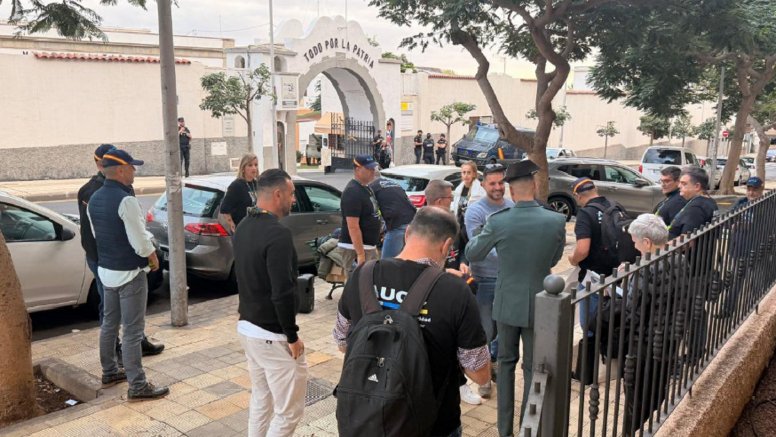
A Civil Guard agent stationed in Tenerife was tried this Thursday by a military tribunal, accused of a crime of desertion of post for traveling to the mainland while on sick leave, for which he could be sentenced to six months in prison.
The trial has been held, after two postponements, in the courtroom of the Almeyda barracks in the capital of Tenerife, outside which a dozen officers, summoned by the Unified Association of Civil Guards (AUGC), have gathered, insisting on protesting that they be subject to the Military Penal Code
In the oral hearing, which lasted two and a half hours, the accused, J.F.S.C., exercised his right to remain silent, except for answering questions from his lawyer.
Four witnesses have testified: three for the defense, the two doctors who signed his leave, and a resident colleague, in addition to the lieutenant commander in charge of the investigation.
Upon leaving the barracks where he was tried, he said he felt "very disappointed" because he believes he is the victim of an "exaggerated" process, but "despite everything, I want to continue being a civil guard".
J.F.S.C. explained to EFE that while stationed in Playa de las Américas, in the south of Tenerife, he suffered a traffic accident in the summer of 2024While on non-incapacitating sick leave – he was diagnosed with acute dorsal pain and cervicalgia – and since "he had no one in Tenerife" to care for him, he requested to be temporarily transferred to Guadalajara to be with his family, and the colonel of the provincial Command denied itA decision he made against the advice of the medical services that granted him leave, who saw no contraindication to him traveling to the Peninsula
Diego Madrazo, secretary of institutional relations for the Unified Association of Civil Guards (AUGC), has indicated that the armed institute has a "very severe" disciplinary regime that could fit cases like that of this colleague, who "was coerced and subjected to an unjust and completely outdated military process".
He opines that subjecting a colleague to a military trial for these events constitutes "an act of injustice" that affects all agents stationed in the Canary Islands because "there will always be a flight log."In the rest of the national territory, Madrazo has argued, there is the option of traveling by train or car, which leaves no record, but above other considerations "the Constitution enshrines the right to freedom of movement"."It seems that some commanders do not want to understand that we civil guards enjoy the same rights," stated the AUGC representative, who believes that the Military Code is used in the Civil Guard "as a tool of pressure"
He indicated that this "is designed for the Army when it is deployed in an operational zone, to defend interests such as discipline and hierarchy," but in no case can it be applied to civil guards who "protect fundamental rights in our day-to-day lives."
The trial has taken place amid the ongoing political debate surrounding this issue.
Months ago, Sumar registered a non-binding proposal in Congress to exclude the armed institute from the application of military law in peacetime.
In the same vein, AUGC requests that the Military Penal Code not be applied to the armed institute's agents except on rare occasions, since, as it argues, 99% of their functions are police-related, not military.In 2007, Article 5.1 of the Military Penal Code was amended so that it was only applicable to the Civil Guard in a few exceptions: in times of armed conflict, in a state of siege, in the fulfillment of military missions entrusted to them, or while they are integrated into Units of the Armed Forces.But in 2016 this measure was reversed, and since then the Benemérita's commanders have had "a tool for abuse of power, of authority, to keep agents coerced," which constitutes "an anomaly in the rule of law," denounces the Unified Association of Civil Guards.
Add La Voz de Lanzarote as a preferred Google source.
Stay informed with the latest current news.