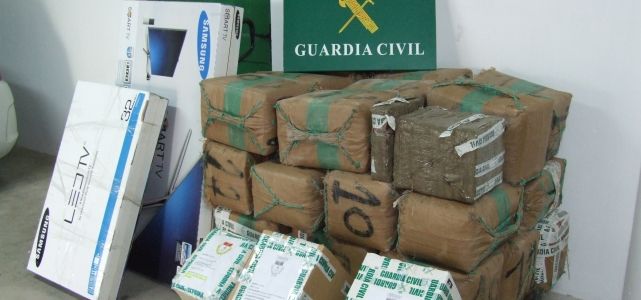
The Second Chamber of the Supreme Court has sentenced four civil guards stationed in Fuerteventura to 6 years in prison and a fine of 1.5 million euros, for devising a plan to introduce a shipment of 733 kilos of hashish by sea to said island, which they carried out in a zodiac-type boat in February 2013. One of them has been sentenced to 1 more year in prison for the crime of obstruction of justice, for threatening to kill a co-defendant, who was in charge of storing part of the drug, so that he would not speak.
These agents called themselves "Group 7", and began to be investigated for alleged illegal practices that came to be defined as "mafia-like". The sentence recalls that they began to be watched when it became known that they could be "moving to the neighboring island of Lanzarote to meet with an I.G.A., a person with numerous records for serious crimes against property and against public health".
That report indicated that this person was not known to have "any type of work activity and yet has two vehicles and pays 600 euros for the rent of his home, which, from the outset, is likely to generate suspicions such contacts, made secretly, between civil guard agents and a person with a criminal record, so, for a minimum reason of professional zeal, it is reasonable that their movements become the object of control".
In addition, the sentence recalls other reports, which indicated that these agents "had been robbing traffickers and were moving to Lanzarote to plan the theft of drugs by simulating a legal entry and search". In fact, it was on this island where the investigation began, carried out by the Investigating Court Number 2 of Arrecife.
Given the power held by this group, one of whose members also had relatives in the Local Police and the National Police, the instructing captain emphasized during the trial "the extreme difficulty of the initial investigation and the need for telephone intervention given the impossibility of obtaining more evidence with ordinary means, even being forced to set up a command center in Lanzarote to avoid being detected by the investigated." It was thanks to this monitoring when the shipment of hashish that they introduced by sea into Fuerteventura was finally intercepted.
The second instance ruling partially upholds the appeals
Although the new Supreme Court ruling confirms the convictions that the Provincial Court had already imposed, it partially upholds the appeal of three of the civil guards (which by extension applies to the fourth) in relation to the individualization of the penalties, and reduces their sentences for drug trafficking from the 9 years in prison imposed by the Las Palmas Court to 6 years, because it considers that the criminal type intended for substances that cause "serious damage to health" was applied, which does not include hashish. However, it also maintains the conviction for the crime of "criminal group" for which they were convicted in the first instance and rejects the greater reduction requested by the defenses.
In this regard, it emphasizes that it was a police structure, "when, among the functions of the security forces, we have seen that there is the investigation of the crime, not to encourage it, with the repercussion that this entails for the disrepute and distrust in the institution to which they belong, to which we can add the added advantage that the circumstance of being police officers entails, both to commit crimes and to evade the investigation to which they could be subjected.
"Nor can we", the Supreme Court points out, "ignore the seriousness in itself of the criminal act, given the 733 kilograms of hashish seized, so that all this valued as a whole makes it reasonable to impose a penalty that approximates the maximum imposable, such as imprisonment for six years".
The Supreme Court maintains the rest of the pronouncements of the judgment of the Las Palmas Court, dismissing the other grounds alleged by the four main defendants, as well as the appeals of the other defendants in the case. Thus, it confirms 2 years of disqualification for a crime against the inviolability of the home for a fifth civil guard (and for three of the main convicts), and penalties of between 1 year and 3 months in prison and 4 years for 8 defendants for trafficking the hashish shipment either as perpetrators or as accomplices.
Add La Voz de Lanzarote as a preferred Google source.
Stay informed with the latest current news.