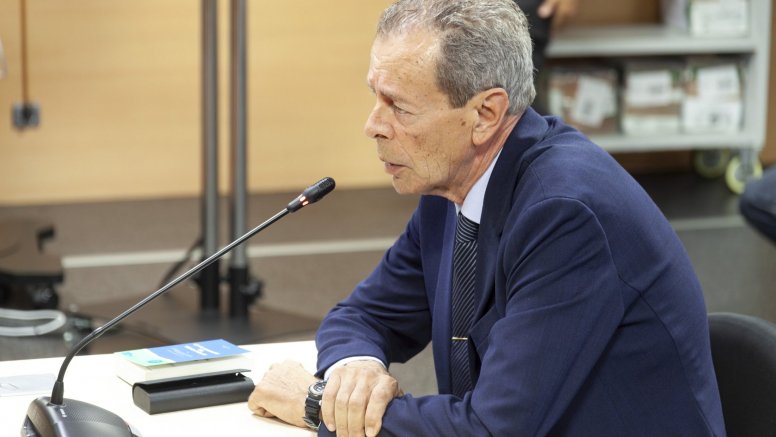
The former auditor of the Arrecife City Council, Carlos Sáenz, has acknowledged this Monday the facts imputed to him in the last of the parts of the so-called 'Montecarlo case', which begins to be judged in the Las Palmas Court.
In the first session of the hearing, which is held in Lanzarote, Sáenz has admitted "with nuances" the irregularities attributed to him, disagreeing with the sentence requested by the Prosecutor's Office in its indictment, which is six years in prison.
The former City Council auditor had already confessed to being the author of similar acts in four of the five previous parts of the case and had to enter prison for the convictions he received for it.
The 'Montecarlo case' originated in 2012, after an anonymous complaint to the Prosecutor's Office. It was divided into six parts (four in Arrecife, one in San Bartolomé and another in La Oliva, Fuerteventura) and this is the last one.
All of them have the Arrecife City Council's comptroller as the central figure in the crimes being judged. The one being examined by the Las Palmas Court since Monday has to do with invoices recognized and paid to the company Tunera, owned by businessman Eduardo Ferrer, who is also being prosecuted.
After two suspensions, the oral hearing has begun on this third occasion, which, in addition to Sáenz and Ferrer, judges former mayor José Montelongo (PSOE), currently head of the Canary Islands School of Health and Social Services, which depends on the Ministry of Health of the Canary Islands Government.
Four former Arrecife councilors are also in the dock: Eduardo Lasso (PIL), Isabel Martinón (PNL), Lorenzo Lemaur (PP), and Víctor San Ginés (PSOE), each from a different party and none currently active in politics.
The other three defendants are former advisor Blas Cedrés and two technicians: José Nieves, now retired, and Miguel Ángel Leal, who is still active.
The case investigates whether payments were made to Tunera Producciones for services not performed, duplicated, or with inflated invoices, as well as irregularities in the contracting or justification of these services, for various events.
The Prosecutor's Office considers that "the amount arbitrarily and fraudulently paid by the Arrecife City Council" to the company amounts, "only between 2009 and 2012, to the minimum amount" of 3.2 million euros, of which "at least" 121,000 euros are "payments for services not provided."
In his statement, Sáenz, who was accompanied by a book containing the Public Sector Contract Law, stated that he only knew Ferrer for professional reasons, as a City Council supplier.
He explained the different types of contracts and the procedure for the formation of expenses, from the expense proposal to the payment, and said that the signature of a councilor and a technician from the area is needed to approve an invoice.
He stated that the person who should check whether the service was performed or whether it was at the agreed price was "whoever executed the purchase, either the councilor or a technician."
Sáenz argued that "contracting procedures are long and tedious," and cited as an example that the Parks and Gardens contract took three years to complete due to a lack of training for technicians in some departments.
The former comptroller acknowledged that the splitting of contracts, a practice that is not allowed, was an "almost habitual" procedure. "I assume my responsibility," he said, before adding that "almost everything that arrived was urgent."
One of the main facts being investigated in this case is the payment of Tunera invoices that presented irregularities, could not be paid through the ordinary channels, and were included in a list to be paid in the municipal plenary session thanks to the request for a specific loan.
According to Sáenz, the conditions for accessing these loans were established in a decree by the central government that was made "so that politicians would not have to intervene," but rather to pay the invoices that had not been able to be paid in order of seniority.
And he indicated that the list with the invoices was prepared in the Comptroller's Office and sent to the Department of Finance, which "should not check anything," and then it was taken to the plenary session.
Add La Voz de Lanzarote as a preferred Google source.
Stay informed with the latest current news.