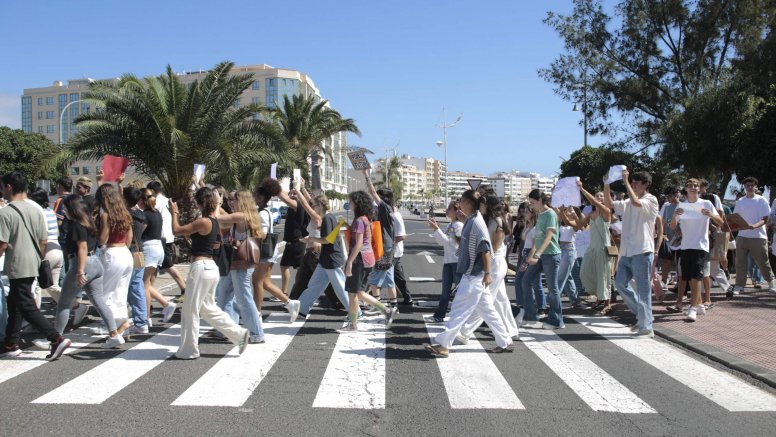
A little more than a month before the University Entrance Exam, PAU, is held throughout Spain, second-year Baccalaureate students are planning their study days ahead of a more practical and homogeneous selectivity that is consolidated in 2026.
Fourteen autonomous communities have accepted the recommendations of the Conference of Rectors and Rectresses of Spanish Universities (CRUE) to harmonize the test, ten of them 100% and another four at 75%. Next academic year, three more autonomies will join these guidelines.
So explains it to EFE the president of Crue-Student Affairs and rector of the University of Almería, José Joaquín Céspedes, who transmits "tranquility" to the student body and points out that "it is not going to change much" with respect to that of 2025.
"The percentage of competency-based questions in certain subjects will be gradually increased, or in others the level of optionality may be slightly reduced," he indicates after emphasizing that they are "small changes" that have already been worked on throughout the course.
For the second time, the PAU - with a duration of 90 minutes - will have a single exam model for each subject - instead of two - and according to the recommendations of the CRUE, this year spelling mistakes in mathematics do not penalize.
In Spanish Language and Literature II and co-official and foreign languages the penalty will be a maximum of 2 points and in the rest of subjects, a maximum of 1 point.
In Madrid, a correction is introduced with grades in multiples of 0.1 instead of 0.25, which has forced an adjustment in computer systems, according to sources from the Complutense University, who highlight that a more global evaluation of performance forces students to pay more attention to expression, the structure of the answer, and justification".
June 2, 3 and 4, dates in most communities
According to data collected by the delegations of the EFE Agency, most of the communities will take the PAU on June 2, 3, and 4, in the ordinary period, although Madrid will start on June 1 until the 4th, Canarias from June 2 to 5, and Castilla La Mancha on June 8, 9, and 10.
The extraordinary exams will be on June 30 and July 1 and 2 in almost all territories, although in Navarra they are brought forward to June 24, 25 and 26, in Castilla La Mancha to June 29, 30 and July 1, and in Asturias they are postponed to July 6, 7 and 8.
Castilla y León will adapt the test to students with specific educational support needs or of another type, both in terms of timing and with special exam models.
And while in La Rioja the morning shift will be brought forward half an hour to avoid the central hours of heat, in the Comunitat Valenciana the threat of an indefinite teachers' strike weighs from May, although it is still up in the air.
Basque Country has already enabled 26 centers for the completion of approximately 95,000 exams and Aragon will have 12 courts distributed among the three provincial capitals and the towns of Ejea de los Caballeros, La Almunia, Calatayud, Tarazona, Jaca, Barbastro, Fraga, Monzón, Alcañiz and Calamocha. In the Region of Murcia, the exams will be held in a total of 12 venues.
Universities such as the University of Castilla La Mancha, the University of Seville, the University of Las Palmas de Gran Canaria or the government of the Valencian Community have published guides and tips to "survive" the PAU. How to plan study, rest and leisure time or strategies for situations of anxiety or stress.
Knowing how to use what has been learned in real or practical contexts
The Commission for Student Affairs of the Conference of Rectors and Rectoresses of Spanish Universities (CRUE) established that this year the competence of the exams may be up to 70% in Castilian Language and Literature II, while in History of Spain a minimum of 50% is established.
This approach changes the way students are evaluated: since it no longer focuses so much on memorizing content, but on checking if students know how to use what they have learned in real or practical contexts.
In Art History, practical questions will represent between 80% and 100%, and in Geography or Applied Mathematics, they cannot be less than 50%.
"It is true that when the exams are 100% competency-based, we will have to review aspects such as the duration of the exam, the reduction in the number of questions, or that specialists in each of the subjects prepare the wording of the questions so that they can be answered within the stipulated time," Céspedes insists.
On the other hand, "a single exam, MIR-type, is not viable", state sources from the Complutense rectorate, who explain to EFE that it is not possible because there are different Baccalaureate curricula depending on the territorial competence of the autonomous communities and, furthermore, the custody of the 26-exam test in all university districts could not be guaranteed one hundred percent.
Add La Voz de Lanzarote as a preferred Google source.
Stay informed with the latest current news.