Agricultural technical engineer Teno Osorio, a professor at the center, explains in an interview with Ekonomus some of the most innovative projects he is leading in this field, whose students have an xx employment rate.
"We have participated in many innovation projects. The Ministry of Education of the Canary Islands government issues a call for vocational training centers every year. It is necessary for at least one company and at least two educational centers from the Canary Islands to participate," explains Osorio."We are delighted to be able to conduct practical research in vocational training. Previously, all research was done at universities," shares the professor
Turning algae into high-quality ecological fertilizer for Lanzarote's vineyards
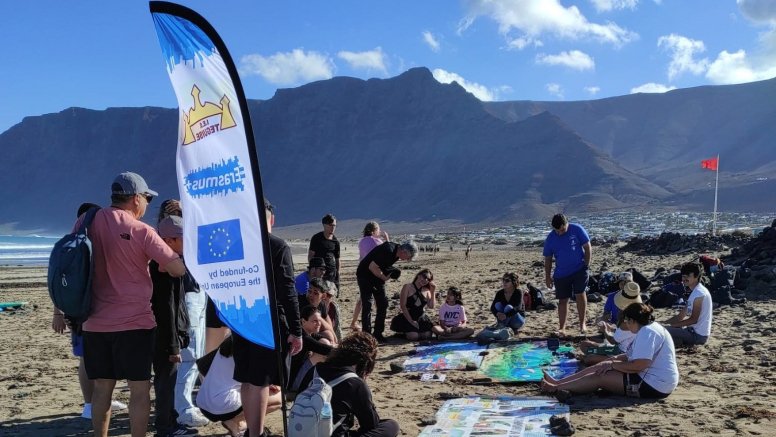
One of the projects they are currently involved in consists of transforming the algae that reach Famara beach with the wash-ups into plant food. (Wash-ups are accumulations of algae, marine plants, or organisms that are dragged by sea currents, waves, and winds to the shore of the beaches).
"We are now designing the dryer. Once we have dried the algae, we will wash the salts off them and use that to generate compost. We expect to obtain a high-quality organic fertilizer," shares the project coordinator.The IES Zonzamas, the Teguise City Council, and the private company Bodegas el Grifo are also collaborating on this project, "which is undergoing a transition to make all its production organic, and they find it very beneficial to have organic fertilizers," shares Osorio.
Immersive Virtual Reality to Understand La Geria, the Enarenados, and the Jable
Osorio also coordinates an immersive virtual reality project in collaboration with IES Zonzamas, CIP Los Gladiolos in Tenerife, and the landscape and food sovereignty area of the Cabildo de Lanzarote.
The project is inspired by the recognition of "La Geria, the sandy soils and the jable cultivation system" in Lanzarote as a Globally Important Agricultural Heritage System (GIAHS) by the Food and Agriculture Organization of the United Nations (FAO).
"It consists of digitizing the arid agroecosystems of Lanzarote. This year we are going to do it with La Geria, we will make different recordings throughout the year. The first recording will be in February, taking advantage of the pruning season."
Osorio explains that once all the vineyards in La Geria have been recorded, they will obtain "a mixed immersive reality product, which can be enjoyed with virtual reality glasses from the computer or mobile phone".
Mixed immersive reality combines elements of virtual reality (VR) and augmented reality (AR) to create an environment where physical and digital objects coexist and interact in real time."The ideal would be to use virtual reality glasses, because you will have a 360-degree environment in which you will be able to go to different points of information. We will talk about the Geopark, the importance of CIPAM, and what the different techniques, milestones, or pests of Lanzarote's crops are."
Lanzarote Plants for Cosmetic Creams
Just a few days ago, the cosmetics company Ejove Laboratory presented a cosmetic cream with active ingredients from a Canary Island plant.
A product born from an innovation project by the Government of the Canary Islands called 'Canarian Cosmetics', in which the Teguise institute participated last year, as well as the Aesthetics and Beauty and Gardening branches of the IES Faro de Maspalomas, the project coordinator, and the Pharmacy cycle of the IES Politécnico de Las Palmas.
Although the plant finally chosen for the cream was grown in Gran Canaria. The Lanzarote center had contributed two of the three plants that Ejove considered for the new productOn one hand, the verode ('Kleinia neriifolia') that IES Teguise was cultivating to research how plants reproduce in arid systems, and the vinagrera ('Rumex lunaria'), an invasive plant they uprooted from the Mala and Guatiza areaThe project continues with the new academic year. "We will contribute new plants to the project. What we are trying to do is find plants adapted to our climatic conditions and generate cosmetic products with their properties," explains Osorio.
Add La Voz de Lanzarote as a preferred Google source.
Stay informed with the latest current news.