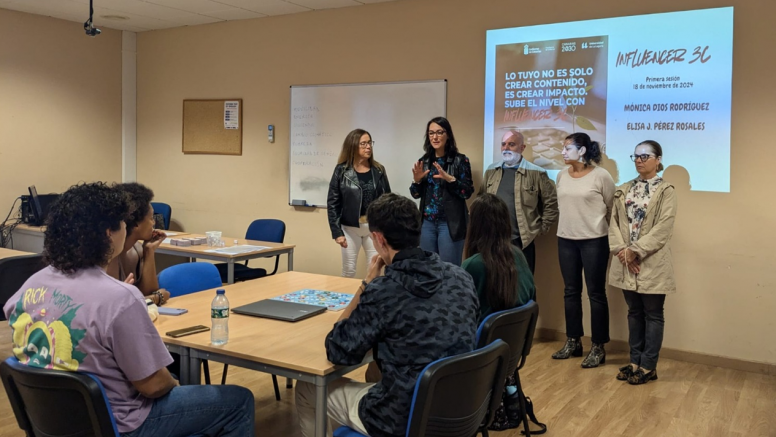
The Government of the Canary Islands, together with the University of La Laguna (ULL), has launched a course to train sustainable influencers.
Within the framework of the objectives of the Canary Islands Agenda for Sustainable Development, the academic center is carrying out this project aimed at preparing young people as sustainability agents to become 3C influencers (knowledge, awareness and commitment) in their curricular, work, associative, social or personal environment.
According to the coordinator of the initiative and professor and researcher at the Faculty of Education of La Laguna, Itahisa Pérez Pérez, it is about talking to young people as equals and with their same tools "as the most effective way to transmit information to them, involve them in certain projects or make them participate in different proposals."
"And for this, there is nothing better than being an influencer and using social networks as a means of communication. However, this model is far from the usual image of celebrities who publicize their way of life and is intended to disseminate content with social purposes," explain from the organization.
The initiative is part of the 14 projects promoted by the two public universities, with funding from the Government of the Canary Islands, for the search for innovative solutions that contribute to facilitating awareness and the development of the Canary Islands Agenda 2030.
Initially, most of the students who enrolled in the course were unaware of Agenda 2030, the SDGs, their purposes or how they work to implement them. Once started, they showed a "great interest" in the possibilities to develop their projects and that they should continue to "give young people options to participate and present their proposals directly" and impact groups that these initiatives do not usually reach, such as the elderly, dependents or people with disabilities, says Pérez.
Small actions, big goals
The students were attracted not only by the name (Influencer 3C), but also by the opportunity to "undertake actions from the small, but with a final goal that can be big," says Wude Castro, one of the participants in the project who is studying Pedagogy at the ULL.
The course was designed with a theoretical part, already completed, and a second phase of "peculiar" practices. The coordinator explains that the students themselves decide their "personalized" itineraries - guided by a tutor - in which they address the Sustainable Development Goals (SDGs) that best suit their personal, educational or even vital interests. Pérez insists that "they are not practices for use", but that their objective is to generate content, mainly in networks, but also through talks or advice and services (ApS).
The initial area of this proposal is the municipality of La Laguna, although its projection is regional to disseminate the SDGs and facilitate their knowledge, while "transmitting the urgency of accelerating their fulfillment and explaining how they contribute to improving the economy and social welfare."
Five people will finish the course in March. The objective is for these young people to become spokespersons for the chosen projects, which refer mainly to the socio-educational and gender field, although they have also addressed poverty or health.
"Not to be famous or to make money. We want to change things and improve them," insists Wude Castro in a reflection shared by her colleague María del Cristo Velázquez.
"Act to change things"
Velázquez, a PhD student at the ULL, is focused on disseminating through social networks - she has opted for Bluesky - aspects related to terrestrial biodiversity, responsible consumption and climate change.
She points out in this regard that "creating awareness is not as difficult as creating the necessary commitments to generate a positive change", and considers that networks are the "most direct and effective" means to get this type of content to young people.
Wude Castro also understands that this route - in her case Instagram - is the easiest way to contact people of her age. She is part of an NGO that works on projects aimed at alleviating poverty and making known "that in the Canary Islands there is also a population that does not have access to minimum services, it is not only a problem of underdeveloped countries." She is convinced that "we can collaborate to change things and build a more equitable world."
This is also the vision of María del Cristo Velasco: her objective is to consolidate a group of influencers creating commitment through projects focused on the protection of the environment.
Another of the students, Katherina Gómez, is interested in promoting well-being and quality inclusive education and found in Influencers 3C a way to work through the SDGs related to Health and Well-being and Quality Education, areas that are also related to her training in Pedagogy.
As a practical part, she works on a socio-educational project focused on the Re-Connect workshop: Prevention of Techno-addictions and Use of ICT (information and communication technologies) through healthy habits. Her proposal is to promote awareness about the responsible use of ICT through a workshop that aims to provide tools to manage the use of technology in a balanced way, avoiding its risks and enhancing its positive use.
Katherina affirms that being an influencer is a good option to get closer to young people, especially because "they access information through social networks such as TikTok." From these platforms, she assures, you can reach her more directly, a vision shared by her colleagues.
Add La Voz de Lanzarote as a preferred Google source.
Stay informed with the latest current news.