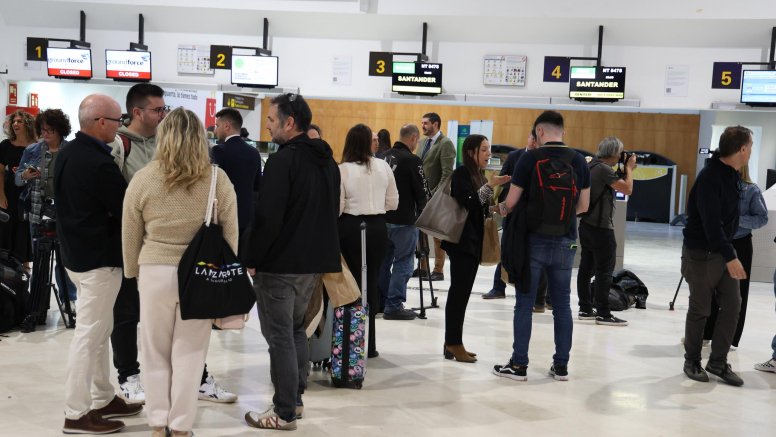
The president of the Chamber of Commerce of Santa Cruz de Tenerife, Santiago Sesé, has warned of the risk that possible restrictions in air transport would pose for tourism in the Canary Islands, given the international uncertainty and its effects on the supply of fuel.
Sesé, in the presentation of the results of the Business Confidence Indicator (ICE) for the second quarter of 2026, has warned that an eventual shortage of kerosene or limitations in air connectivity would have a direct impact on the archipelago's economy, as it is a territory especially dependent on air transport, as was confirmed during the pandemic.
The business leader explained that this concern is framed within a context of a 4.6% drop in the business confidence index in the second quarter, influenced by seasonal factors, after the end of the high tourist season, and by a moderation of economic activity.
Faced with this scenario, he has asked for prudence and the adoption of contingency plans by the administrations to guarantee connectivity and minimize the impact on tourism, which he has insisted is the economic engine of the islands.
In this regard, the general director of the Chamber of Commerce, Lola Pérez, has emphasized the need to anticipate with contingency plans that take into account the uniqueness of the Canary Islands as an outermost region, and has called for guaranteeing the fuel supply to avoid further isolation.
For his part, Santiago Sesé has argued that the problem does not depend solely on Spain, which has strategic reserves and refining capacity, but also on the tourist-emitting countries, such as the United Kingdom, whose reserves are more limited.
The chamber president has maintained that air operations depend on supply at origin, which could hinder connectivity if restrictions occur, with a direct impact on tourist demand.
Both officials have settled that an eventual lack of kerosene would especially affect external demand, one of the pillars of economic growth in the Canary Islands, along with internal consumption.
Sesé added that, although Spain remains a safe destination in relation to the war in Iran, a possible transfer of tourists from areas affected by the conflict would be distributed among multiple destinations, especially in the Mediterranean, so the Canary Islands do not foresee a significant increase in demand.
Uncertainty and costs increase the risk for tourism in the Canary Islands
Likewise, Lola Pérez has added that the 4.6% drop in the business confidence index in the Canary Islands reflects a scenario of uncertainty and rising costs that increases the risk for tourism, the archipelago's main economic engine.
He explained that although this decrease is usual after the high season gives way to the low season, on this occasion it is more pronounced than in previous years, in a context marked by economic uncertainty.
"There is nothing worse for confidence than uncertainty," he asserted in reference to a changing international scenario that particularly affects tourist territories like the Canary Islands.
In this regard, it has indicated that the transport and hospitality sector shows a clear moderation in its expectations, with a drop in favorable responses and an increase in unfavorable ones for the second quarter.
Furthermore, it has warned that the increase in costs is affecting all sectors, reducing business margins and increasing pessimism about the evolution of activity, a trend that is reflected in the increase in negative responses in areas such as trade or construction.
The general director also highlighted that the price increase represents “the main risk”, especially in a remote territory dependent on transport like the Canary Islands, where these costs can be passed on to the price of trips as well as to consumption at the destination.
This scenario can affect both domestic and external demand, including tourist flows, which have been the main support for the archipelago's economic growth in recent years, he/she/it has stressed.
Furthermore, it has pointed out that, although employment remains stable in general terms, with most companies not anticipating changes in their workforces, a slight increase is observed in those that foresee reductions.
By sectors and territories, it has continued, the fall in confidence is generalized in all the islands, except in specific cases, and it is part of a trend also present in Spain as a whole, although more pronounced in the Canary Islands due to their greater dependence on tourism.
In this context, from the Chamber they insist on the need to closely follow the evolution of the international scenario, since the duration of the conflict and its impact on prices and transport will be decisive for the evolution of tourism and the Canarian economy.
Add La Voz de Lanzarote as a preferred Google source.
Stay informed with the latest current news.