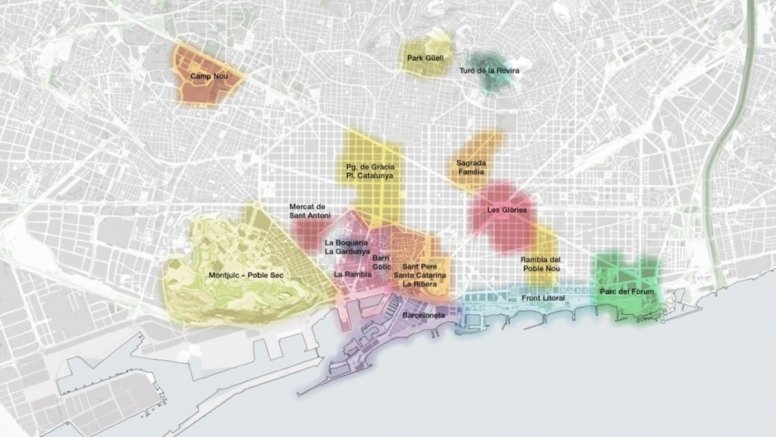
The Barcelona City Council has defined a new tourism management plan in the city, which will begin to operate this summer, and which is applied in 16 High-Traffic Spaces (EGA) with the objective of minimizing the impact that large concentrations of visitors can generate.
Some of the places included in the plan are Park Güell, the Sagrada Familia, the surroundings of La Boquería market, Paseo de Gracia and Plaza Cataluña, as well as the Gothic Quarter, La Rambla and Barceloneta.
The plan involves an initial investment of more than 44 million euros and includes the creation of a Technical Coordination Office and a data office to correctly know and analyze the impacts in these environments.
With this data, explained the Deputy Mayor for Economic Promotion, Jordi Valls, it will be possible to send alerts to the mobile phone with instructions and suggestions to tourists to avoid visiting saturated places and advise them on other less crowded areas.
More civic agents, cleaning and security
The plan also expands the allocation of civic agents from 58 to 70, launches a support program for local commerce in these spaces; reinforces the campaign to control street vending and increases cleaning and security teams, among other measures.
In the case of the Sagrada Familia environment, it includes the improvement of access to the metro, the renovation of the nearby Plaza Pablo Neruda; the reorganization of public space and urban elements around the temple.
In the area of Park Güell, the traffic restriction zone has been expanded, the taxi ranks have been reorganized, bus lines have been reinforced, one of them no longer appears in digital routing applications such as Google Maps. A ticket sales system exclusively online has also been introduced.
Part of the plan's financing will come from the income generated by the Tax on Stays in Tourist Establishments (IEET), the Barcelona eco-tax.
The Barcelona City Council has historically been a pioneer in the regulation of tourism, with initiatives such as the Special Urban Plan for Tourist Accommodation (PEUAT), the fight against illegal accommodation, the regulation of personal mobility vehicles, the tourist tax and the decrees to limit group guides, among other measures.
Campaign to promote respect
The Plan is born with a specific communication campaign aimed at tourists and which is visible in the city.
With the main slogan 'Barcelona, our home. And yours' and the subtitle 'Everyone is welcome. Be respectful and you'll be respected', this responsible tourism campaign can be seen in different formats and places in the city until the end of next August.
The campaign, with a budget of around 400,000 euros, contains a decalogue of seven specific tips that aim to raise awareness among visitors of the need to respect the rules.
With a message in English, it is recalled that the neighborhood deserves a good night's rest, it is pointed out that the population of Barcelona is proud of its city and that is why visitors are asked to take care of the city as the native population does, or the need to use water responsibly is remembered.
The campaign wants to insist, therefore, on the need for civility and non-tolerance towards behaviors that represent annoyances for the neighborhood, as well as reinforce the projection of Barcelona in the rest of the State and internationally as a benchmark for the city model of the 21st century.
The campaign messages will be visible in tourist information offices, city hotels, municipal markets, buses or in cubes installed on public roads in especially touristy places.
Add La Voz de Lanzarote as a preferred Google source.
Stay informed with the latest current news.