The Cabildo of Lanzarote, through the Centers of Art, Culture and Tourism (CACT), has launched the Strategic Transformation Framework (MET), a pioneering initiative aimed at redefining the island's tourism model under the principles of sustainability, cultural identity and positive territorial impact.
The MET, with a planned duration of four years (2025-2029) and a budget of 3.3 million euros, will be developed through the Office of Projects and Strategic Initiatives. This ambitious project aims to connect all economic sectors linked to tourism – mobility, energy, commerce, agriculture, housing and culture – in a transformative process that guarantees the balance between economic development and environmental conservation.
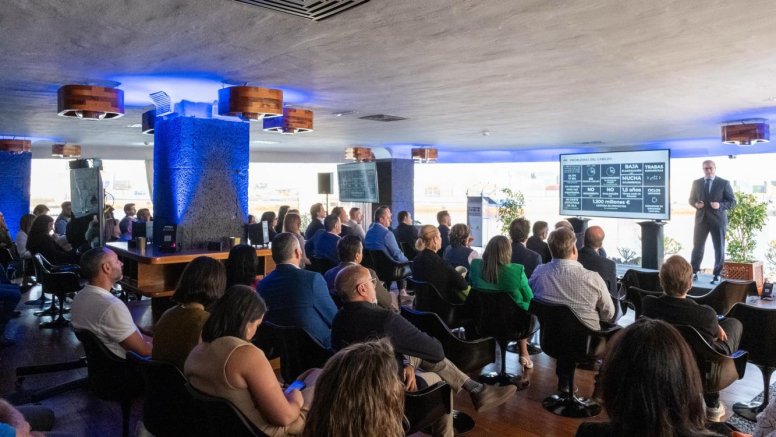
The presentation ceremony, held on Friday afternoon at the Castle of San José, was attended by numerous authorities and representatives of the island's business community. Among the attendees were the Vice President and Minister of Economy, Industry, Commerce and Self-Employed of the Government of the Canary Islands, Manuel Domínguez, the President of the Cabildo of Lanzarote, Oswaldo Betancort, and the Councilor of the Tourist Centers, Ángel Vázquez, among others.
The Centers of Art, Culture and Tourism: Precursors of the Lanzarote tourism model
Since their creation, the Centers of Art, Culture and Tourism (CACT) have been the precursors of tourism in Lanzarote, establishing a pioneering model that has defined the island's identity and its economic development. This visionary leadership gives them the responsibility of redesigning and improving that model to ensure its long-term sustainability and its benefit for the island. With the new management led by the Councilor of the Tourist Centers, Ángel Vázquez, a strategic management has been implemented in 2024 that included a tariff update and achieved a reduction of almost 15% in the influx of visitors. This approach has demonstrated that it is possible to considerably increase income, exceeding 37 million euros, thanks to the controlled decrease in the influx of visitors, which has allowed decongesting tourist spaces, improving the visitor experience and, at the same time, preserving the natural and cultural environment.
"These resources allow us to finance projects like this, reinforcing our objective: to turn Lanzarote into an international benchmark for sustainability, culture and authenticity," said the Councilor of the Tourist Centers, Ángel Vázquez, who added that "we have demonstrated that it is possible to reduce the pressure on our tourist spaces and at the same time significantly increase our income, with effective and committed management."
A tourism model in evolution and in action
For his part, Oswaldo Betancort, president of the Cabildo of Lanzarote, stated that "this project is not only a tourism strategy, but it is a change of island model. It is essential that the benefits generated by tourism are reinvested in the society of Lanzarote and La Graciosa to improve the quality of life and social well-being." Betancort insisted that "our duty is to optimize and improve essential infrastructures and services, ensuring at the same time a sustainable tourism compatible with local life, taking into account, in addition, as fundamental pillars, our culture and the protection of our natural environment."
In this same line, Marcos Cohen, director of the project, expressed himself, "The MET seeks to transform the tourism model of Lanzarote through a comprehensive approach that prioritizes sustainability, culture and landscape. To this end, we will reinforce the execution capacity of the public sector through strategic planning and technical assistance, as well as a new governance framework that integrates institutional, social and economic agents."
He added that the objective is "to improve the quality of life of residents and visitors, revaluing the role of the tourist as an active agent in the conservation of the destination and promoting key projects in areas such as gastronomy, viticulture, traditional culture and crafts."
The priority actions include the supervision of impact indicators, administrative simplification, training for public and private teams, and the execution of innovative initiatives such as the Canarian Culinary Center, the Vitivinícola Hub and the Network of Micromuseums.
The Vice President of the Government of the Canary Islands, Manuel Domínguez, also showed his support for the project, highlighting the importance of betting on a balanced tourism that guarantees benefits for the community and the territory. "In a moment like the present where our tourism model of the Canary Islands is being debated, it is important to celebrate and applaud initiatives like these that aim to analyze the current situation and propose solutions for the future. And they do it also through the Tourist Centers returning to the residents what the tourists leave on the island," Domínguez asserted.
"With the MET, Lanzarote takes a firm step towards a more balanced, responsible and sustainable tourism, in which growth translates into authentic well-being for the island and its inhabitants," they say from the entity.
Add La Voz de Lanzarote as a preferred Google source.
Stay informed with the latest current news.