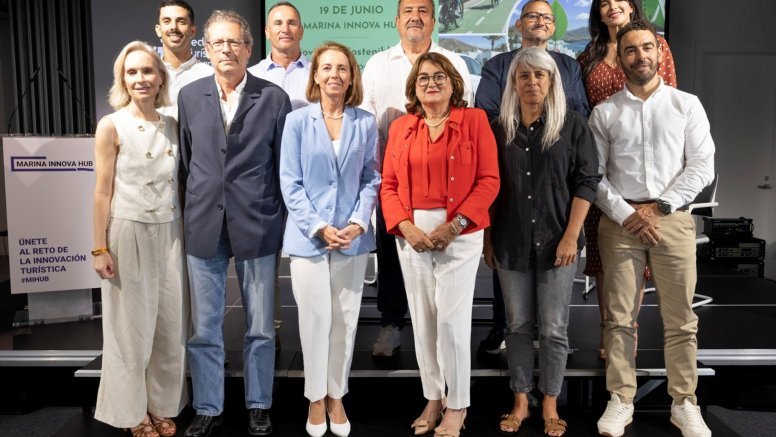
Authorities, experts, and businessmen from the sector met last Friday at the VI Lanzarote Tourism Sustainability Conference to chart the roadmap towards cleaner, more efficient, and intelligent transport on the island. The Marina Innova Hub facilities hosted this meeting organized within the framework of the CIDE Turismo Lanzarote of ASOLAN, in collaboration with the Lanzarote Tourism Federation, under the title “Sustainable Mobility in the Canary Islands: challenges, opportunities, and transition of the tourism model”.
The institutional opening was carried out by the president of ASOLAN and the Lanzarote Tourism Federation, Susana Pérez; the Minister of Mobility and Transport of the Cabildo de Lanzarote, Miguel Ángel Jiménez; and the Director General of Transport and Mobility of the Government of the Canary Islands, María Fernández, who outlined the main axes of the future Canary Law of Sustainable Mobility.
The Director General of Transport and Mobility of the Government of the Canary Islands explained that “the future Law of Sustainable Mobility of the Canary Islands is born with the vision of understanding mobility not only as a transport system, but as a tool for territorial cohesion, equal opportunities, and economic development. In an archipelagic territory like the Canary Islands, ensuring that people can access employment, public services, or education on equal terms, regardless of where they live, is also a way of strengthening the social and territorial cohesion of our islands,” she pointed out.
Fernández highlighted that the new regulation, together with the Canary Islands Sustainable and Intelligent Mobility Strategy, will allow for the first time a common planning for the entire Archipelago, favoring coordination between administrations and collaboration with the private sector. “We are not talking about a law to impose obligations, but to generate opportunities. We want to promote more efficient, innovative mobility adapted to the reality of each island, and move towards a model that improves the quality of life of citizens,” she affirmed.
For his part, the Minister of Transport and Mobility of the Cabildo de Lanzarote, Miguel Angel Jimenez, thanked the Lanzarote Tourism Federation for the initiative, and highlighted "how appropriate and necessary it is to organize these conferences to talk about transport and sustainable mobility".
Finally, Susana Pérez defended that the tourism sector must be a strategic ally in the transformation of the mobility model in the Canary Islands. “Sustainability is no longer an option, but an essential element to maintain the competitiveness of our destinations. We are not only talking about reducing emissions, but about building a mobility system that improves the visitor experience, facilitates the movement of workers, and contributes to a better quality of life for residents,” she pointed out. She also highlighted the role of the CIDE Network as a tool to bring innovation closer to companies and support them in their transformation process.
Next, the technical meeting on the challenges of mobility in island tourist destinations allowed for the analysis of issues such as connectivity between the airport and tourist areas, the mobility of sector workers, intelligent data management, intermodality, or the promotion of cycling and other micro-mobility solutions. Representatives from the Cabildo of Lanzarote and the city councils of Arrecife, Tías, and Haría participated in the debate, along with the president of the Association of Discretionary Transport of Lanzarote (ASTRATUR), who shared the vision of the administrations and transport operators on the main challenges for moving towards a mobility model adapted to the island reality.
Subsequently, the business round table offered the private sector's vision on the adaptation of tourism and transport to a more sustainable mobility scenario. In the debate, in addition to ASTRATUR, the Association of Rent a Car of Lanzarote (ASERENT), the Líneas Romero Foundation, and the Pérez Moreno Group were represented. The participants agreed on the need to move towards innovative solutions that allow for the compatibility of the destination's competitiveness with environmental sustainability and the needs of the resident population.
During the event, the CIDE Network was also presented, as well as the lines of aid and subsidies available to promote business innovation and sustainability projects. In the closing, Susana Pérez emphasized that “dialogue spaces like this event are fundamental to anticipate regulatory changes, generate alliances between the public and private sectors, and turn mobility challenges into opportunities for the future of Lanzarote.”
The CIDE Network is an initiative of the Ministry of Universities, Science and Innovation and Culture of the Government of the Canary Islands, promoted through the Canary Agency for Research, Innovation and Information Society (ACIISI), and co-financed by the European Regional Development Fund, with a co-financing rate of 85% within the framework of the FEDER Canarias 2021-2027 Program.
Add La Voz de Lanzarote as a preferred Google source.
Stay informed with the latest current news.