The Canary Islands has managed to reduce emissions per tourist by 22% since 2019 and by 16% for tourist activities carried out in the archipelago.
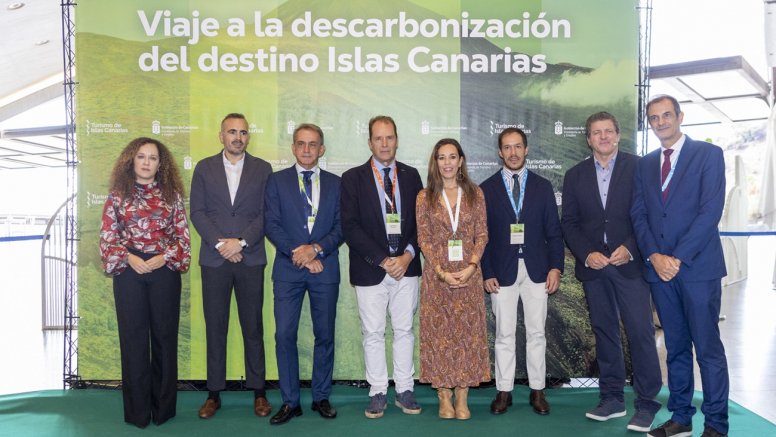
These estimates of the carbon footprint of the Canary Islands tourism sector were addressed at the 'II Meeting Trip to Decarbonization of the Canary Islands destination', organized by the public company Turismo de Islas Canarias.
This forum, which brought together international and national specialists in climate action and the Canary Islands tourism sector, was inaugurated by the Minister of Tourism and Employment, Jéssica de León, and the Minister of Ecological Transition and Energy, Mariano H. Zapata. The presenter of the event was the meteorologist and climate change expert Mario Picazo.
Turismo de Islas Canarias has estimated the carbon footprint of the tourism sector for 2023, comparing it with the base year, 2019, and taking into account accommodation, local transport and activities carried out at the destination.
Emissions per tourist went from 118.1 kilograms of CO2 in 2019 to 92.3 kilograms of CO2 last year, which leads to the aforementioned decrease of 22%. Regarding total emissions at the destination, these were 1.7 tons of CO2e in 2019, compared to 1.4 tons the previous year, which is 16% less.
“The tourism industry has always been committed to our land, but it is necessary that initiatives like this meeting show how we are transforming our companies, and our commitment to climate neutrality. It is important to show citizens how the private and public sectors are moving forward hand in hand,” said Jéssica de León.
“The Canary Islands will be sustainable or it will not be,” said the councilor, who explained the advances of the tourism sector in energy efficiency, use of resources and digitization, all focused on sustainability.
“Together we are making our destination more competitive, with our adherence to the Glasgow Commitment two years ago, which we joined as the first destination in Spain with the Climate Action Plan already prepared, and with this Trip to decarbonization that companies and Administrations have undertaken,” she pointed out, noting that we must go further: “Our objective is for tourism to be regenerative. We must compensate for the carbon footprint of our industry and renaturalize our islands.”
The Minister of Ecological Transition, Mariano H. Zapata, stressed the need to work jointly and in a coordinated manner from all the Government's ministries in a transversal way to face climate change, in favor of the decarbonization of the archipelago.
“We are convinced that, with the commitment and collaboration of all the agents involved, the Canary Islands can lead the transformation towards a model of tourism development that respects the environment and is resilient to the effects of climate change,” he said.
In this sense, Zapata stated that “climate and tourism are closely related” and highlighted some of the actions promoted by his area, such as “the recent modification of the Climate Change Law to accelerate this green transition or the efforts to increase the penetration of renewables in the Canary Islands, which are positive not only for those who come to visit us, but also for our inhabitants,” he concluded.
Add La Voz de Lanzarote as a preferred Google source.
Stay informed with the latest current news.