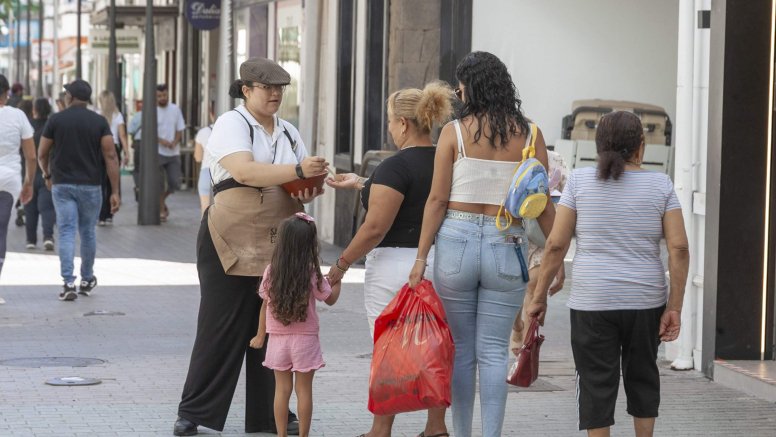
A total of 57,057 households in Lanzarote show signs of social exclusion despite the archipelago having improved its situation after the socio-health crisis derived from the pandemic. This emerges from the Report on Exclusion and Social Development in Canarias 2025, prepared by Foessa at a national level and disseminated by Cáritas Canarias.
Around 25.5% of the archipelago's population lives in social exclusion and 9.3% does so in severe exclusion, although the figures have recovered with respect to the pandemic, when 29.2% lived in social exclusion and 15.3% in severe exclusion.
Exclusion does not affect all residents equally. The document highlights that having been born outside the islands or not having Spanish nationality is an aggravating factor when it comes to being pushed into exclusion. Proof of this is in the Canary Islands the rate of social exclusion among foreign persons doubles that of those born in the Spanish State or who have Spanish nationality.
Among those most affected by social exclusion are those who belong to a household headed by unemployed people, without income or who depend on social protection aid, as well as households headed by people born outside of Spain. There is also more risk of social exclusion in large families, composed of five people or more, and in single-parent households.
Of the total number of respondents, the most frequent situations of deprivation in Canarias occur due to economic difficulties in buying medicines and following medical treatments, excessive housing costs, situations of severe poverty, and the obstacles derived from being a foreigner.
The report indicates that the lack of economic resources and the difficulty of the population to exercise social rights such as accessing housing, or health are added to the obstacles to be able to participate in politics due to not having Spanish nationality.
At the same time, it highlights that the problems of "severe overcrowding in the home" have increased. Almost half of the people who belong to a household without any type of income from activity are in social exclusion in the archipelago.
Social exclusion does not always occur in people who suffer monetary poverty. 18.8% of people in social exclusion exceed the income of the poverty threshold, while a third of people who suffer monetary poverty are socially integrated. This means that in the archipelago different realities are experienced that are not only explained through income.
In the islands social exclusion is divided into different axes: the economic (employment and consumption), the political and citizenship (political participation, education, housing and health) and the relational (social or family conflict or lack of social ties and support).
In the archipelago, 53% of the population is affected by political exclusion, while 31% have economic problems and 12.5% suffer relational problems. Which exposes the difficulties in being able to exercise the right to vote or being able to run in elections and the capacity for political participation, restricted in the case of people who do not have nationality.
Add La Voz de Lanzarote as a preferred Google source.
Stay informed with the latest current news.