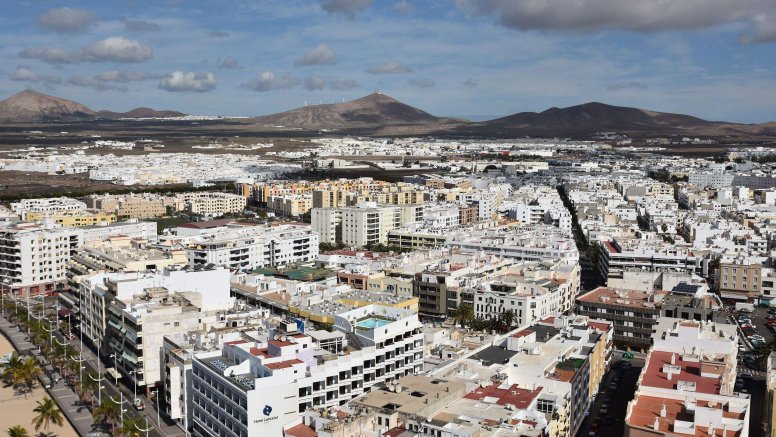
The problem of access to housing in Lanzarote is a social drama for many people, but it also represents a “structural challenge for economic growth and social cohesion on the island,” as stated in the Activation Plan for the Stimulation of Sustainable Economic and Social Growth of the Chamber of Commerce of Lanzarote and La Graciosa.
The document considers the lack of housing on the island a “critical barrier to the island’s competitiveness, conditioning both the quality of life of the local population and the capacity of the business fabric to attract and retain the talent demanded by its economy”.
The Chamber of Commerce of Lanzarote and La Graciosa analyzes the three major phenomena affecting the housing shortage on the island: empty homes, difficulties in building new housing, and the proliferation of tourist-use homes.
Housing stock on the island of Lanzarote
The Chamber advocates for a “coordinated and effective intervention by public administrations to guarantee the right to adequate housing for the entire population, prioritizing strategic planning that prioritizes the rehabilitation, reuse, and optimization of already urbanized land”.
According to the latest Housing Census, Lanzarote has a residential stock of 79,092 homes. 32% are in Arrecife, 22% in Tías, 14% in Teguise, 13% in Yaiza, 11% San Bartolomé, 5% in Haría and 3% in Tinajo.
Of the housing stock on the island, only 75% are used as residences, so that the remaining 25% is classified as vacant housing, due to, among other factors, the current regulatory framework that "generates uncertainty among owners," according to interviews conducted with institutional and business representatives by the Chamber of Lanzarote.
Housing prices in Lanzarote grow by 27.7% between 2024 and 2026
The tension between effective supply and growing demand is notably manifested in the evolution of real estate market prices.
Lanzarote has experienced an increase of 27.7% in housing prices between January 2024 and January 2026, reaching in the latter year an average sale price that nears 3,000 euros per square meter (2,974 euros).
Some tourist municipalities on the island, such as Tías (3,775 euros) and Yaiza (3,638 euros), exceed the regional average, which currently stands at 3,200 euros, driven by strong price increases on the island of Tenerife in recent years.
Mobilize 20,000 empty homes in Lanzarote
The Chamber proposes to identify and mobilize empty homes in Lanzarote as a first key step to face the challenge.
According to the National Institute of Statistics (INE), Lanzarote has some 20,000 homes considered empty, which represents 25% of the island's total residential stock.
The data was obtained by measuring electricity consumption as an indicator of occupancy. A total of 11,000 homes are considered empty because they do not have an active electricity supply contract and the other 9,000 because they have very low or sporadic consumption, below what an average household consumes in 15 days.
The Chamber attributes this situation to reasons such as “very occasional use as a second home, sporadic unregulated tourist use, or for reasons related to the legal or economic insecurity that some owners perceive regarding traditional residential rentals”.
Empty homes by municipality
The territorial distribution of these homes shows notable differences between the different municipalities of Lanzarote. Tías stands out especially, concentrating 8,289 empty units, 48% of the municipal residential stock.
Next, Yaiza, with 3,165 empty homes, almost one in three homes in the municipality (31%). In third place, Haría, where it is estimated that there are 1,141 empty homes (29%).
In an intermediate position are located Teguise (2,386 empty homes, 21%), San Bartolomé (1,508 homes, 18%), and Tinajo (422 homes, 16%).
In contrast, the island capital, Arrecife, although it has the largest absolute number of homes, presents a significantly lower percentage of vacant homes, with 3,101 units (12%).
Build housing in a limited and protected territory: 91% non-developable
According to 2023 data, non-developable land represents approximately 91% of the insular territory (72,434.5 hectares),” which significantly limits any residential expansion and forces attention to be focused on the efficient use of available land,” consider La Cámara.
The consolidated urban land, that which is fully integrated into existing urban centers, represents only 4.3% of the territory, which is why “building new homes in already urbanized areas will require complex urban renewal or densification actions”.
On the other hand, there is moderate potential in unconsolidated urban land (1.8% of the island's territory), but its development is "conditioned by prior urban planning processes and lengthy administrative procedures".
Finally, the developable land (both delimited and undelimited) accounts for 2% of the territory and "offers the main medium-term opportunity for the creation of new housing, "especially in Yaiza, Tías and Arrecife".
However, “its activation will depend on strict territorial and urban planning, subject to rigorous environmental regulations and complex administrative procedures,” consider the experts from the Chamber of Lanzarote.
The Chamber highlights other limitations such as “bureaucracy, slowness in granting licenses, lack of coordination between administrations, the existence of obsolete general planning schemes, and the increase in construction costs and materials”.
New housing projects planned in Lanzarote
The document for the Economic Activation highlights an Extraordinary Report from the Diputación del Común in which it is emphasized that between 2020 and July 2023, a total of 2,102 family units from Lanzarote and La Graciosa registered in the Public Registry of Applicants for Protected Housing in the Canary Islands and only one dwelling was granted.
After a year's delay, a total of 201 homes are expected to be awarded in 2026 in the Maneje neighborhood. On the same plot, with less clear dates, as the execution of the project and the work will probably extend beyond 2026, there are another 200 newly promoted homes being tendered in Arrecife by the Government of the Canary Islands.
Also in 2026, it is expected that the ICAVI will begin to assign the 42 homes that the Cabildo de Lanzarote bought a year ago in Playa Blanca. It is possible that some of the 76 homes purchased by El Cabildo in Playa Blanca will still be delivered in 2026.
In Arrecife, its city council approved another project to build 46 VPO on Triana street, next to the Cabildo and the Canary Islands Housing Institute (ICAVI). However, there is still no definitive schedule for the start of construction.
In addition, there are 136 other homes planned for construction in Playa Blanca on a plot of land ceded by the Yaiza town hall. Not all phases have been put out to tender yet.
The Cabildo has bought several plots, including one in Uga for the development of future public developments.
The Dilemma of Vacation Homes
In its analysis of holiday homes, the Lanzarote and La Graciosa Chamber of Commerce's Activation Plan highlights that there are two major opposing lines of thought.
On the one hand, those who consider that holiday rentals are not the determining cause of housing problems and highlight the “significant benefits to the local socioeconomic fabric, especially by distributing income among
smallholders and economically revitalize certain peripheral areas of the island”.
On the other hand, those who consider it “a key factor that largely explains the recent worsening of housing access problems in Lanzarote”.
The Chamber notes that both positions recognize the importance of properly managing vacation rentals to ensure that the economic and social benefits derived from tourism can coexist in a balanced way with the needs of access to adequate housing for the local population.
From this consensus emerge specific demands such as establishing “concrete limits to the granting of licenses in certain particularly strained areas, differentiating norms according to the characteristics of each municipality or urban center, or implementing fiscal instruments that incentivize residential rentals”.
Lanzarote, the island with the most vacation spots per inhabitant and the most profitable
The number of vacation homes available for rent at the close of 2025 in Lanzarote amounted to 7,313 units, although the total number of registered homes rose to 11,094 at the beginning of this year.
the Chamber highlights in its analysis that “Lanzarote is the most affected Canary Island by the tourist pressure derived from vacation rentals”.
With data from March 2025, they calculate that in Lanzarote there are 21.9 tourist spots in vacation homes for every 100 residents, while the average for the archipelago stands at 9 spots per 100 inhabitants.
Fuerteventura presents comparable figures, with 21.2 beds per 100 inhabitants, while Tenerife and Gran Canaria, have notably lower ratios, of 8.6 and 5.0 beds per 100 inhabitants.
Regarding the economic importance of the phenomenon, the Chamber of Lanzarote calculates that the average profitability per vacation home in Lanzarote stood at 31,650 euros annually in 2024.
The figure is notably higher than the average in Fuerteventura (20,570 euros), Tenerife (23,400 euros) and Gran Canaria (22,400 euros).
Add La Voz de Lanzarote as a preferred Google source.
Stay informed with the latest current news.