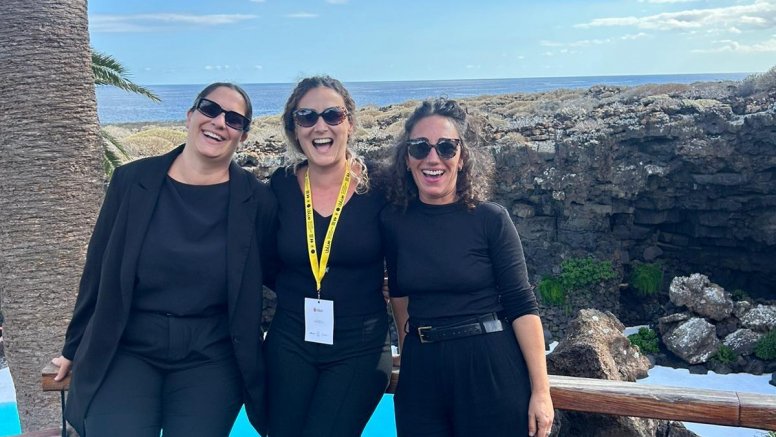
The Lanzarotean Laura Loiterstein, the Sevillian Lucía García and the Basque Mariana Tyseira had been self-employed for more than a decade working as technicians of sign language interpretation for deaf people in Lanzarote until they created Signalanz, the first cooperative in the Canary Islands, and the second in the country, in this field.
Loiterstein explains how it works the cooperative and addresses the integration of deaf people in Lanzarote, the progress made and what remains to be done, in an interview with Ekonomus.
“A cooperative is basically the union between self-employed workers to generate decent working conditions for all equally. There is no hierarchy of bosses and employees, but rather all participating individuals are on equal terms,” explains Loiterstein.
“In Spain we only know of another one in Madrid. It is a novel format. Interpreters have always worked in the associative movement, with temporary contracts. It is a format that has been talked about for many years in the interpreters' movement, but no one dared to take the step.”
It's what undertaking implies. In a way, creating a cooperative is a bit like creating a company. When creating something new, you have to “establish many contacts, organize meetings, work many, many hours” until the benefits begin. “We the first year earned very little and worked a lot. Much, much more than now.”
Events, audiovisual, courses, consultancies and conferences
In addition to being sign language interpretation technicians, the three founders of Signalanz have other complementary trainings. García is also a social worker, Tyseira has a communicative training cycle and Loiterstein completed the degree in sign language and deaf community from Rey Juan Carlos University and also has an integration cycle and a master's degree in teaching, among other studies.
Signalanz offers professional interpretation services both in-person and online for institutional, cultural, or artistic events. Also courses, consulting, and conferences in sign language interpretation.
“Our main client is the Cabildo de Lanzarote, which through its Inclusion Strategy, interprets many of its acts in sign language, including the plenary sessions. We also have agreements with almost all the town councils on the island”.
"The word Cabildo is interpreted on each island with a different sign”
Thus, two more permanent interpreters have joined the team of the three founders in Lanzarote. In addition, Signalanz occasionally provides interpretation services in other Canary Islands.
Another of the services that Signalanz offers is to incorporate sign language on web pages or audiovisual materials such as news, documentaries and films, creating content for the deaf community. This service has been carried out both in the Canary Islands and on the peninsula.
"In Lanzarote the situation has improved by leaps and bounds"
Asked about the symbolism of the film 'Sorda', which won the Goya Award for Best New Director for Eva Libertad, Best New Actress for Miriam Garlo and Best Supporting Actor for Álvaro Cervantes, Loterstein considers it “a work of art”.
I thought that it narrates very well what the life of a deaf person is. My skin crawls just remembering the mother's feeling upon upon wanting, knowing that she shouldn't want it, that her son was deaf.”
Because despite all the efforts of society to include the deaf community, much remains to be done.
“Everything must be accessible by default, not just some events, I would like the deaf person to be able to go wherever they want, not just where I as an event organizer decide it should be accessible”.
However, Loiterstein highlights that “in Lanzarote the situation has improved a lot, by leaps and bounds, thanks to the Strategy led by Social Welfare, which for me is quite pioneering”.
“We always need interpreters in Lanzarote"
The businesswoman from Lanzarote emphasizes that sign language interpretation has become a public service and does not depend on associations. “We have achieved something great, that it is a service directly dependent on the island council that contacts the interpreters, without intermediaries.”
However, there are still things to do. For example, that there are ipermanent interpreters always available for ordinary services of interpretation such as accompanying deaf people to the doctor, to the police or to school because their child has a meeting with the teacher or whatever. It's true that now they are starting to be covered, but they still need to be always available.”
The founder of Signalanz also believes that training in sign language would be necessary for public administration staff in Lanzarote and for the general public.
A profession with much demand, but without university training in the Canary Islands
To the question of whether sign language interpreting is a profession with a future, Loiterstein is clear that it is and explains that “there is a lot of demand throughout the country and also in Lanzarote, we always need interpreters”.
However, she/he emphasizes that there is no university training in the Canary Islands in this field. “Before, the interpretation cycle of sign language was used to access this job. That cycle they eliminated it because it was established as a university degree, but in the end only Rey Juan Carlos University in Madrid offered it. I believe that if the Canarian universities were encouraged to offer that degree, it would be very successful.”
“We always need interpreters in Lanzarote. In fact, we have had to bring the latest addition from Seville, because in Lanzarote or in the Canary Islands we cannot find interpreters.”
And that, like all regions of Spain, sign language in the Canary Islands has its particularities. “We as interpreters study all dialectal varieties. For example, for ‘just in case’, there is a sign that is made in the Canary Islands, there is another different one in Andalusia, another in Madrid”.
And many signs typical of the Canary Islands, such as for example “the word Cabildo, which in each island is interpreted with a different sign”.
Add La Voz de Lanzarote as a preferred Google source.
Stay informed with the latest current news.