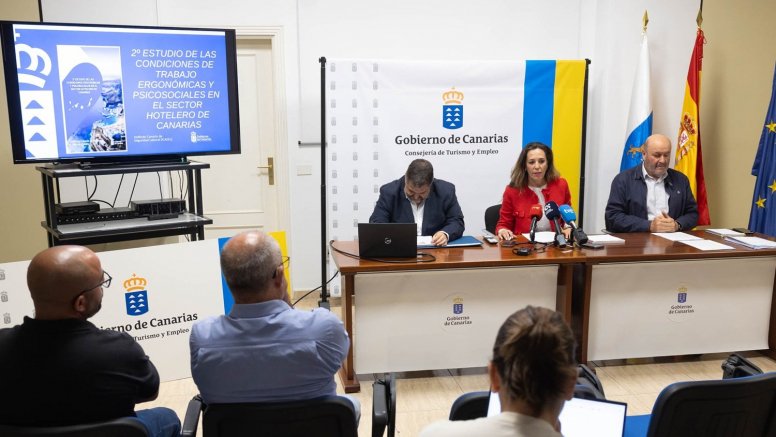
The Ministry of Tourism and Employment of the Government of the Canary Islands, through the Canary Islands Institute for Occupational Safety (Icasel), has just presented the main conclusions of the second study of ergonomic and psychosocial conditions in the hotel sector in the Canary Islands.
One of the main findings of the report is that only 12% of the hotels in the archipelago have adjustable beds. One of the main concerns of unions and authorities is specifically the working conditions of the cleaning ladies.
The information obtained after the first study carried out nine years ago, explained the Minister of Tourism and Employment, Jéssica de León, will allow the design of effective prevention plans to improve safety and health conditions at work and reduce the rate of work accidents and other damages derived from work.
The study was conducted in 121 tourist establishments of three, four and five stars, in order to have a significant sample of the situation in the Canary Islands in relation to the ergonomic and psychosocial conditions of the hotels.
“The conclusions of this work, which we are going to complement with the elaboration of another study on the extra-hotel sector of the islands, will become measures, in actions of prevention of occupational risks, which will be incorporated into the new future Law of Tourism Planning of the Canary Islands”, said De León.
The counselor indicated that “there is still much work to be done in terms of prevention of occupational hazards, especially in the departments in which workers have more workload or have higher rates of accidents, such as floors or kitchen”.
The general director of Labor, José Ramón Rodríguez, assured that “of the results obtained, it stands out that 88% of the tourist establishments have personnel for the prevention of occupational risks, although one in three has not received basic training in the prevention of occupational risks, so we must insist on the need for this essential training so that they can adequately develop their functions”.
This analysis covers all existing jobs in the establishments. The study highlights that it is in the position of cleaning ladies where the highest number of risk assessments has been made and preventive measures are proposed. However, it is noted that only one in three hotels has conducted time studies for this group and in less than half, a maximum number of rooms per type of cleaning has been established.
Likewise, the document emphasizes the lack of participation of workers in specific risk assessments. The reasons for these shortcomings are, according to the report, that they are not included in the evaluation procedure.
Half of the hotels in the Canary Islands have assessed psychosocial risks
On the other hand, the study focuses on the significant improvements in the management of psychosocial risks, which has been progressively extended to the different jobs and to the hotels of lower category, although it indicates that 50% of the establishments have not yet carried out a specific evaluation.
For his part, the director of Icasel, Elirerto Galván, stated that “with regard to the planning of preventive measures, the field work reveals that more and more measures are being implemented related to the organization, especially in five-star hotels, although they are still below those related to the training and information of workers”.
The percentage of hotels that have addressed a planning of preventive measures after the evaluation of occupational hazards of psychosocial type is 48% “so we must continue to promote the specific evaluation and especially the implementation of measures and review to determine if these have been effective, in this case, it has only been possible to verify in 20% of cases”, he stressed.
With regard to the protocols of action against the different types of violence, there is a higher percentage of execution of the protocols against sexual harassment and on grounds of sex compared to those of psychological harassment. “The percentage of protocols against external occupational violence is still very low, especially in three-star hotels, despite the fact that most of the jobs in this sector are exposed due to continuous contact with customers”.
With respect to health surveillance, medical examinations are the most used instrument. 54% of the hotels have applied specific health surveillance protocols, with no significant differences according to the category of the hotel.
Add La Voz de Lanzarote as a preferred Google source.
Stay informed with the latest current news.