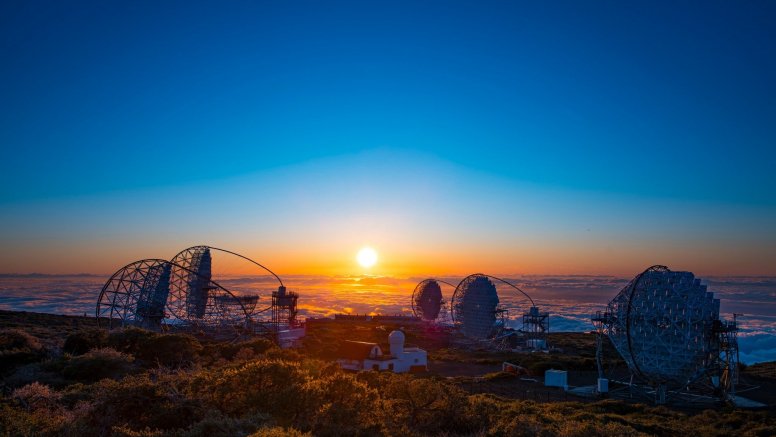
The Ministry of Universities, Science and Innovation and Culture of the Government of the Canary Islands, through the Canary Islands Agency for Research, Innovation and the Information Society (ACIISI), promotes the development of the European Solar Telescope (EST), an international reference scientific infrastructure that will be located at the Roque de los Muchachos Observatory, in La Palma.
The European Solar Telescope is considered as the most ambitious project of solar physics in Europe. It is, in essence, the "European brother" of the American telescope DKIST (Hawaii) and is designed to become the definitive tool to understand how the solar magnetism dictates the behavior of our star.
While the DKIST has an enormous resolution capacity, the EST is specifically designed to be the most precise instrument in the world measuring magnetic fields. Its optics are optimized so that the telescope itself does not alter the polarization signal of the light.
In addition, By being almost on the opposite side of the world from Hawaii, both telescopes will be able to work together to monitor the Sun 24 hours a day without interruptions.
For its part, China is advancing very fast with the CLST (Chinese Large Solar Telescope). Although currently it is smaller (1.8 meters).
The fact that the telescope is located in the Canary Islands contributes to placing the archipelago in a prominent position within world astrophysics, thanks to the excellence of its scientific infrastructures, the quality of its skies and its capacity to attract and develop international scope projects.
The EST project is considered one of the most advanced initiatives in European solar astrophysics and is part of the roadmap for the continent's major scientific infrastructures. Its development will allow for unprecedented observations of the Sun and advance the understanding of phenomena such as space weather, with a direct impact on technologies that are part of everyday life.
In this context, the Ministry allocates one million euros to this strategic project, an investment that will allow progress in its design, instrumentation, and technological development. This funding also allows for the generation of qualified employment, to boost the economic fabric linked to innovation, and to favor the transfer of knowledge towards sectors with an impact on society.
The Minister of Universities, Science and Innovation and Culture, Migdalia Machín, highlighted that “the Canary Islands is today a world reference in astrophysics, not only for its natural conditions, but for the talent, scientific capacity, and international collaboration generated from the islands”.
“Infrastructures like the European Solar Telescope strengthen our presence in global science and demonstrate the contribution of the Canary Islands to the advancement of knowledge worldwide,” he added.
The head of the area also stressed that “this type of project positions the Canary Islands at the forefront of international research, generates opportunities for scientific and technological talent, and contributes to diversifying our economy through innovation.”
The Institute of Astrophysics of the Canary Islands (IAC), an international reference organization, leads the development of this project, which includes advances in design, instrumentation, and state-of-the-art observation technologies. The telescope will feature a large mirror and advanced systems that will allow obtaining high-resolution images of the Sun.
The impetus for this infrastructure is framed within the strategy of the Government of the Canary Islands to strengthen the scientific capabilities of the archipelago, foster international collaboration, and consolidate a competitive R&D+i ecosystem, based on knowledge, innovation, and talent.
Add La Voz de Lanzarote as a preferred Google source.
Stay informed with the latest current news.