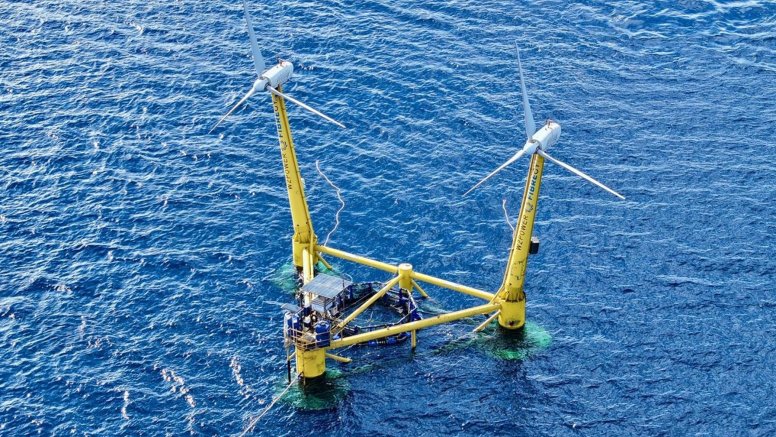
Canarias has presented the final results of the AquaWind project, which combines a floating wind platform and an automated aquaculture farm in the same infrastructure.
Considered of high strategic value, the initiative has been coordinated by the Canary Agency for Research, Innovation and Information Society (ACIISI), co-financed by 80% by the European Union through the European Maritime, Fisheries and Aquaculture Fund (EMFAF).
The meeting brought together representatives from the European Commission (DG MARE and CINEA) and the Government of the Canary Islands, who were able to learn about the successful work results of the last 45 months (almost four years). The conclusions demonstrate in real conditions that the production of renewable energy and aquaculture can not only coexist, but also complement each other to optimize the use of the sea.
The project responds to one of the main current challenges in Europe: how to optimize the use of maritime space in a context where activities such as fishing, transport, or tourism converge. The AquaWind proposal proposes a change of model, moving from a fragmented use of the sea to an integrated approach that allows for the simultaneous production of renewable energy and sustainable food.
The event also served to debate the future and unite the efforts of research centers, companies, and European organizations. Thanks to this joint work, the project has been recognized with the Atlantic Project Award 2025, an award that confirms the capacity of the Canary ecosystem to drive applied innovation with real impact.
In the institutional opening, the director of ACIISI, Javier Franco, highlighted the strategic role of the islands: “Canary Islands not only participate in European projects, but we are coordinating initiatives that mark the path of the blue economy in the Atlantic.”
Likewise, Franco warned that, after the technological success, the next step is administrative: "The main obstacle is no longer technical, but regulatory. The challenge now is to move from demonstrative projects to commercial realities that generate employment and wealth in the archipelago".
A real prototype in the Atlantic
The main milestone of the project has been the installation and validation of a prototype on the PLOCAN test bench, where tests have been carried out in real open sea conditions. This infrastructure integrates the W2Power double-turbine floating wind platform, developed by EnerOcean, together with an automated aquaculture farm equipped with advanced monitoring systems.
During the tests, gilthead sea bream juveniles have been introduced to analyze their behavior, while the structural resistance of the system and its interaction with the marine environment have been evaluated. “We are no longer talking about simulations, but about a real prototype operating in the Atlantic,” they emphasized during the event.
Furthermore, the system has been designed to study high value-added species such as the greater amberjack (Seriola dumerilii), contributing to the diversification of the aquaculture sector.
Environmental and social impact
Beyond technical validation, AquaWind has allowed progress in the knowledge about the environmental impact and social acceptance of this type of solutions. The results indicate that the combination of offshore wind and aquaculture can optimize space use, reduce pressures on the environment and generate synergies between sectors.
The project has actively worked on the involvement of key actors, administrations, companies, the scientific community, and civil society, through surveys, interviews, and participatory actions. In total, more than 120 contributions from the sector in the Canary Islands were collected, which has allowed for the analysis of perceptions and the detection of barriers.
According to the data obtained, the integration of both activities is not perceived as a problem, but as an opportunity to generate economic value and qualified employment in the archipelago.
Regulation and acceptance: the big challenges
Despite the advances, the project directs attention towards the main obstacles for its large-scale deployment. “The main bottleneck is no longer technological, but regulatory and administrative,” they pointed out during the event.
Currently, there is no clear legal framework for multipurpose platforms, and authorization processes remain complex and fragmented. Added to this is the need to reinforce social acceptance through communication and dialogue strategies from the early stages of the project.
In this regard, AquaWind has developed recommendations aimed at public administrations and the sector, with the objective of facilitating future developments and preventing innovation from being limited to demonstrative projects.
From prototype to market
AquaWind leaves a double legacy: on the one hand, real data that validate the technical, environmental, and economic viability of this type of solution; and on the other, a collaboration model between sectors that lays the groundwork for its future development.
The next step will be to move towards pre-commercial and commercial phases, in a context where Europe needs to accelerate the deployment of marine renewable energies and strengthen food security.
“The challenge now is that these projects do not remain in the demonstrative phase. That is where it is decided whether this innovation becomes a real opportunity for the economy and employment in the Canary Islands and in Europe,” concluded the consortium.
Do you usually read us to find out what's happening in Lanzarote? Choose La Voz de Lanzarote as one of your preferred sources on Google
Add La Voz de Lanzarote as a preferred Google source.
Stay informed with the latest current news.