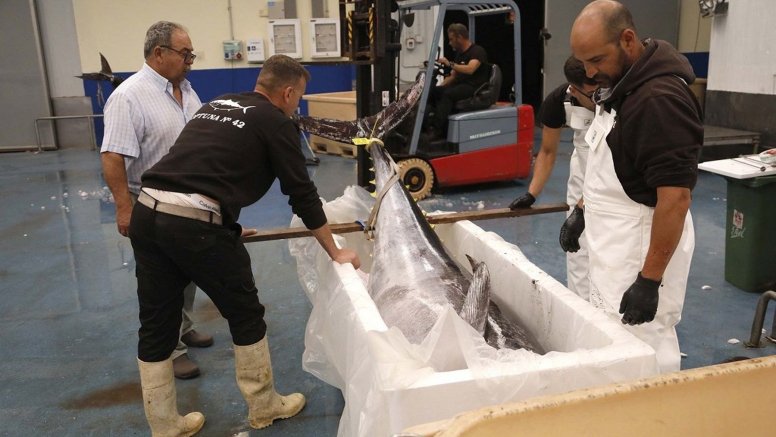
The Minister of Agriculture, Livestock, Fisheries and Food Sovereignty of the Government of the Canary Islands, Narvay Quintero, has announced the granting of a line of direct subsidy of an extraordinary nature for the maintenance of the fishing activity of shipowners of vessels of the pole-and-line tuna fishing modality based in the Canary Islands.
The support line for the amount of €884,138.29 is distributed among a total of 40 vessels to compensate for losses derived from the decrease in extractive activity in the current campaign, due to environmental and biological constraints beyond the will of the shipowners, such as variations in oceanic currents, changes in water temperature, or atypical displacements of shoals.
With the aim of conveying this measure to the sector's associations, the head of the department, along with the Vice-Minister of the Primary Sector, Eduardo García, and the Director General of Fisheries, Esteban Reyes, held a meeting this morning with the spokesperson for the Regional Federation of Fishermen's Guilds of the Canary Islands, David Pavón; the mayor patron of the Arguineguín Guild, Jesús Vega; the president of the San Casiano Fishermen's Association, Carlos Braun; the representative of Teide Tuna, Francisco Jiménez; the mayor patron of the San Ginés Guild and member of Optuna, Aquilino Arrocha; and the representative of Canarias Tuna, Pedro González, among other professionals and association heads from the sector.
In his speech, Quintero explained that "despite the decrease in extractive activity, vessels have had to continue facing unavoidable structural and operational costs, such as **fuel, maintenance, insurance, crew** and general expenses associated with vessel operation, leading to situations of economic imbalance and liquidity tensions that compromise the viability of the activity."
“The **warming of the waters** causes tuna, mainly bluefin tuna, to not pass through the Canary Islands,” so that during the last two years this migratory flow has intensified in the Azores and Madeira area, where even surpluses in the assigned quota have been registered. Looking ahead to the 2026 campaign in the Canary Islands, Quintero explained that this winter a decrease in water temperature has been recorded in the Canary Islands, so “we hope that, under these conditions, tuna will pass through the Canary Islands so that fishermen can catch it”.
According to campaign records, tuna catches in 2025 have been limited to 123 out of the 568 tons - which include an additional 30 tons from a quota transfer between Iceland and the EU - allocated to the fleet based in the Canary Islands. This extraordinary reduction in activity during this fiscal year has had a direct and significant economic impact on pole-and-line tuna vessels, resulting in a substantial decrease in income for shipowners
The counselor detailed that "the losses of some vessels, which can carry between eight and fourteen crew members, have exceeded 50%" and, for this reason, some of the shipowners who manage the more than fifty vessels dedicated to this fishing method in the Canary Islands have considered abandoning the activity. In this regard, during the meeting, Quintero conveyed to the sector representatives other additional support actions such as the negotiations with the Ministry to achieve the advancement of the red tuna fishing season to January 20th and proposals for modifications to "try to optimize the catch quota through, not only pole-and-line tuna vessels, but all authorized boats in the Canary Islands for tuna fishing".
In accordance with the technical parameters of these grants, a maximum limit of 40,000 euros in de minimis aid has been established during the previous three fiscal years, taking into account a weighted calculation by vessel length and tide days to determine the individual amount
Add La Voz de Lanzarote as a preferred Google source.
Stay informed with the latest current news.