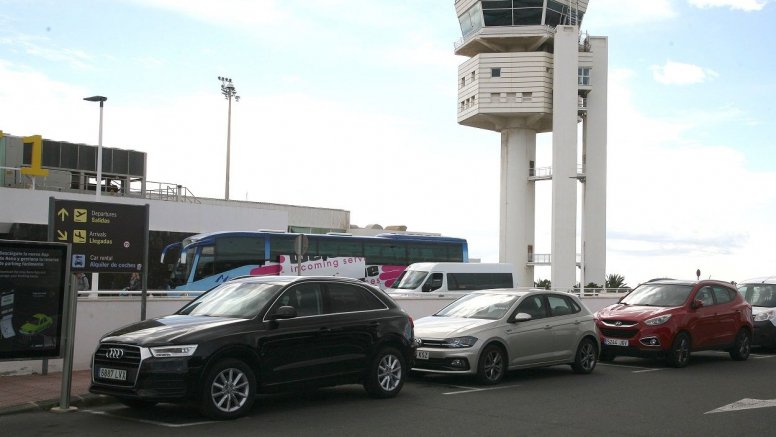
On Thursday, July 27, flights from Lanzarote suffered the longest delays of all European airports, as confirmed to La Voz by the Air Traffic Controllers' Union (USCA), due to the strike being carried out by controllers working for the private company SAERCO, which manages the control tower of César Manrique, in addition to those of Fuerteventura, El Hierro, and La Palma.
This Thursday, flights at Lanzarote airport accumulated more than 1,500 minutes of delays in total per day (7.44 minutes on average per flight). The César Manrique airport also suffered the most delays of all Spanish airports throughout the week between July 21 and 27.
The strike was called at the beginning of the year by USCA and CCOO themselves due to the failure of negotiations for the IV collective agreement.
SAERCO sources explain that "the controllers' union is asking for salary increases of more than 30%, which make an agreement impossible." The company proposes "an increase of around 6% in three years, which is added to the 10% already foreseen in the agreement, so workers would increase their remuneration by 16%."
"No company can assume increases of 30%," they say from SAERCO, "but in this case, it is also impossible because there is no option to pass these increases on to the prices of the service, given that it is a fixed contract."
The strike has not been noticeable much before the arrival of summer. In fact, the unions have been denouncing that "SAERCO was not complying with the minimum services" of 69% that the Ministry of Transport set at the time for Lanzarote, but was "calling 100% of the services."
"What SAERCO does is say, for example, to comply with 69% of the flights, I need 100% of the staff, so the minimum services are really 100% or close to 100%," illustrates Susana Romero, national spokesperson for USCA. This has been more noticeable in El Hierro and La Palma, where there is only one controller per shift.
With the arrival of summer and the increase in flights, "at Lanzarote airport there are two, or even three controllers at some point, so some are being able to exercise their right to strike," explains Romero.
The unions have been negotiating the collective agreement with the business association APCTA, which includes private providers in the liberalized market. On the one hand, SAERCO, which, in addition to the towers of the four Canary airports mentioned, controls those of A Coruña, Castellón, Cuatro Vientos, Jerez, Seville, and Vigo. And on the other, Skyway (formerly Ferronats), which manages those of Alicante, Valencia, Murcia, Ibiza, Sabadell, and Lleida.
"Skyway is more willing to accept some demands, SAERCO is completely immovable, not only does it not accept improvements, but the workers have clearly worsened their conditions. In addition, SAERCO has fired many controllers, two in the Canary Islands, dismissals that have been declared null or unfair in court. SAERCO is interested in having a lot of turnover to continue profiting from its school," Romero detailed.
Saerco denies "categorically that there is a dismissal policy" and emphasizes that its "priority has been to maintain all jobs, even when there have been staff surpluses."
Add La Voz de Lanzarote as a preferred Google source.
Stay informed with the latest current news.