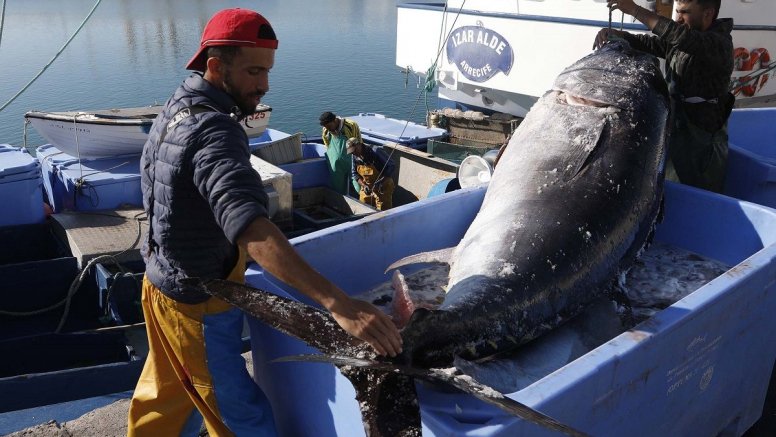
The fishing treaty between the European Union (EU) and Morocco ends this Monday, July 17, with many doubts about its renewal and the future of the fishing ground for the affected vessels, mainly from the Canary Islands, Andalusia, and Galicia.
As of this date, the tuna fleet of Lanzarote can no longer fish in Moroccan waters or hire personnel in the territory of the neighboring state, one of the biggest concerns of the fishermen of the island, since the teams are usually completed with hires in Moroccan ports.
The Official State Gazette (BOE) has just published the aid to fishermen and shipowners for the cessation of activity due to the end of the fishing agreement between the European Union (EU) and Morocco, for an amount of 302,000 euros.
Of this aid, 120,000 euros will be allocated to shipowners and 182,000 to crew members, co-financed 50% by funds from the European Union (EU), for the period between July 18 and September 30, 2023.
Spain obtained 92 of the 128 licenses to fish in Moroccan waters under the agreement that expires this Monday, but only 21 vessels applied for a license in 2021 and 2022 or in 2023, according to sources from the MAPA.
Is the renewal of the agreement possible?
The negotiations between Europeans and Moroccans for its renewal depend on a ruling by the Court of Justice of the EU on a European appeal against another opinion from 2021, in which the community judges annulled the fishing agreement for not taking into account Western Sahara.
In 2021, the Community Justice determined that both this agreement and the association agreement with the North African country - which affects the trade of food such as tomatoes - had not taken into consideration the Saharan interests, on whose coasts are the fishing grounds from which the Community vessels benefit.
If the expected ruling is favorable to the Europeans, there would be room, but if the opposite occurs, it would be very difficult to renew it by excluding the Western Sahara fishing grounds, according to sources from the sector and the European Commission.
This week, the EU and Morocco have held contacts, in a joint committee held in Brussels. From Rabat it has emerged that Morocco wants a new vision of the protocol "with more added value".
A fundamental treaty that worked at half gas
According to sources in the sector, the maximum use of the agreement has been 27 vessels, because the pandemic or the high cost of diesel caused the fishermen to stay fishing closer to their ports.
According to the Ministry of Agriculture, Fisheries and Food, between 21 and 50% of the fishing possibilities for Spain have been consumed.
Apart from the 93 Spanish permits, the agreement has benefited vessels from Lithuania, the Netherlands, Germany and Poland mainly dedicated to pelagic species (sardine or herring) for the manufacture of flours.
In exchange for the access of the fleet, Morocco has received an economic compensation of 50 million euros per year, including sectoral support and the fee paid by the shipowners, of around 12 million.
The Secretary General of Cepesca, Javier Garat, has lamented, in statements to EFE, the "temporary loss of a fishing ground" due to the interruption of a historical agreement, due to the impact on the vessels and because, he added, the Spanish fleet has fewer and fewer waters where to fish.
Add La Voz de Lanzarote as a preferred Google source.
Stay informed with the latest current news.