With the permission of the housing shortage, which worries the vast majority of Lanzarote residents, water management is the biggest problem on the island according to 24% of residents.
And it is not for less. The awarded company loses, year after year, half of the water that flows in the public network and every day there are towns on the island that wake up without water.
Thus, the 60th anniversary of the first desalination plant in Europe, which obtained drinking water for the homes of Lanzarote, is passing without pain or glory.
But it was an unprecedented historical milestone that boosted the economic development of the island. Until the mid-20th century, the people of Lanzarote depended on the scarce rains over Lanzarote to fill their cisterns and pools with drinking water.
For centuries this uncertainty caused the exodus of thousands of Lanzarote residents to other places where the water supply allowed for agriculture and a life with more guarantees.
In the 50s of the last century the extraction of water from the Famara massif proved insufficient, so ships continued to arrive with drinking water from Gran Canaria and Tenerife to be then transported in camels and carts through the island territory.
In 1965 drinking water begins to flow in homes
Everything changed in early 1965 thanks to the efforts of a naval engineer from La Vegueta, Manuel Díaz Rijo. The illustrious tinajero had observed since the beginning of that decade how the United States had promoted desalination to supply its ships.
Since then his objective was to “consider Lanzarote as a large ship anchored in the Atlantic, among whose machinery included a desalination plant for sea water”.
First he tried with the public administration, with little luck, and ended up turning to private initiative. Thus arises the company Termoeléctrica de Lanzarote SA (Termolansa), which buys the Arrecife power plant and obtains, through public tender, the award of the drinking water supply service for the capital of Lanzarote.
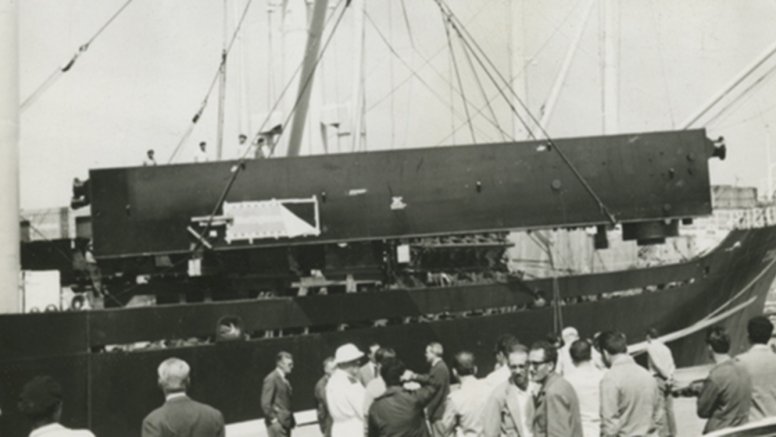
Next, Termolansa signs an agreement with the American companies Westinghouse and Burns and Roe. The first had designed a desalination plant for San Diego, California, and the second built it.
This model is thus transferred to Lanzarote and the construction of the first Lanzarote desalination plant concludes at the end of 1964. In parallel, the pipes for water distribution were installed.
In the spring of 1965, drinking water began to arrive directly to the homes of Arrecife. The desalination plant could then produce up to 2,300 cubic meters of drinking water and 1,500 kilowatts every day.
Thus begins an era in which Lanzarote and the Canary Islands as a whole become a world reference in desalination technologies and in the associated procedures of installation, operation and maintenance, exploitation, research, development and innovation.
Currently, desalination plants are a source of concern due to their environmental cost, discharges to the coast and the use of chemicals, as well as their intensive use of electricity.
But it cannot be forgotten that the arrival of desalination plants in Lanzarote completely transformed the life of the island and boosted its economic development more than any other previous innovation in its history.
Add La Voz de Lanzarote as a preferred Google source.
Stay informed with the latest current news.