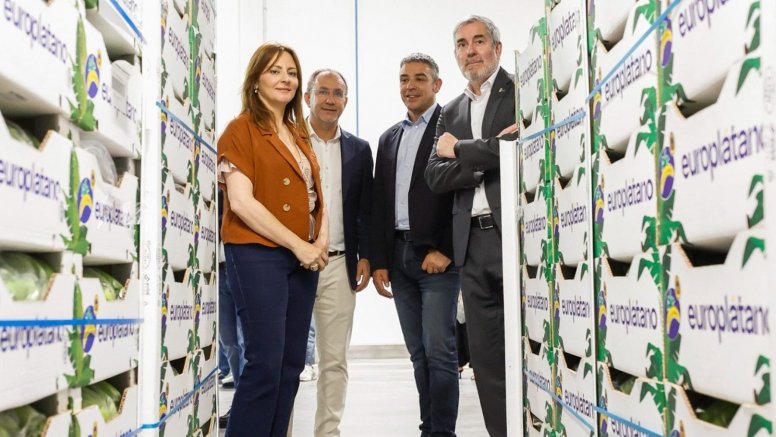
The president of Canarias, Fernando Clavijo, participated this Thursday in the inauguration of the new ripening plant of the Europlátano Group in Orozco (Vizcaya), an infrastructure that he considered strategic to reinforce the competitiveness of Canarian Bananas in the national market.
The facility inaugurated this Thursday has a surface area of 6,000 square meters, in which it has 21 high-precision ripening chambers, with temperature and ethylene control, and capacity to manage up to 40,000 tons of fruit per year. Its location in Orozko reinforces the distribution capacity of Canarian bananas in the north of the peninsula and facilitates connection with other European markets.
Europlátano has another center in the Alicante town of Mutxamel with 46 ripening chambers, from where the logistics of the Mediterranean, central, and southern Spain are managed.
During the event, the head of the autonomous government assured that the new plant reinforces the strength of the sector in the peninsula with an annual consumption of more than 330 million kilos of Canarian bananas and a business volume exceeding 820 million euros.
Canarias-Euskadi Collaboration
The head of the Canarian Government highlighted that this new plant is a reality thanks to the support of the Basque Government, a Canarias-Euskadi collaboration that is making good progress on the path of work agreed upon with the team of lehendakari Imanol Pradales.
Furthermore, Clavijo congratulated the "commitment to the future" made by the Europlátano Group to, hand in hand with local companies, make this new plant a reality with an investment exceeding 22 million euros, despite the sector experiencing "complicated times." "It demonstrates the capacity of our producers to improve the quality of the banana and increase the price of its commercialization," he said.
The president stressed that this new facility shows that the future of the Canarian primary sector also involves gaining presence in the higher value links of the chain, because "when our farmers have more capacity to control how it ripens, how it is distributed, and how their product reaches the consumer, they also gain profitability, stability, and capacity to compete."
According to his explanation, the Orozko plant "is not just a logistics infrastructure, but an extension of the work that begins each day on the farms in the Canary Islands." "Every improvement in ripening, distribution, and utilization of the product directly impacts those who cultivate, care for the land, and sustain a crop essential to our economy, our landscape, and our identity," he said, after highlighting the innovation capacity of the archipelago's primary sector. Canarian banana, he added, "is more than a fruit, it is landscape, it is identity, it is culture, and ultimately it is the Canary Islands."
The President of the Government emphasized that these types of investments are especially relevant in a context of growing competition from imported bananas and increasing costs borne by Canarian producers. Plátano de Canarias competes with a fruit produced under very different conditions than those in the archipelago, which is why the sector needs "all possible tools" to improve efficiency, reduce losses, and enhance the quality of production," he stated.
High-precision ripening
The new Vizcaya plant allows Grupo Europlátano to advance in greater control over the process the fruit undergoes from its departure from the islands to its arrival at the point of sale. Its work system contributes to reducing losses associated with the ripening phase and food waste, in addition to improving the final quality of the product and responding more precisely to the needs of different markets through technological innovation.
During the event, President Fernando Clavijo also highlighted the symbolic nature of the plant, whose ripening chambers bear the names of Canarian farms. "That detail expresses very well what this project represents: even though the fruit ripens here, its origin, its value, and its reason for being are in the Canary Islands and in the effort of our farmers," he affirmed during the event.
Representing the Government of the Canary Islands, in addition to the president, the inauguration of the plant in Euskadi was attended by the Minister of Agriculture, Livestock, Fisheries and Food Sovereignty, Narvay Quintero, the Minister of the Presidency, Nieves Lady Barreto, and the Vice Minister of the Cabinet of the Presidency, Octavio Caraballo. In addition, the president of the Cabildo of La Palma, Sergio Rodríguez, and the delegate of the Government of Spain in the archipelago, Anselmo Pestana, were present.
Also participating were the Minister of Food, Rural Development, Agriculture and Fisheries of the Basque Government, Amaia Barredo, and the president of Europlátano, Francisco Lorenzo Speranzini, in addition to farmers, clients, suppliers, and various agents linked to the Canarian banana sector.
Canarian bananas in mainland Spain
The data support this statement. The Europlátano Group has nearly 700 farmer members dedicated to growing bananas, avocados, and other tropical fruits with farms in La Palma, Tenerife, and El Hierro. With this new facility, the organization reinforces a model that seeks to improve traceability, guarantee the optimal point of ripeness, reduce intermediaries, and increase the economic return for the producer.
The objective: to continue leading the Spanish market. Currently, Plátano de Canarias has a marketing and distribution network in mainland Spain comprising over 122 companies involved in ripening, distribution, and sales in wholesale markets, generating an annual business volume exceeding 820 million euros.
Thanks to this network, in terms of consumption, Plátano de Canarias remains among the most in-demand fruits in Spain, with over 330 million kilos consumed in peninsular Spain. The Basque Country stands out in this regard as one of the communities with the highest loyalty: in Euskadi, the market share exceeds 70% by volume, with an annual consumption of over 17 million kilos.
The aforementioned commercial network allows for 89% penetration in peninsular households, equivalent to over 16.2 million households that regularly consume Plátano de Canarias. This supply is channeled through six main ports: Huelva, Cádiz, Barcelona, Alicante, Galicia, and Bilbao, which facilitate the product's arrival at the various peninsular markets.
Add La Voz de Lanzarote as a preferred Google source.
Stay informed with the latest current news.