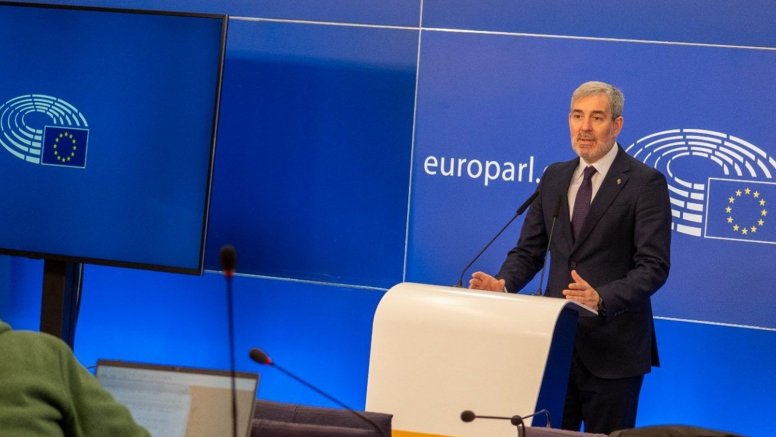
The president of the Canary Islands, Fernando Clavijo, will hold top-level working meetings in Brussels over the next two days to defend specific measures to help the Canary Islands face the energy crisis.
This Tuesday he will meet with the European Commissioner for Transport and Tourism, Apostolos Tzitzikostas, while on Wednesday he will meet with the Executive Vice-President of the European Commission for a Clean, Just and Competitive Transition, Teresa Ribera.
In both meetings, the head of the Canary Islands government will convey to the top European authorities in energy and connectivity his concern about the special impact that the increase in fuel costs as a consequence of the Iran war is having on the archipelago.
Clavijo will emphasize that, as an outermost territory, Canary Islands has an isolated energy system and is still very dependent on oil, in addition to the fact that 90% of supplies arrive by sea and air transport is vital for connectivity. To face this reality and under the protection of Article 349 of the EU Treaty, he will debate with Tzitzikostas and Ribera the possibility of activating concrete actions for the benefit of all RUPs to protect their citizens from price increases.
The objective is that Brussels keeps the Canary Islands in mind when adopting measures, because “it is evident that the energy crisis hits more intensely territories far away and dependent on the outside as is the case of the archipelago and all the outermost regions,” explained the spokesperson Alfonso Cabello at the press conference after the Governing Council.
To achieve this, this new trip by the head of the Canary Government to Brussels comes at a key moment when the EU is debating how to face the effects of the war in the Middle East. In fact, just last Wednesday and at the proposal of Vice President Ribera, the European Commission put on the table a package of urgent measures to address the energy crisis caused by the closure of the Strait of Hormuz.
This plan, called AccelerateEU, includes a battery of emergency actions aimed at reducing dependence on fossil fuels, protecting households and industries, and accelerating the transition to clean energy. The European initiative proposes tax rebates on electricity, energy vouchers, and the possibility of temporarily prohibiting supply cuts.
The president of the Canary Islands will take advantage of the meetings with the vice president and the European commissioner to demand that these tools be adapted to its island and outermost region reality, and that the AccelerateEU plan incorporate that perspective in compliance with Article 349 of the Treaty, which guarantees specific treatment for Outermost Regions.
Do you usually read us to find out what's happening in Lanzarote? Choose La Voz de Lanzarote as one of your preferred sources on Google
Add La Voz de Lanzarote as a preferred Google source.
Stay informed with the latest current news.