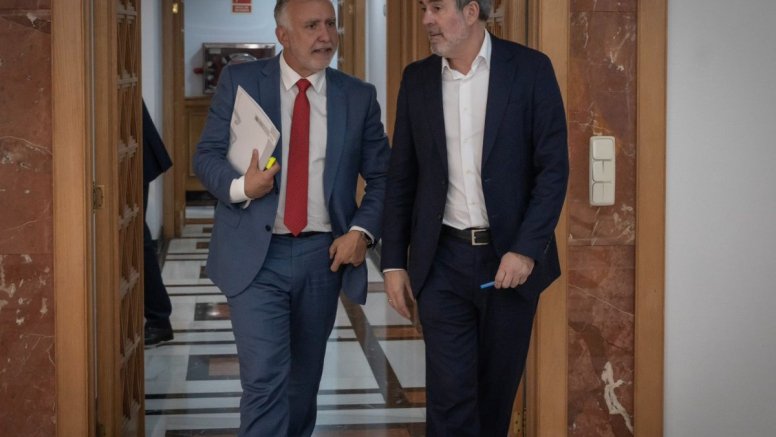
The Government of the Canary Islands has confirmed its intention to file an appeal before the Constitutional Court to resolve the conflict it maintains with the State regarding the scope of the coastal powers transferred to the autonomous community, after the attempt to reach an understanding in the Bilateral Commission failed.
The Minister of Public Works of the Government of the Canary Islands, Pablo Rodríguez (CC), announced this decision at a press conference after the Commission, in which he says he has verified "that there is no will" political by the central Executive to negotiate and has insisted that Article 157 of the Statute of Autonomy of 2018 grants "exclusive powers over the coastline to the Canary Islands".
The president of the autonomous community, Fernando Clavijo (CC), and the Minister of Territorial Policy, Ángel Víctor Torres (PSOE), have led the two negotiating parties in the Bilateral Commission.
Torres has stated to journalists that, apart from the announced appeal, he is willing to hold the necessary meetings to try to reach an agreement, since the positions of both administrations are "forceful" and there is a "legal clash".
The Minister of Public Works has argued that the Canary Islands has defended the same position in all conflicts regarding coasts since 2018 - the past legislature, as Minister Torres himself as president - and, although he has appreciated the "good tone of the meeting", he has pointed out that "there is no will" from the State Government to change its position.
Rodríguez has insisted that the general framework of powers of the Canary Islands is set in the Statute of Autonomy, so "it does not matter what happens in other communities such as Catalonia, Andalusia or the Balearic Islands", to which, according to Torres, these powers were also granted and in "all of them the transitional provisions are in the hands of the Government of Spain".
The minister has remarked that the Statute of Autonomy of the Canary Islands is not being questioned, but rather its interpretation, while emphasizing that the Constitution says that the power "is in the hands of the State".
For the Canarian minister, the meeting has been "disappointing", so they have announced their intention to file the appeal before the Constitutional Court to decide on the scope of these powers, which will presumably be addressed in the Council of Ministers next week.
One month to file an appeal while negotiations continue
After the pronouncement of the Council of Ministers, which will be contrary to the thesis proposed by the Canary Islands, the autonomous community will have one month to file the appeal, Torres and Rodríguez have explained, who has indicated that this will not be an obstacle to continue negotiating, as the minister has proposed.
"If there is room for an agreement along the way, it is welcome" and the Canary Islands will sit down as many times as necessary, the minister added.
Rodríguez has emphasized that the "powers are absolutely clear and leave no room for doubt that the State is invading them", as stated in the report of the Canary Islands Advisory Council, a body that "is not biased, but to address issues like this", compared to what the State Council report maintains.
According to Rodríguez, the Canary Islands was confident that a possibility of agreement would open up in the Bilateral Commission, but "they have not found the will" to modify the royal decree on transfers that came into force in January 2023, which, in his opinion, is the only possible way to resolve the matter.
The minister explained that the meeting did not address any particular file, but that the Canary Islands has the statutory powers of coastal management, so after the transfers on coasts are completed, the State only maintains the demarcation in the maritime-terrestrial public domain and the legal considerations that may be made of the concessions or actions on the coast that are of general interest.
Minister Ángel Víctor Torres has indicated that he hopes that another meeting will take place before the summer to discuss the matter again and has also recalled that when he was president of the Canary Islands he already tried to convene this Bilateral Commission to be able to clarify the differences in criteria between the State and the autonomous community.
Add La Voz de Lanzarote as a preferred Google source.
Stay informed with the latest current news.