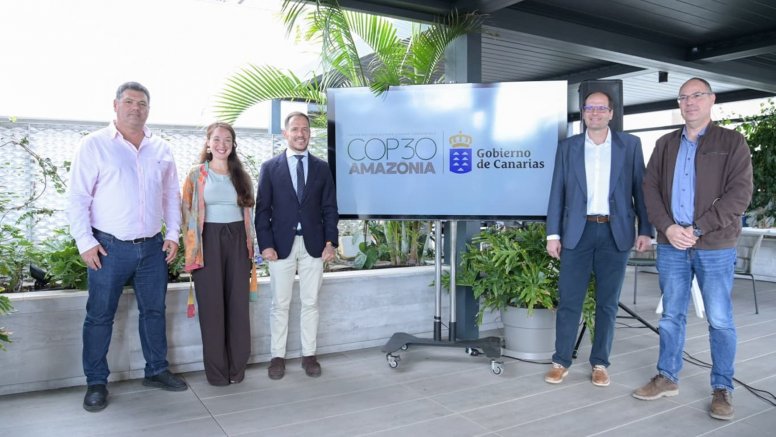
The Ministry of Ecological Transition and Energy of the Canary Islands Government is participating this November in the United Nations Climate Change Conference (COP30), which is being held in Belém, Brazil, reaffirming the archipelago's commitment to global climate action and international cooperation in the face of environmental challenges.
The councilor for the area, Mariano Hernández Zapata, heads the Canary Islands delegation, accompanied by a researcher from the University of La Laguna and member of the Earth and Atmosphere Observation Group (GOTA), Juan Carlos Pérez Darias. Additionally, the professor from the University of La Laguna, Juan Carlos Santamarta, will also participate
Zapata stressed that "Canary Islands cannot be left out of the global conversation on climate. We are a **territory especially vulnerable, but also a space for innovation and knowledge**. Our presence at COP30 demonstrates that the islands have much to contribute to the world and that it is essential to transfer our Canarian way of doing things to all corners."Likewise, he highlighted that, despite the logistical complexities of attending an event of this nature in the Brazilian Amazon, "Canary Islands, due to its firm commitment to the fight against climate change, must be present as in previous years and continue the important work we have been developing on the islands for years," which have "a **world-class scientific team in environmental matters**."In addition, he detailed that this will be a new occasion in which the Ministry participates in a Climate Summit, "a continuity that has allowed the creation of **synergies with other regions** and the strengthening of the Archipelago's presence in international networks such as Regions4, as well as fostering alliances with other island territories committed to sustainability".
Scientific Studies Presented by the Canary Islands
One of the studies the Ministry will present in Brazil will be the project Climate Projections for the Canary Islands, developed in collaboration with the University of La Laguna, which aims to provide regionalized climate projections to better understand the impacts of climate change on island environments and demonstrates the alliance between the Government and scientific research.
According to GOTA researcher Juan Carlos Pérez Darias, this research "aims to overcome the limitations of current CORDEX (Coordinated Regional Climate Downscaling Experiment) system models, which focus on continental-scale projections, and to collaborate with other regions of the world in the development of scientific tools adapted to their territorial reality to understand how climate phenomena will affect the world's islands".
In addition, "with this study, the Canary Islands are consolidated as a laboratory for the observation and analysis of climate change in island territories, putting science at the service of action and the planning of more effective public policies."
Alongside this, the Canary Islands will also present the ‘IDAFE Project: Canary Islands Educational Centers Against Climate Change’, an initiative promoted by the Ministry and co-financed by the European Union within the framework of the Canarias FEDER 2021-2027 Program. This program, which will be showcased on November 18th during the session dedicated to Planetary and Community Management, with a focus on forests, oceans, and biodiversity — also highlighting local and traditional communities, children, and youth, emphasizes the role of education as a tool for change and international cooperation.
The IDAFE Project, which has already involved more than 2,500 students and 150 teachers, transforms Canary Islands schools into spaces for climate learning, resilience, and hope. Through the new MAC IDAFE phase: Network of Schools for Climate Action in Macaronesia, this experience is shared with Madeira, the Azores, and Cape Verde, weaving an educational network that connects different Atlantic archipelagos under a common vision: education as the light that guides climate action.
During his speech, Zapata highlighted that "we want to share the experience of our schools with the world, as they have become true educational beacons in the face of climate change. From the Canary Islands, we send a message of hope, cooperation, and knowledge." In this way, he detailed that a dynamic with young people from the country will be developed during the presentation that will take place in Brazil.In addition, the counselor detailed that the professor from the University of La Laguna, Juan Carlos Santamarta, will also participate in the summit, with the presentation titled "Climate, Water, and Islands: An Engineering Response," representing the World Federation of Engineering Organizations (WFEO), an organization that brings together engineering associations worldwide and acts as UNESCO's technical arm on issues of engineering, sustainability, and development
Santamarta will explain, with practical examples, two open tools developed in the Canary Islands: the SICMA-Canarias platform, which offers climatic and hydrological projections at 100 meters resolution for all islands for water resource management, and the RISK-Agua platform, which allows simulating cascading failures by integrating climate, infrastructure, and management decisions to strengthen island water resilience.
She currently leads three Horizon Europe international projects at the University of La Laguna related to water and climate change —GENESIS, NATALIE, and ARSINOE—, the latter recognized by the European Commission as a European success story for its results obtained in the Canary Islands, replicable in other island regions.
Add La Voz de Lanzarote as a preferred Google source.
Stay informed with the latest current news.