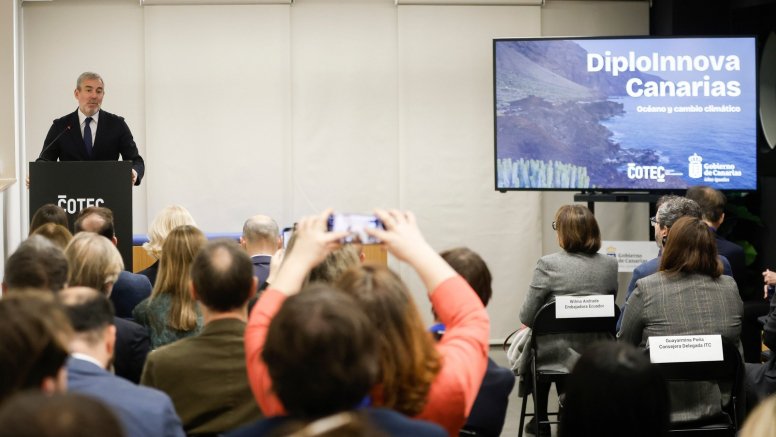
The president of the Canary Islands, Fernando Clavijo, highlighted during the inauguration of the II edition of DiploInnova Canarias that the islands have all the necessary elements to become a global laboratory for ocean protection and climate change mitigation.
The Government of the Canary Islands, it stressed, is "totally involved and committed” to environmental policies, supported by unique conditions for the research and development of pioneering projects, as well as facilities and infrastructures that have become an international benchmark.
This has been the objective of the new DiploInnova Canarias meeting, held this Tuesday, February 3, at the headquarters of the Cotec Foundation in Madrid with the presence of representatives from 17 embassies, which has focused its attention on research surrounding oceans and climate change, a matter of great importance globally but especially relevant for the archipelago, whose territory is sea in more than 80%.
Clavijo emphasized that this program opens a new stage in the external projection of the Canary Islands, linked not only to knowledge but to **innovation** and **talent**, "so that the islands actively participate in providing solutions to the great global challenges of our time".With this initiative, the Canary Executive reaffirms its commitment to science as a driver of economic and social development, as well as to the internationalization of the research carried out in the archipelago.
To favor the growth of high-tech companies, the president underscored the potential of the Economic and Fiscal Regime (REF), “a tool that offers legal guarantees and fiscal advantages that attract more investment and new innovative companies to the islands each year”.
For her part, the president of Cotec, Cristina Garmendia, highlighted the scientific, technological, and talent competencies of the Canary Islands, "which make it one of the most strategic territories in Europe for advancing in blue economy and applied innovation".He affirmed that the islands are “a natural laboratory where Europe can experiment, validate, and scale solutions that it urgently needs”. From Cotec, he said, “we want to contribute to that positioning being recognized and reinforced”.
Garmendia recalled that, according to studies carried out by Cotec, “Canarian companies lead in Spain the use of artificial intelligence applied to the automation of physical movements, an indicator of the territory's unique potential in ocean innovation”.
Examples of ongoing research in the archipelago
In this regard, the president of the Canary Islands highlighted that "the Archipelago has begun a determined transition towards an economy based on **knowledge, innovation, and the responsible use of its natural resources**", a transformation that is supported by collaboration between administration, science, business, and society to generate added value, diversify the economy, and offer responses to challenges that manifest in island territoriesClavijo elaborated that the islands and coastal areas are exposed to **greater risk from climate change**, from sea-level rise, extreme weather events, erosion, floods, etc. These circumstances oblige, in the case of the outermost regions (ORs), to intensify actions to be prepared with a specific strategyRegarding this, he added that the European Commission has already announced “that it will redouble its efforts to support these regions in strengthening their adaptation to overcome these adverse scenarios”. Brussels recognizes that these territories need specific attention and adapted measures to meet their needs: strengthening their resilience and connectivity, developing their economic, energy, and food autonomy, as well as protecting their natural heritage.Clavijo pointed out that, in the case of the Canary Islands, its ecological richness, its location in the mid-Atlantic, and its natural conditions make it an exceptional natural laboratory for advancing solutions to climate change, biodiversity loss, and the sustainable management of marine ecosystems. In this context, he noted that the sea is an engine of life and prosperity and "we must be able to harness its enormous potential, but always with sustainability as our horizon".
In this line are projects that work on desalination with wave energy, such as the one developed by Ocean Oasis; the Research Centre on the Ocean and Climate carried out by Geomar; the proposal for clean energy and water from waves by Wavespiston; the double-turbine floating offshore wind carried out by Enerocean and Pronoe; the direct CO2 capture with very low costs by Brineworks; the proposal by Aquawind, which combines aquaculture and offshore wind energy or the work carried out by Manta, specialized in marine floating photovoltaic systems.
Add La Voz de Lanzarote as a preferred Google source.
Stay informed with the latest current news.