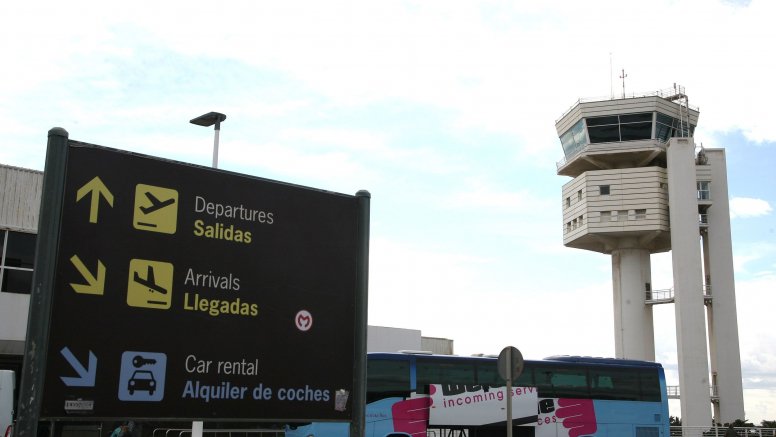
The air traffic controllers' strike at the Lanzarote airport, which caused César Manrique's flights to suffer the biggest delays of all European airports on Thursday, July 27, will continue during the summer.
Sources from the company SAERCO, which manages the control tower of Lanzarote, as well as those of Fuerteventura, El Hierro and La Palma, in the Canary Islands, have confirmed to La Voz that "the 30% salary increase requested by the union is unaffordable for the company, so the negotiation is completely blocked." In addition, this case is impossible because there is no option to pass these increases on to the prices of the service, since it is a fixed contract."
For its part, the Air Traffic Controllers' Union (USCA) describes SAERCO's position as "completely immovable, not only does it not accept improvements, but the workers have clearly worsened their conditions."
SAERCO, which has 12 air traffic controllers for the Lanzarote tower, explains that its controllers earn an average of 45,000 euros per year and that the company is willing to offer "an increase of around 6% in three years, which is added to the 10% already foreseen in the agreement, so the workers would increase their remuneration by 16%".
Why is the strike being felt more in summer?
Until the arrival of summer, the strike had hardly been noticed. In La Palma or El Hierro, the towers are single-position, that is, they are for a single controller and, therefore, when he is called to cover the minimum services, he controls all the flights during his working day.
In position towers, such as the Lanzarote airport, controllers have to rest for at least half an hour every two hours of work, "so depending on the traffic demand we have two or three controllers called to rotate," explains SAERCO.
When there are two controllers they also cover 100% of the flights because they are obliged to rest and therefore both are needed for the airport to continue operating.
However, in summer there are more often three controllers in Lanzarote, since the flight day is longer, and "that is where one of those three controllers is exercising his right to strike," explain sources from the union.
Add La Voz de Lanzarote as a preferred Google source.
Stay informed with the latest current news.