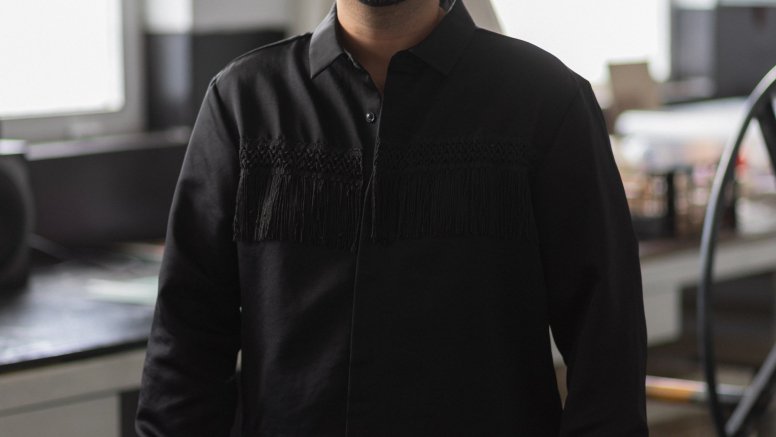
The Lanzarote native Adonay Bermúdez is exhibition curator, especially in Latin America, Italy, and Portugal. He is also art critic for different media such as ABC Cultural or the Italian contemporary art magazine Segno, which has just launched a Spanish edition. He studied Interior Architecture and has a master's degree in communication.
In an interview with Ekonomus, he analyzes the barriers that artists from Lanzarote and the Canary Islands face to sell their work at a time when, with returns exceeding 7%, investment in art in the world is increasingly common and moves more than 50 billion euros.
Positioning the artists of Lanzarote and Canary Islands
“The Canarian talent is palpable, it is tremendous, I feel proud and a participant. Many artists have positioned themselves, but not because of the support of the institutions,” explains Bermúdez.
The art critic from Lanzarote considers that the public support initiatives in the Canary Islands have not had a “long-term strategic vision to position their artists”.
“Catalonia, Basque Country and Balearic Islands do it very well. Any list of Spanish artists has many Catalan, Basque and Balearic names,” he/she explains.
“We have just seen the reorganization of the Reina Sofía with hundreds of works and there is only one Canary Islander, who is from Lanzarote, Carmela García,” he/she exemplifies.
“One must make agreements with other institutions, generate exchanges, just with that, art begins to flow”.
"Canarian artists think in volumes that they can transport in an easy way inside a suitcase".
Very high taxes and customs
The national legislation also does not benefit the artists of the archipelago.
Regarding the Artist's Statute, a set of legal reforms to improve the labor, fiscal, and social security conditions of professionals, Bermúdez believes that “it has not taken into account territories as complex as the Canary Islands”.
“We have customs, just to take out or bring in works of art you have to pay even if you haven't sold it. Canarian artists do not compete on equal terms”, explains.
During the financial crisis, the central Government raised the VAT on cultural products, which over the years has been lowered for concerts, cinema, and books, but it remains at 21% for art sales through intermediaries.
“If an artist from Lanzarote has a work valued at one thousand euros, and wants to try to sell it at an art fair in Madrid, the gallery will take 50%, 500 euros, and when they register it at customs, they will have to pay 21%, 210 euros, to take it out of the Canary Islands, as long as they carry it with them,” Bermúdez exemplifies.
Indeed, Spain is still one of the countries with the highest taxes in Europe for works of art when sold through galleries. In Italy it is 5%, in France 5.5%, in Germany 7%.
“In the Canary Islands there are very few galleries due to customs. If you go to the Balearic Islands, for example, there are a huge number of galleries that work very well and that take advantage of tourism, mainly German, that invests and buys art, here it is much more expensive”.
Regarding possible solutions, he advocates for “a specific clause with which from a value downwards, the one that is decided, that artists do not have to pay”.
The high costs of the transfer: "There is no ambition to produce large pieces"
“Whether you live in the city of Valencia, or if you live in in a lost village in Cantabria, the transport of work taking it to Madrid is going to be much cheaper for you than from Lanzarote,” shares the art critic.
Thus, ambition is also different: “Canarians think of volumes that they can easily transport inside a suitcase. There is no ambition to produce large pieces because then those pieces stay here, they can’t get them out.”
It is true that there are aid for mobility from the Government of the Canary Islands, which covers the cost of going out to exhibit but the problem is that you have to pay for it yourself and then, if all goes well, they give it back to you”.
That causes that “only those who have money, for whatever reason, savings, family money, work or sales, are those who will be able to go out.”
Despite the obstacles, in Lanzarote there are some galleries like Lanzarote Art Gallery or Galería De Arte Enmala.
“There are great private collectors on the island”, but the most common profile is “one who can dedicate up to 400 euros a month to buying art".
That is precisely the public that buys at Lanzarote, Art and Guateque, the art exhibition and sale initiative that Bermúdez organizes in Tías during Christmas in collaboration with the association Ars Magna and which, without mobility impediments, sells almost everything it presents.
Add La Voz de Lanzarote as a preferred Google source.
Stay informed with the latest current news.