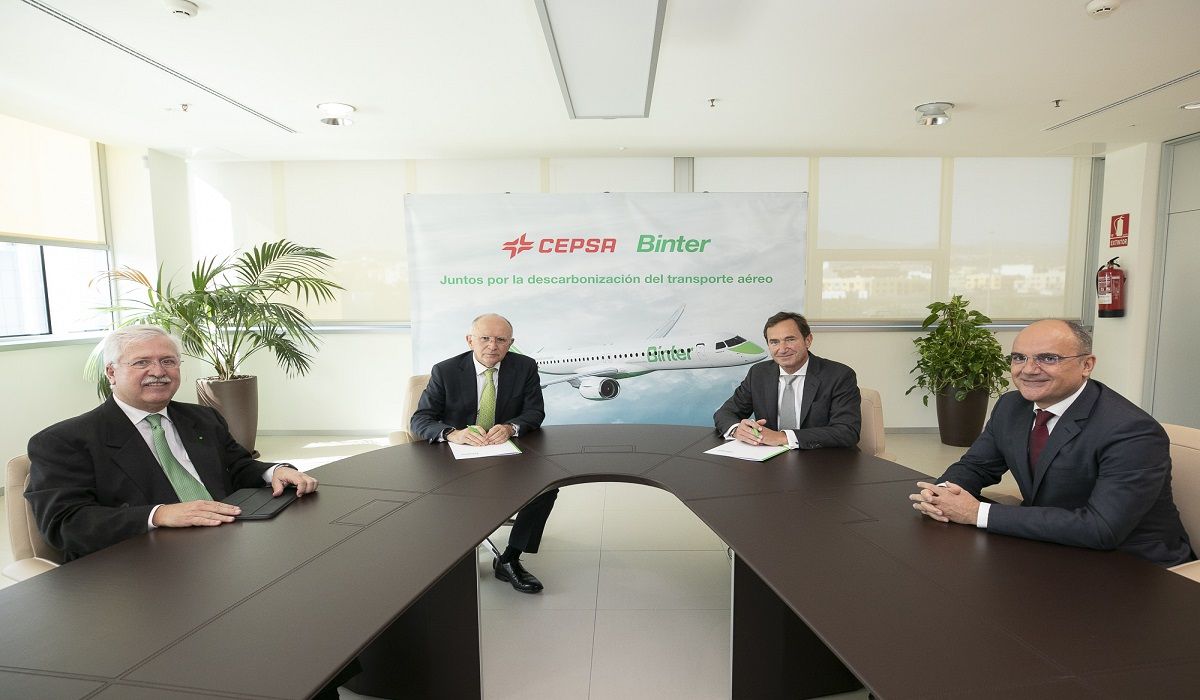
Cepsa and Binter have signed an agreement to promote the decarbonization of the aviation sector through the development and research of sustainable aviation fuels (SAF). Likewise, through this alliance, other energy alternatives will also be developed, such as renewable hydrogen and electrification, for the airline's land fleets (vehicles for supply, cargo loading and unloading operations, aircraft assistance, etc.).
This agreement, which will promote the sustainability of air transport from one of the main tourist regions of Spain and the world, was signed on February 18, at an event held in Gran Canaria, which was attended by representatives of both companies. This agreement is in line with the European Commission's Fit for 55 measures, which includes a legislative initiative called "RefuelEU Aviation", which aims to boost the supply and demand for sustainable aviation fuels in the European Union, reaching a use of at least 2% in 2025, 5% in 2030 and 63% in 2050.
SAFs play a key role in the decarbonization of tourism and air transport. These fuels are produced from circular raw materials that do not compete with food, such as used cooking oils, non-food animal waste or biodegradable waste from different industries. Compared to conventional fuel, SAF can reduce aviation emissions by up to 80% compared to conventional kerosene, according to the International Air Transport Association (IATA).
In addition, they provide other benefits: they boost the circular economy, increase energy independence (and, with it, security of supply), ensure the maintenance of an important engine of the Spanish economy (200,000 quality jobs) and can be used immediately without the need to renew the fleet and taking advantage of current supply infrastructures.
During the signing of the agreement, the president of Binter, Rodolfo Núñez, stressed: "With this alliance, we are taking a very important step in Binter's objective of providing air transport services in the most sustainable way possible, for which it is essential to promote the consumption of new fuels with low environmental impact, which we will soon be able to start applying to our flights, thanks to the joint work with Cepsa".
Pierre-Yves Sachet, director of mobility and new commerce at Cepsa, highlights: "At Cepsa we work to provide innovative solutions that promote sustainable mobility. This agreement is a good example, with which we also contribute to the competitiveness of the tourism sector in Spain, with the Canary Islands being its main reference".
For his part, Carlos Barrasa, director of commercial & clean energies at Cepsa, points out that "with this alliance we continue to accelerate the decarbonization of air transport and our clients. In addition, we reinforce Cepsa's commitment to the economic and sustainable growth of the Canary Islands, a region in which we have been present for more than 90 years".
The development of sustainable aviation fuels is a priority for both companies as a tool to continue reducing the carbon footprint of air transport and thus contribute to the fight against climate change and the achievement of the 2030 Agenda. This alliance supports several of the Sustainable Development Goals, such as: SDG 7 (ensure access to affordable, safe, sustainable and modern energy), SDG 8 (promote inclusive and sustainable economic growth, employment and decent work), SDG 12 (ensure sustainable consumption and production patterns) and SDG 13 (take urgent action to combat climate change and its effects).
Cepsa is working on a plan to give a green turn to all its businesses and become a benchmark for the energy transition. The company is one of the suppliers of aviation fuels in the Spanish market and, in particular, in the Islands, where it has a presence in all its airports. In addition, the company has experience in the production of sustainable fuels in its industrial centers and develops pioneering studies worldwide to convert waste and used oils into renewable fuels of high energy value.
Binter has made sustainability one of its lines of action and for years has been studying and implementing measures to reduce the impact of its activity on the environment. The airline has been a leader in Spain in the implementation of an ecological ground fleet composed of electric and lower consumption equipment and has championed measures such as the replacement of single-use plastics in the on-board service with less polluting elements. In addition, it has one of the youngest aircraft fleets in the country, which allows it to take advantage of the improvements introduced by manufacturers to reduce both consumption and emissions.
Add La Voz de Lanzarote as a preferred Google source.
Stay informed with the latest current news.