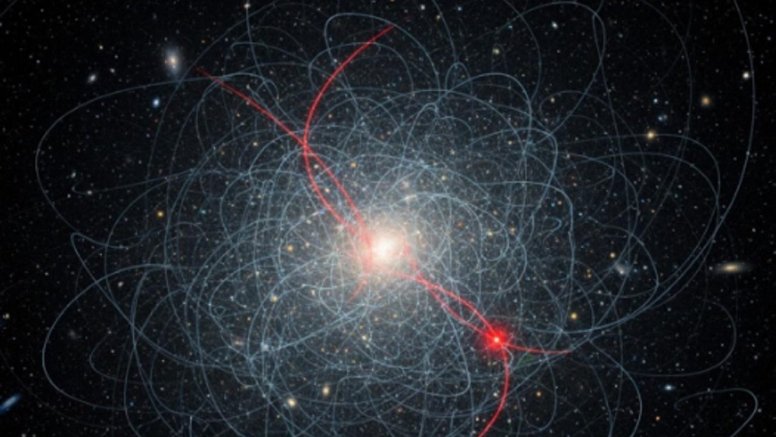
A study by the Canary Islands Institute of Astrophysics (IAC) reveals that a single collision between dark matter particles every 10 billion years, approximately the age of the Universe, is enough to explain the dark matter cores observed within the smallest galaxies.
Ultra-diffuse dwarf galaxies, the smallest and faintest known, could hold the key to understanding one of the Universe's greatest mysteries: the true nature of dark matter, according to the IAC this Tuesday.
These galaxies, which contain only a few thousand stars, are dominated by dark matter and have had very simple evolutionary histories, making them ideal cosmic laboratories for testing theories about dark matter physics.
Now, this novel study from the IAC demonstrates that extremely infrequent interactions between dark matter particles can naturally generate the observed central structures—or cores—formations that traditional collisionless dark matter models struggle to reproduce with ease.
“We know that the current dark matter model is just an approximation,” explains Jorge Sánchez, a researcher at the IAC and author of the study.
Thus, all particles, including dark matter, must eventually interact through forces beyond gravity, and the study shows that even extremely rare interactions can leave observable traces in the smallest galaxies, the researcher adds
By analyzing the size of stellar and dark matter cores in these galaxies, the study managed to estimate the probability of dark matter particles colliding with each other.
"The study shows that both low-interaction dark matter halos (which are forming the core) and high-interaction ones (where the core is collapsing) can reproduce the observed structures, with cross-section values between 0.3 and 200 cm² per gram," the researcher points out.
These values are consistent with those found in other galaxies, but now they extend to objects where the measurement is not biased, emphasizes Jorge Sánchez.
The team also developed a simple model relating a galaxy's stellar mass to its core radius, two properties that can be measured observationally.
The IAC explains that this model successfully reproduces the observed core sizes and predicts that the core radius increases with stellar mass, a trend also observed in larger dwarf galaxies.
This relationship offers a powerful tool for connecting the visible structures of galaxies with the invisible properties of dark matter.
If the high-interaction scenario is correct, dark matter in ultra-faint dwarfs would reach thermal equilibrium in regions spanning more than 3,000 light-years, meaning far beyond the visible extent of their stars.
“Such large thermalization scales could influence how dark matter substructures form and evolve within more massive galaxies, affecting phenomena such as gravitational lensing or the distribution of satellite galaxies,” explains Jorge Sánchez.
"Even extremely rare collisions between dark matter particles leave a lasting imprint on the smallest galaxies. Our results show that tiny galaxies offer a direct pathway to understanding dark matter physics," the scientist highlights
These results position ultra-faint dwarf galaxies as unique natural laboratories for studying dark matter interactions at very low velocities, a regime inaccessible to both terrestrial particle accelerators and observations of massive galaxy clusters.
"Future cosmological simulations that consider a high probability of interaction between dark matter particles will be essential for exploring how these ultra-rare collisions shape galaxies over cosmic time," the researcher points out.In addition, he adds that these studies could help "to refine our understanding of dark matter and, ultimately, of the fundamental forces that govern the Universe."
Add La Voz de Lanzarote as a preferred Google source.
Stay informed with the latest current news.