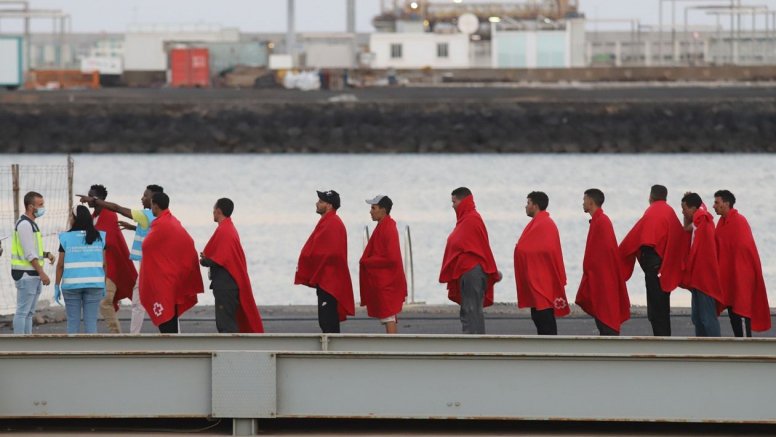
Given the unprecedented figures that the month of October is leaving on the Canary Islands migration route, in which more than 13,000 people have arrived in canoes, the Government has accelerated the transfer of migrants to the peninsula to decongest the first reception centers in the Archipelago.
So far this year, a total of 23,537 people have arrived in the Canary Islands via the Atlantic route between the African continent and the Islands. This represents an increase of 79.4% in arrivals.
A mechanism that diverts migrants according to their vulnerability to the places available throughout the humanitarian care network and that, as stated a few days ago by the Government Delegate in the Canary Islands, Anselmo Pestana, "is working reasonably well", despite the fact that the islands are experiencing an unprecedented peak since the 2006 canoe crisis.
The Government does not provide the figures or the destination of these transfers, which have generated discomfort in city councils and communities governed by the PP, who accuse the Executive of lack of coordination and of not informing them sufficiently in advance of the referrals.
How are these transfers being made?
The effort is being especially intense in El Hierro, an island of 11,000 inhabitants to which more than 8,600 immigrants have arrived this year, according to the counts provided each day by the different emergency services.
Transfers from the port of La Restinga to Tenerife or Gran Canaria are being carried out on the same day.
And immigrants are being referred from the Archipelago to the Peninsula within a few days. This Tuesday, for example, the National Police was in charge of escorting the transfer of more than 300 migrants by plane from the Canary Islands to Madrid, from where they were taken by bus to Almería.
Who can be referred to the peninsula?
Foreign adults in an irregular situation. The reception of unaccompanied minors is the responsibility of the autonomous community and the Canarian Government currently protects around 4,400 migrant children, according to the latest data provided this Wednesday by the Minister of Social Welfare, Equality, Youth, Childhood and Families, Candelaria Delgado.
According to the usual protocol, after the first 72 hours, while their affiliation is completed, Migrations identifies those who are in a situation of vulnerability and communicates it to the Interior Ministry so that their transfer to a more suitable resource is authorized. However, given the intense arrival of canoes to the Canary Islands, several of these procedures are now being carried out in the centers to which they are transferred.
In the case of Almería, the provincial coordinator of the Red Cross, Francisco Vicente, explained that throughout this week they hope to have individual interviews with all those transferred to learn about their situation "and support them and put them in contact with their support network and family members they have in Spain".
Where are migrants housed on the peninsula?
The Ministry of Inclusion, Social Security and Migration, responsible for transferring, housing and assisting these migrants, is following the "usual procedure" of referring them according to their vulnerability to the places available throughout the network, which can be Administration's own centers managed by NGOs or spaces enabled for this purpose.
240 migrants transferred to the Malaga municipality of Torrox, for example, have been housed in the Urban Beach hotel, currently closed to the public after the end of the summer season, while 150 referred to Medina del Campo (Valladolid) are installed in the spa of the Palacio de las Salinas, which is closed for renovation.
Sources from the department headed by José Luis Escrivá, point out that in many cases they are specific stays, very short, while it is decided what the final destination of these people is. If they do not meet the conditions to be returned to their countries, they can register in the care network and the Ministry determines their distribution and pays for their reception in centers.
Are there enough locations for all migrants?
Migrations is looking for locations throughout the peninsula to guarantee a dignified reception for immigrants.
"Many spaces are being seen", both public and private, to find out what availability exists and "be prepared", say sources from this department who insist that at the moment there are no problems.
For the moment they have confirmed that Defense has given them two plots of land in the Community of Madrid: a barracks in the Carabanchel district of the capital, with 450 extendable places, and another in the municipality of Alcalá de Henares.
Some city councils, such as Cartagena, where there is already a Temporary Foreigners Assistance Center (CATE), have opposed the installation of a new center after it became public that in recent weeks Migration technicians have visited Defense facilities in the area looking for spaces.
Immigrants are not obliged to remain in the centers and can move freely within the national territory. Many decide to use their own family support networks and sometimes their final destination is another European country.
Add La Voz de Lanzarote as a preferred Google source.
Stay informed with the latest current news.