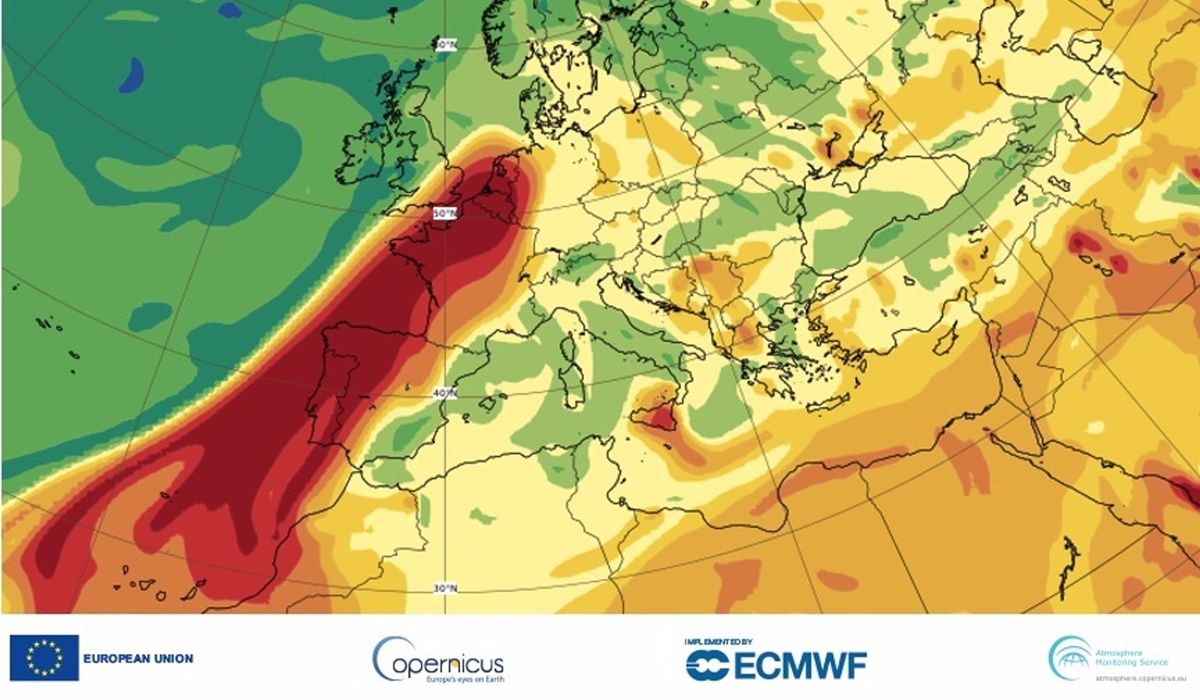
The eruption of the Cumbre Vieja volcano in La Palma has caused large plumes of sulfur dioxide to have spread through North Africa, Europe and the Atlantic to the Caribbean, according to the monitoring that the scientists of the Copernicus Atmosphere Monitoring Service are carrying out on the effects of the current emissions of the volcano.
The monitoring carried out on the evolution of the total column of sulfur dioxide (SO2) began at 00:00 on October 19 and is based on satellite observations of the total columns of SO2 (this is the number of SO2 molecules existing per unit area in a column formed from the surface to the upper layer of the atmosphere).
Scientists from the Copernicus Atmospheric Monitoring Service (CAMS) have been doing a "close monitoring" of the impact on the atmospheric composition of the volcano since it first erupted on September 19, 2021, which includes the displacement of large plumes of sulfur dioxide (SO2) over thousands of kilometers.
This volcano, which has erupted for the first time in 50 years, has multiple lava flows that "have wreaked havoc, showing no signs of abating after almost a month."
CAMS, which is implemented through the European Center for Medium-Term Weather Forecasts (CEPMPM) on behalf of the European Commission and with EU funding, continuously monitors air quality around the world, providing users with previous data on atmospheric composition, as well as its forecasts for the coming days.
In this way, CAMS can assess numerous aspects of air quality on a global scale, including the impact of natural phenomena such as volcanic eruptions, forest fires and desert dust, combining data from observations with a detailed model of the Earth's atmosphere, and CAMS can predict the atmospheric composition up to five days in advance.
CAMS scientists have tracked the movement and chemical evolution of SO2 emitted by the volcano as it moved through North Africa, Europe and the Atlantic, although forecasts can show SO2 in the atmosphere but do not use or offer information on volcanic ash, responsibility that falls on the advisory centers on volcanic ash (CCCV).
In this sense, they point out that when the Cumbre Vieja volcano erupted on September 19, 2021, the plumes mainly traveled through North Africa and the countries of southern Europe, including Spain and Portugal, and later reached northern and western Europe.
However, the wind direction changed in early October and CAMS tracked the SO2 plumes that traveled approximately 5,000 kilometers to the Caribbean. In addition to information on SO2, data on atmospheric particulate matter are also provided, both in terms of concentration and optical depth (AOD).
The chemical conversion of SO2 to sulfate aerosol is included in the CAMS model and the CAMS analyzes on the optical depth of aerosols (AOD) revealed a displacement of sulfate aerosol together with the SO2 of the total column, so the displacement of dust from the Sahara through the Atlantic and its coincidence with the volcanic plume recorded episodes of haze and poor air quality in Puerto Rico and other areas of the Caribbean between October 8 and 10, reducing visibility to 5 miles or less even.
The evaluation of the CAMS forecasts on concentrations of fine particles (PM2.5) showed an increase in some places in Puerto Rico, in line with the measurements made in situ.
Better understand the effects
In this regard, the senior scientist at the Copernicus Atmospheric Monitoring Service of the CEPMPM, Mark Parrington, pointed out that the Cumbre Vieja volcano "has been in constant eruption for more than a month, with far-reaching impacts on both the atmospheric composition and the local destruction caused by the lava flow" and CAMS monitors air quality around the world to "provide information to better understand" the effects of natural phenomena such as this on its different scales.
He added that the monitoring of this event "depends on the availability of satellite observations of SO2" and "an initial injection at about five kilometers of altitude is assumed, which, in this case, seems reasonable to capture the long-range displacement of the plume through Europe and to the Caribbean."
In this sense, he explained that when the SO2 plume is at this height, as was initially observed over Europe, the risk of a reduction in air quality "is very limited" but as the plume is followed along 5,000 kilometers towards the Caribbean, a "decrease in air quality related to the conversion of SO2 to sulfate aerosol was observed, which also corresponded to the arrival of dust from the Sahara."
"Although the eruption of a volcano is a natural phenomenon, it is vital that we monitor the height and displacement of sulfur dioxide plumes to understand any potential impact on air quality downwind of the volcano," he said.
Finally, they indicate that according to the daily forecasts of CAMS, the sulfur dioxide plumes will be reoriented towards the north and west of Europe in mid-October, and while the volcano remains active scientists will continue to monitor the plumes and the air quality of the affected regions.
Add La Voz de Lanzarote as a preferred Google source.
Stay informed with the latest current news.