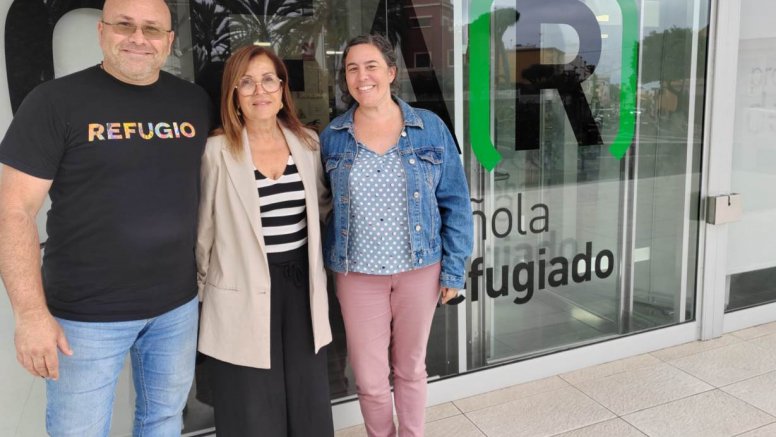
The Deputy of the Common, Lola Padrón, met last Thursday in the capital of Gran Canaria with representatives of the Spanish Commission for Refugee Aid in the Canary Islands (CEAR) to learn firsthand about their work and perspective regarding migrants or those in need of asylum and refuge.
The Deputy of the Common is gathering information and making a round of contacts with organizations that work with migrants in the islands to have a general map of the actions being carried out.
Following the complaint received about the situation of unaccompanied minors on the island of Lanzarote, and admitted for processing, Lola Padrón has opened an ex officio action. The Deputy of the Common has sent letters requesting information to the relevant institutions, such as the Cabildo of Lanzarote and the Minister of Social Welfare, Equality, Youth, Children and Families, Candelaria Delgado, in order to respond to the complaint received. She is also coordinating with the Ombudsman.
Common objectives
Both the Deputy of the Common and Juan Carlos Lorenzo, territorial coordinator of CEAR, exchanged their work objectives, establishing a series of common points, such as the need to establish a joint line in which social resources are improved and integration policies are implemented with people
migrants. For this, they have agreed that it is necessary to plan and execute actions to work with the population arriving in our country. In fact, this is one of the ethical objectives that the NGO raises in order to work from the perspective of globalization with each of the users of the entity.
After almost two hours of meeting, Lorenzo, who was very satisfied to open spaces for collaboration “that result in the defense of Human Rights”, gave several reports to the Deputy of the Common, agreeing on how important it is to take into account the vulnerability of minors, “a figure that is not entirely clear, which is close to 6,000 unaccompanied minors, but what is really important is that we do not lose the perspective that it is not about chronicling the emergency, that we need to go further, develop a common language in the search for a planning that ensures intercultural coexistence, the participation and access of these people to the receiving community, because saying host, I think it is very pretentious and above all preserve the rights”, said the territorial coordinator. During the meeting, they recalled that most of the migrants who enter the country do not do so by sea, and yet they are not given bone tests to determine their age, nor are they as publicized as those who arrive in boats.
Padrón was attentive to all the information received in her round of meetings to have sufficient arguments and know the narrative of the people who work in the third sector “because they are part of the backbone of all the protection of the Human Rights of all people and especially the most vulnerable, something that civil society is already doing, as well as hospitals, schools, employment … etc ”, she indicated. In this case, she concluded that CEAR is an organization “whose arguments may not be so fashionable, but they are very necessary in the face of more scandalous messages that do not contribute anything and that generate more conflicts than social cohesion. That is why it is absolutely necessary to approach those who, like the Deputy of the Common, defend Human Rights and work side by side to resolve critical situations”.
Responses from the Ombudsmen
On the other hand, the Deputy of the Common, Lola Padrón, who on July 28 sent a letter to the Ombudsmen of the entire State requesting that they be in solidarity with the critical situation that is being experienced in the Canary Islands with the migratory phenomenon, assures that she is receiving responses from various communities “but we hope to continue receiving those responses of support and solidarity that the Archipelago needs, because the Canary Islands is a bridge that we cannot let fall, because vulnerable people will always look for another bridge. I hope that society does not pay attention to those movements that, taking advantage of the humanitarian crisis and emergency in the Canary Islands, wave the flags of xenophobia, hatred and racism against a position of common work to resolve the emergency we are experiencing and where the State and Europe must turn with joint actions”, she indicated.
Add La Voz de Lanzarote as a preferred Google source.
Stay informed with the latest current news.