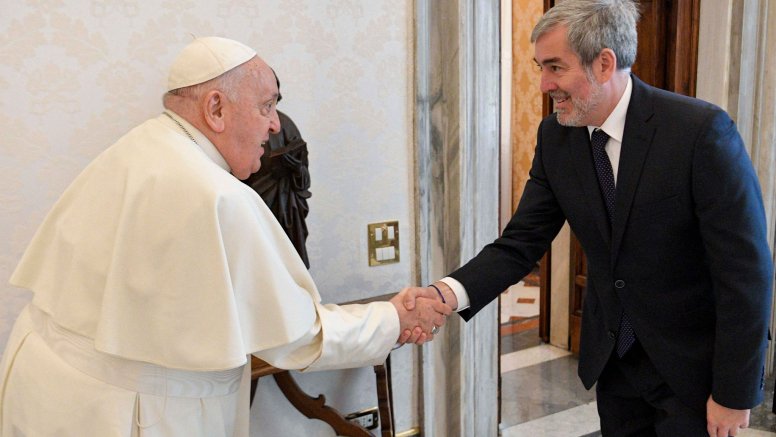
The death of Pope Francis frustrates the pontiff's desire to visit Spain, specifically the Canary Islands, an archipelago to which he had expressed his willingness to travel on multiple occasions, the last one just three months ago, concerned as he was about the situation of migrants.
"I would like to go to the Canary Islands." This is the desire that Francis himself conveyed to the auxiliary bishop of the province of Las Palmas, Cristóbal Déniz, at the end of January during a brief meeting in Rome, in which the Pope congratulated the dioceses of the Canary Islands for their work with migrants.
A visit to the Canary Islands has always hovered over the Pope's agenda, but it was never scheduled. On his last trip through Asia and Oceania, in September, Francis commented to journalists: "I am thinking of going to the Canary Islands because there is the situation with migrants arriving from the sea and I would like to be close to the rulers and the people of the Canary Islands."
Both the Spanish Government and the Episcopal Conference (CEE) have personally conveyed their invitation to the Vatican on numerous occasions for a visit to Spain, but only the Canary Islands were in the pontiff's plans, because immigration has been the constant concern of the Pope throughout his pontificate.
Bergoglio referred to the situation in the archipelago on many occasions. Last September, on the plane returning from his trip to Belgium and Luxembourg, he said that the tragedies of migrants, such as the one that had recently taken place in the Canary Islands, with dozens of dead and missing, are "to cry for."
"I am saddened by those people who disappeared in the Canary Islands, so many migrants... who seek freedom and who are lost at sea or almost on the coast, as happened in Crotone," said Francis, who added sadly: "We think and it is to cry, it is to cry..."
Concerned about abuse, but without "ear-pulling" for Spanish bishops
While Francis's main relationship with Spain has been his concern for migrants, the reality of abuse within the Church has forced the pontiff to take an interest in the steps taken by the Spanish Episcopal Conference to eradicate abuse and repair the victims.
There was no "ear-pulling" - as the then president of the CEE, Cardinal Juan José Omella, assured at the time - but rather a show of interest in the issue of cases of sexual abuse by religious figures in Spain and the protection of victims.
The Vatican has had to take action on the matter and, for example, on March 3, it decreed the expulsion from Opus Dei of the former teacher of the Vizcaya school of Gaztelueta, sentenced to two years in prison for sexual abuse of a student when he was a minor.
The Pope has recalled on several occasions that cases of abuse with minors "do not expire in the Church (...), child abuse is a drama, not only in the Church, everywhere, precisely where you have to take care of people you destroy them."
Cordial relationship with the Spanish Government
Regarding the relationship with the Spanish Government, Bergoglio has received several members of the Executive in the Vatican, from President Pedro Sánchez to Second Vice President Yolanda Díaz, who described the meeting as "very cordial and emotional."
He has met with Sánchez on two occasions, the last in October 2024, when they agreed to continue joining efforts in favor of peace in the Middle East, after one year since the beginning of the conflict between Israel and Hamas.
These meetings with members of the Spanish Government have always been cordial, pointing out the points of agreement: migration, social justice, decent work or care for the environment.
In his years of pontificate, Pope Francis has had words of encouragement for the Spanish people affected by various tragedies, from the floods caused by the DANA in the Valencian Community to those affected by the eruption of the La Palma volcano.
But he has also denounced and shown his concern about the situation of the 1,300 families who live in the town of Cañada Real in Madrid, the largest irregular settlement in Europe, who have been without electricity or heating for more than four years.
Add La Voz de Lanzarote as a preferred Google source.
Stay informed with the latest current news.