More than a hundred experts from the Canary Islands and the autonomous communities of Aragon and the Basque Country have agreed on a document with 51 measures that aim to promote "sustainable" economic development in the Canary Islands. These expert panels have been the subject of controversy and labeled by the groups convening the demonstration on April 20 as "a patch" for not taking into account the opinions of the population to carry them out. The Canarian Executive has announced this measure two days before the new mobilizations scheduled for this Sunday, October 20 in the tourist areas of the islands.
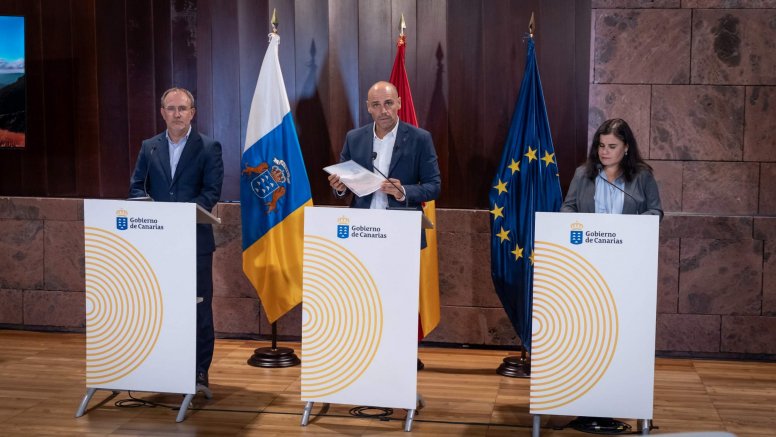
On the morning of this Friday, in a press conference, the Deputy Minister of the Presidency, Alfonso Cabello, the president of the FECAM, Mari Brito, and the current president of the FECAI, Sergio Rodríguez, presented the document of conclusions that “has been the result of dialogue and debate between specialists, officials, business and union associations, ecologists, the third sector, university experts, jurists and public representatives in an unprecedented exercise of consensus in the islands.”
Alfonso Cabello described this document as an opportunity for economic development to be sustainable and have an impact on all Canarians, “taking into account that the islands live two different realities, those that are densely populated and those that are not, and within them the areas with more population and those that we could call emptied.”
In this sense, both Sergio Rodríguez and Mari Brito agreed that the measures that are promoted “must be adjusted to the reality of each of the islands and municipalities, counting on them for their legislation and providing resources to allow both councils and town halls to execute them.”
“The islands have common challenges, objectives to fight for together such as climate change, the energy-water binomial, but we are talking about two different Canaries, which although they go at two speeds, none can be left behind,” Rodríguez emphasized.
From the FECAM, Brito celebrated “that we have been taken into account to participate in these working groups, while we demand that our proposals materialize.”
The president emphasized that it is necessary to respect the principle of co-governance and that the principle of differentiation is taken into account when adapting measures, “because not all municipalities have the same reality.” In this regard, she reiterated the request that “the Canarian municipalities be listened to, as we transmit the closest reality and advocate that every Canarian, wherever they live, has the same opportunities.”
Five tables: demographic challenge, taxation and tourist employment, transparency, access to housing and environmental protection
The tables were organized around five themes: the demographic challenge, taxation and employment in the tourism sector, transparency in the protection and development of the territory, access to housing and environmental protection. Meanwhile, the 51 measures will be submitted to a public participation process “to which civil society is invited to participate with their contributions on the website of the Government of the Canary Islands that will be activated from October 21 to November 15.” The document will be presented at the II Conference of Presidents and the final conclusions included in the opinion of the parliamentary Commission on the demographic challenge.
One of the ideas that all the working groups have addressed is “the need to review the entire current legislative framework so that it agrees with the objectives worked on, in relation to the Land Law or the Tourism Planning Law, for example,” explained Alfonso Cabello, who referred to the "mismatch" that exists between the current reality and the current legislation.
Regarding transparency in the management of the territory, the need to have a Virtual Office to facilitate the management of procedures has been highlighted, contributing to mitigating the lack of resources of local administrations.
Likewise, it is proposed to develop a study and analysis of intensely occupied spaces, regarding the capacity of the territory and resources to establish strategies and locations where to locate solutions for housing, infrastructure and services that achieve greater balance and territorial cohesion.
In terms of housing, the proposed solutions involve "the efficient management of urban planning licenses" counting on the town halls and councils to promote a real transformation in the deadlines, and having a catalog of land available for the construction of protected housing, both on public and private land.
It should be noted that the conclusions coincide with what was approved in Decree-Law 1/2024, of February 19, on urgent measures regarding housing “which already allows that land destined for other uses, such as endowment, equipment or undeveloped plots for tourist use to residential, can be reoriented to the construction of protected housing, provided that local needs allow it,” added the Deputy Minister.
The measures to facilitate access to housing are focused on designing fiscal measures that benefit both the landlord and the tenant to encourage rent, also bonuses in the sale of housing and promote the use of the Investment Reserve (RIC) for the construction of protected housing and destined for affordable rent, “which has not worked correctly because the revision of the module prices was missing,” he argued.
It is true that “the incorporation of empty homes into the rental market is essential with measures that guarantee the collection of rent, that it is adjusted by areas and with the provision of insurance for its maintenance, providing greater protection to the owners, and in this sense the use of the existing building stock for residential purposes is already being carried out, with the VISOCAN call to buy empty homes and rehabilitate,” he detailed.
Tourism sector
Alfonso Cabello stressed the need to review the tourism legislative framework “to respond to the new reality we are experiencing, and hence the law on tourist use of housing and the proposal to revise the Tourism Planning Law.”
The tourist resources of the islands must consider the local population as one of their reference points and involve them in their benefits, for which it could be established to charge for access to natural and national parks, “similar to the system that Lanzarote has,” Cabello pointed out.
Training is fundamental, key to avoid unemployment and depopulation and each administration advance, by virtue of its powers, “in improving remuneration and promoting work-life balance, the provision of nursery and transport services, with schedules adapted to the tourism sector,” he listed.
To fix the population in rural areas, which must be protected “fiscal and/or tax mechanisms must be established that also promote companies, employment and the generation of wealth with the accompaniment of the training of workers and entrepreneurs.” added the Deputy Minister of the Presidency, insisting that “public administrations in the Canary Islands must favor the visibility of the rural environment in all their policies and facilitate the generation of income with differentiated taxation.”
Environment
As one of the main measures in the working group on environmental protection, progress has been made in a draft of the Decree of Local Participation in the Development of Renewable Energy Projects that has taken into account the contributions presented by the seven Island Councils and the FECAM.
In addition to improving the management of accesses in protected natural spaces and their surveillance and the renaturalization of urban and peri-urban environments and the elaboration of Action Plans for Climate and Sustainable Energy.
Demographic Challenge
Alfonso Cabello announced the creation of an Observatory of the Demographic Challenge, as a tool to develop awareness policies, transparency and access to information, which facilitates the management and planning of public resources and guides the approval of public policies, “so that what has happened does not happen again; we cannot legislate with our backs to the evolution of the population,” he stated.
Finally, mobility and public transport plans adapted to the real conditions of demand are promoted, especially in rural areas, to guarantee connectivity and accessibility between nuclei; recover the sustainable rural development plan, specific to municipalities with less than 10,000 inhabitants; promote technological innovation projects, such as the aerospace industry, to islands such as Fuerteventura or La Gomera; and promote digital training.
Add La Voz de Lanzarote as a preferred Google source.
Stay informed with the latest current news.