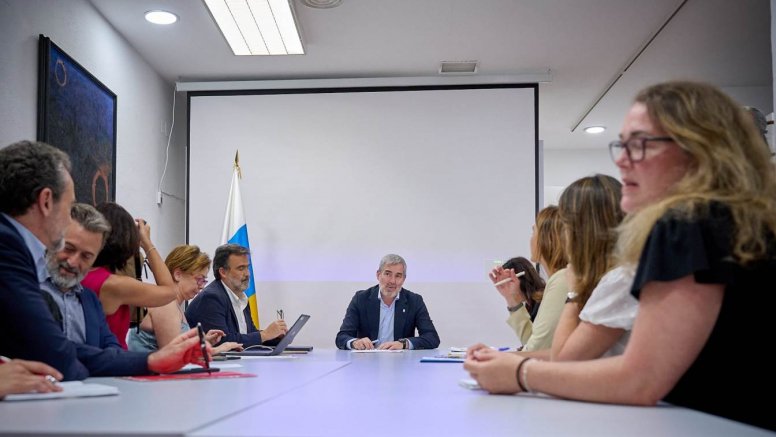
The president of the Canary Islands, Fernando Clavijo, held a meeting with the main Spanish social entities that manage the care of minors this Wednesday, in which they closed ranks in defense of co-responsibility on the part of all the autonomous communities with unaccompanied minors arriving to the archipelago.
The meeting, held at the headquarters of the delegation of the Government of the Canary Islands in Madrid, was attended by a broad representation of the main entities of the third sector, with the presence of Unicef, Save the Children, Acnur, Cruz Blanca, Cruz Roja, the Cepaim Foundation, Accem and CEAR.
Fernando Clavijo, who finished this Wednesday the round of contacts with the political forces represented in the Congress of Deputies, stressed that "the Canary Islands is experiencing an unsustainable situation and cannot continue to face the current migratory crisis alone." In this context, he valued the work of the NGOs that "carry out an invaluable work with a commitment and professionalism that is the best guarantee for those boys and girls who flee from hunger, misery and the horror they have had to live until they reach our coasts can find a friendly space, an environment in which to develop."
The objective of the meeting, explained President Clavijo, "is none other than to transmit with absolute transparency what we are doing to address the emergency situation we have in the Canary Islands," as well as the forecasts for the coming months, which he stressed "could worsen the situation due to the collapse of the reception network for unaccompanied children and young people in the islands."
Similarly, the president of the Canary Islands and the entities addressed the reform of article 35 of the Immigration Law promoted by the Canary Islands Government together with the State and which also requires "a broad social agreement and the consensus of the political forces, the co-responsibility of all the autonomous communities to guarantee the redistribution of minors." He also expressed his openness to the suggestions of the entities, which will send their suggestions to the Canary Islands Executive with the aim of "providing greater protection and guaranteeing an immediate response to the different circumstances with which unaccompanied minors arrive."
For his part, the general director of Save the Children, Andrés Conde, valued the meeting of the Government of the Canary Islands and entities that "work with migrant and refugee children" to analyze not only the situation of the islands, which he described as "anomalous due to the overcrowding of the protection system" for minors, but also the legislative reform. Conde insisted on the "co-responsibility" of the autonomous communities because "the Canary Islands cannot be, as the southern border, the only one responsible for the protection and care of these minors" and showed his collaboration and that of the entities "so that this reform, for which we have been fighting for years, goes ahead," he concluded.
During the meeting, emphasis was placed on the need to intervene quickly to face the current migratory crisis, especially considering that, so far this year, the Islands have already received more than 19,000 people from the African continent, with an increase of over 220% compared to last year. These data also show an increasing upward trend in the figures in general and in terms of the arrival of minors.
Another of the points addressed in the meeting between the Government of the Canary Islands and the third sector entities focused on the improvement of the current asylum application system, an aspect that also affects minors.
To this end, the autonomous Executive is carrying out a study to determine how many minors, of the more than 5,500 that the Government of the Canary Islands has under its tutelage in its 80 emergency devices, can benefit from this right in order to provide adequate advice so that they can apply for it.
In addition to the head of Save the Children in Spain, Andrés Conde, the meeting was attended by the general director of CEAR, Mauricio Valiente, the head of International Protection of Acnur, Carolina Mateos, the reference for asylum-seeking children of Acnur, Margarita de la Rasilla, the director of the Las Raíces device and adjunct of the autonomous coordination, Laia García, the executive director of UNICEF, José María Vera, the director of Social and Political Advocacy of Save the Children, Catalina Perazzo, as well as Carmen Ynzega of Cruz Blanca, Attabe Mane of the Cepaim Foundation and Íñigo Vila and Daniel Fernández of Cruz Roja.
Add La Voz de Lanzarote as a preferred Google source.
Stay informed with the latest current news.