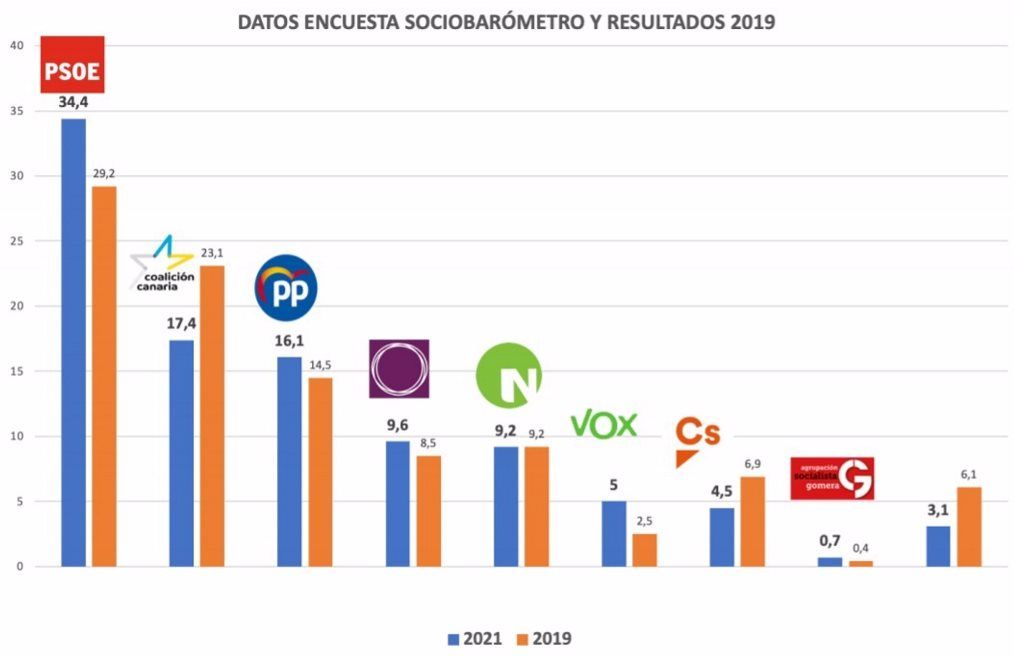
PSOE, PP, Podemos, Vox and ASG have increased their voting estimate compared to the 2019 Canary Islands regional elections, while CC and Cs fall and NC remains at the same levels, according to the Canary Islands Socio-barometer published this Saturday.
As for the parties that make up the regional government --PSOE, Podemos, NC and ASG--, the PSOE has a voting estimate of 34.4%, compared to 29.2% in the last elections; Podemos 9.6% (8.5% in 2019); NC would remain with 9.2%; and ASG would go from 0.4% in the last elections to 0.7%. Together, they would have 53.9% of the votes.
Meanwhile, among the parties that are currently in the opposition, CC would go from 23.1% of the votes in 2019 to 17.4%; the PP would increase from 14.5% two years ago to 16.1%, approaching the nationalists; and Cs would fall from 6.9% to 4.5%.
Finally, Vox, which does not have parliamentary representation in the Canary Islands, would go according to the Socio-barometer from 2.5% of the votes it obtained in the last elections to 5%; and the rest of the parties would fall from 6.1% to 3.1%.
The Socio-barometer of the Autonomous Community of the Canary Islands (SBC) is an initiative of the Vice-Presidency of the Government of the Canary Islands that is embodied in a cooperation agreement with FESAD, the entity that owns the Associated Center to the UNED in Las Palmas de Gran Canaria, under the technical direction of the sociologist and professor tutor Juan del Río.
Its implementation is intended to scientifically and periodically know "the cultural, scientific-technical, social, political, labor, economic, territorial and communicational reality of the Canary Islands, as well as to promote the use of existing information resources and disseminate scientific and technical thinking, for the benefit of the progress, development and welfare of the Canarian community.
In this first study, of a pilot nature, the sample includes 1,500 effective interviews, distributed in the eight islands, proportionally to their population. The fieldwork was carried out between February 1 and 19, 2021, through computer-assisted telephone interviews.
Add La Voz de Lanzarote as a preferred Google source.
Stay informed with the latest current news.