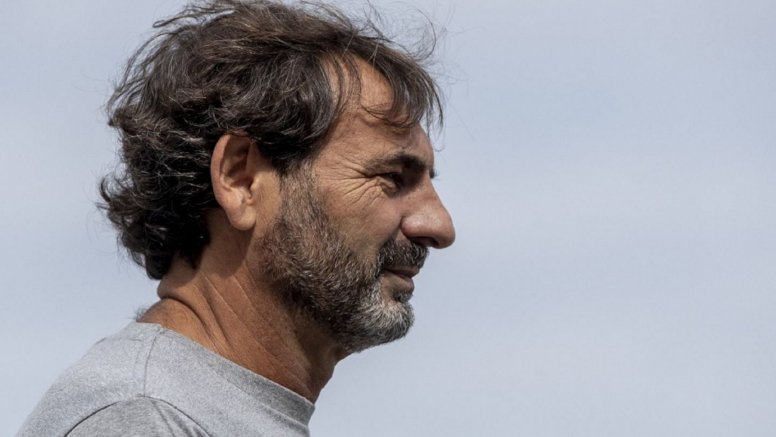
Ten years after the photo of Aylan Kurdi "took him off the sofa" to take his profession as a lifeguard "to the ultimate consequences", the director and founder of Open Arms, Óscar Camps (Barcelona, 1963), is blunt about the possibility of another humanitarian mission in Gaza: not until there is a ceasefire.
"We are committed to development and reconstruction in Palestine as soon as there is a ceasefire. But if there isn't, I can't put my team's lives at risk, no," says the activist.
Camps says this almost a year and a half since Israel bombed and killed seven aid workers from a World Central Kitchen convoy, the NGO of Spanish chef José Andrés, on a mission in which Open Arms was also involved and in which, as he recalls, they had to exchange life jackets for bulletproof vests but with which they managed to unload 200 tons of food, despite the attacks.
Awareness campaign in the Canary Islands
In an interview with Efe during his visit to Tenerife, where they will carry out an awareness campaign on the drama of the Atlantic route for two months, Óscar Camps insists that, in his case, they are not considering deploying more missions because "even complying with all the conditions imposed in that mission, we were bombed". And because that took a "physical and emotional" toll on them and he cannot conceive of living that continuously.
"Having authorization, having permits, doing everything right, complying with every last detail of all the conditions imposed on us by the government of Israel, we were still bombed. So, how are we going to go there?" asks Camps, who stresses that you cannot trust the word of the Netanyahu government, which he accuses of malice and genocide.
"Europe is losing humanity very quickly"
"I am very sorry for what they are doing in Gaza and what the poor Gazans are suffering. And what I regret most is seeing how Europe is losing humanity at this speed. We are normalizing genocides, one at sea and one in Gaza," declares the Catalan activist.
For Camps, the migratory policy in Europe of the last ten years consists of building walls, closing borders and letting thousands of people take to the sea. "We have financed third countries to do our dirty work for us, but nothing more. It's a bit disappointing," reflects Camps, who regrets that Spain was "one of the first countries to start with this."
Thus, he laments that European leaders believe that "paying third countries of dubious democratic solvency to violate human rights outside European territory is the solution," says Camps, who mentions cases such as Libya or Tunisia, where he criticizes that the European Union has legitimized a government that violates human rights.
For the founder of Open Arms, nations such as Spain, Greece and Italy "cannot be walls", but rather host countries, with projects designed and prepared to receive. "But we continue to treat migration as if it were crime," he summarizes.
72,000 rescues
Behind each of the 72,000 people that his NGO has rescued in these 10 years, a number that he still finds hard to believe, Camps recalls that there is "insecurity, violence, forgotten conflicts and devastated territories."
And all this, he asserts, "while we continue to exploit their resources and destabilize their countries" to which he attributes the migratory pressure, which he believes will be increased by the annual increase in the number of climate migrants.
"I never thought we would be like this ten years later. I thought Kurdi's case would be a 'never again' for Europe, but since then 3,500 children have died in the Mediterranean. One every day while we have breakfast," he says.
Camps also refers to the change in discourse and in society's awareness: "We went from 'we want to welcome' to being criminalized. Our ship has been blocked in five countries of the European Union and we have gone from receiving awards and recognitions to now being blocked, persecuted or silenced."
"Who says that in 15 years we will not have to migrate because this area - the Canary Islands or southern Europe - is desertified? Nobody thought what was going to happen with Ukraine either and we welcomed five million Ukrainians without ruffling our feathers while we are unable to welcome the 5,000 children who arrived in the Canary Islands," he adds.
From fins and neoprene to lawyers
When asked about the legal battles that Open Arms has fought, such as the one they are waging against the Italian vice president Matteo Salvini for the "kidnapping" of one of their ships in Lampedusa in 2019, Óscar Camps ironically sees how they have gone from having to buy fins and neoprene at the beginning of the NGO's activity in Lesbos to having to assume that one of the main expenses of the organization is lawyers.
"First we needed boats, ship captains and crews. Then we had to put doctors and now we have to put lawyers. We not only fight against the waves of the sea, but against a system that treats all these people as disposable merchandise," concludes Camps, who admits that this issue is an "economic drain."
Add La Voz de Lanzarote as a preferred Google source.
Stay informed with the latest current news.