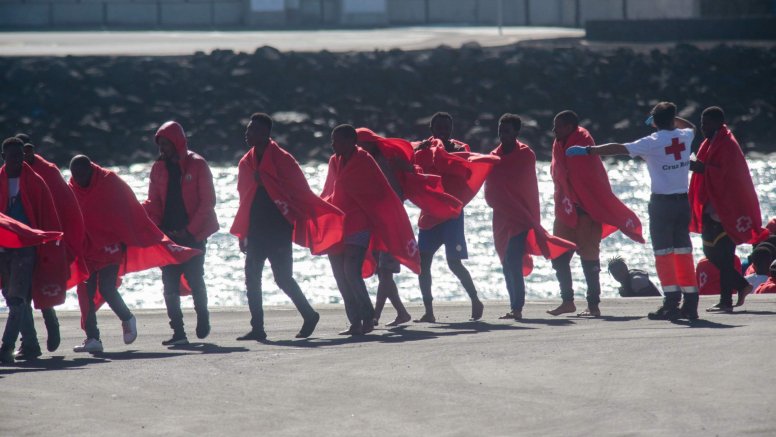
A total of 9,757 people died on the Atlantic Route trying to reach the Canary Islands in pateras or cayucos during 2024, which represents an average of 28 deaths per day in what has become the deadliest year to date, breaking the record of 2023, when 6,007 migrants perished.
These are the data from the annual balance carried out by the NGO Caminando Fronteras with its report "Monitoring the Right to Life" and which represents an increase of 62.4% compared to the figures of last year and one death in the Atlantic every 51 minutes, according to figures up to December 15.
Of the total number of deaths throughout Spain, nine out of ten lost their lives on the route to the Canary Islands, while 517 died on the Algerian route to the Balearic Islands, 110 on the Strait route and 73 on the Alborán Sea route.
By geographical areas, the cayucos with the highest mortality rate were those that left from the Mauritanian coast area, from where 6,829 of the deceased migrants departed for the Canary Islands. 2,197 died after leaving from Senegal-Gambia and 801 after embarking from the coastal area between Agadir (Morocco) and Dakhla (Western Sahara).
1,538 dead girls and boys
A total of 1,538 girls and boys have died trying to reach the Spanish coasts in precarious boats, while in the case of women that figure rises to 421.
By months, the deadliest have been April and May, a period in which almost 23% of the total victims were concentrated.
These deaths occur in a year in which a total of 57,738 migrants have arrived in Spain by cayuco or patera, of which 43,737 of them did so to the Canary Islands, a figure that represents a new historical record in the number of people who have accessed the Spanish coasts irregularly, surpassing the 57,498 entries of this type registered in 2018.
Caminando Fronteras, which regularly publishes the figures of deaths in the crossings that head towards Spain obtained through the alerts they receive from the sea and with information from family members and migrant communities, has counted 131 boats that disappeared with all the people on board throughout last year.
By nationalities, deaths are registered from a total of 28 countries: Algeria, Bangladesh, Burundi, Burkina Faso, Cameroon, Ivory Coast, Egypt, Ethiopia, Gabon, Gambia, Ghana, Guinea Bissau, Guinea Conacry, Iraq, Comoros Islands, Mali, Morocco, Mauritania, Nigeria, Pakistan, Democratic Republic of the Congo, Somalia, Senegal, Sierra Leone, Syria, Sudan, Tunisia and Yemen.
The report this Thursday places the Canary route or the Atlantic route again as the deadliest migratory region in the world and continues the trend that began last year, with more distant routes that force boats to enter the ocean to the island of El Hierro, due to an increase in controls along the coasts of Senegal and Mauritania. The same with the Algerian route to the Balearic Islands, of greater length and danger.
Inaction and childhood route
Likewise, Caminando Fronteras points out that in the 217 cases of tragedies that it has had enough data to analyze, in 69% of the times there was "direct inaction" by search and rescue services.
Among the issues highlighted in the report is that the Atlantic Route has become the childhood route and that, for example, there has been a significant increase during 2024 in the presence of children from Mali, where the expansion of the armed conflict has generated a constant fear of forced recruitment, kidnapping for forced labor and widespread violence.
"This has led many families to prioritize the departure of their children as a protection strategy," the report states.
Currently the Government of the Canary Islands is the guardian of about 5,500 unaccompanied foreign minors.
It also refers to climate change as a causal factor and for its definitive role in an area such as northern and eastern Mali, in which desertification has worsened, causing internal displacement and conflicts over the use of natural resources.
The document also highlights the departure on the Atlantic migratory routes of girls and adolescents from Guinea, Ivory Coast and Senegal, who are trying to escape from forced marriages, genital mutilation and structural violence against women.
"Failure of rescue and protection systems
“These figures show a profound failure of rescue and protection systems. More than 10,400 people dead or missing in a single year is an inadmissible tragedy. We urge that the protection of the right to life be prioritized, search and rescue operations be reinforced, and justice be guaranteed for the victims and their families," said Helena Maleno, coordinator of the investigation.
She also stressed that they are aware that the figures of people dead and missing in the intervention area could be higher.
"What we do know for sure is that they are no less than the data we provide in this investigation," concluded Maleno.
Add La Voz de Lanzarote as a preferred Google source.
Stay informed with the latest current news.