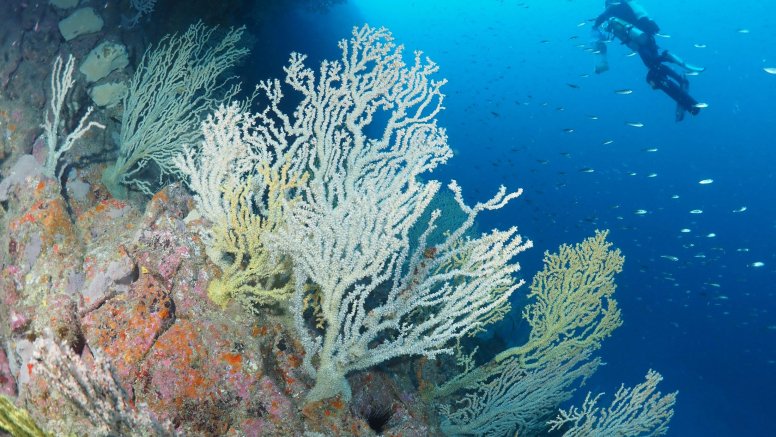
The 21.7% of the sea surrounding Canarias has some legally binding protection figure, but only one in ten marine protected areas (11%) has active management instruments, reveals a study in which the University of Las Palmas de Gran Canaria participates.
This report, carried out by the MPAs Canary Islands project following the methodology of the International Union for Conservation of Nature (IUCN), proposes a roadmap to follow for the islands to comply by 2030 with the European Union's requirement to have at least 30% of their marine spaces protected.
In a statement, its authors highlight that, at this moment, 21.7% of the Marine Demarcation of Canarias is under some legally binding protection figure.
These zones are included in the Natura 2000 Network, a European Union instrument for the conservation of habitats and species that the scientists of the MPA Canary Islands project consider to constitute "the fundamental pillar of marine protection in the islands".
The Natura 2000 Network is complemented in Canarias with other protection figures, such as the Marine Reserves of Fishing Interest located in La Palma, El Hierro and La Graciosa and Northern Islets of Lanzarote.
However, the researchers add, it is estimated that only 11% of the marine protected areas in the islands have an active management system and that only 1% has strict protection.
"Expanding the surface area of marine protected areas is not enough on its own. Its true value depends on effective management, continuous monitoring, and periodic evaluation of measures, to ensure that they generate real conservation results and can be improved over time,” highlights Eva Meyers, study leader and researcher at the Leibniz Institute for the Analysis of Biodiversity Change.
Currently, there are various proposals for new marine protected areas that, if materialized, would significantly expand coverage in the Marine Demarcation of Canarias, points out the MPA Canary Islands project.
Among them, the proposal for the Marine National Park of the Sea of Las Calmas, in El Hierro, and the new Guguy National Park that is promoted in Gran Canaria stands out.
Habitats and species in the waters of Canarias, this study points out, face increasing pressures derived from coastal urbanization, pollution, overfishing, the introduction of exotic species, and intensive tourism.
The Canarian archipelago is one of the main marine biodiversity hotspots of the northeastern Atlantic, the authors recall.
Its volcanic origin, the influence of the Canary Current and the Saharan upwelling generate extraordinary biodiversity around the islands, where at least 30 species of cetaceans live and five of the eight global species of sea turtles have been detected.
In addition, Canarias hosts the main global refuge of the angelshark, a shark classified as critically endangered. And, on the other hand, 76 exotic marine species have been registered, the highest figure in the region.
The study on the State of Marine Protected Areas of Canarias has been prepared by Eva Meyers (Leibniz Institute for the Analysis of Biodiversity Change and Angel Shark Project), Héctor Toledo and Carolina Bousquet (Angel Shark Project).
Ricardo Haroun, Yaiza Fernández and Ayoze Castro (University of Las Palmas de Gran Canaria); and Octavio Llinás (MPAs Canary Islands) have participated as reviewers.
Add La Voz de Lanzarote as a preferred Google source.
Stay informed with the latest current news.