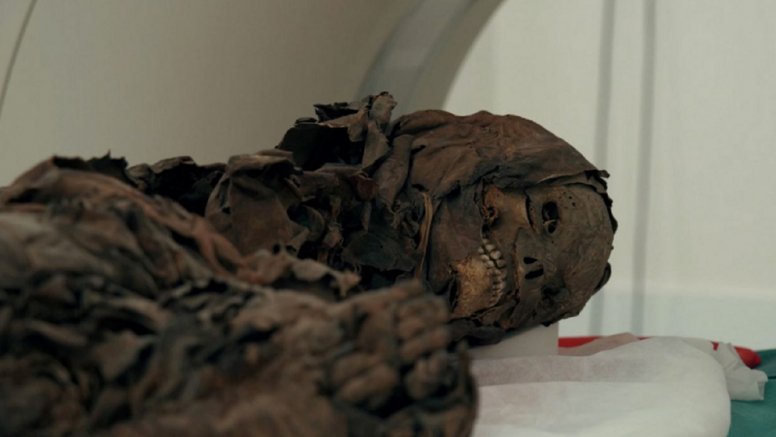
When one enters the Verneau room of the Museo Canario, it is difficult not to feel overwhelmed: it seems that hundreds of empty eyes are looking at you from the past and that the creaking of the nineteenth-century wooden floor is going to disturb those who rest there. You are surrounded by skulls and mummies of people from a culture that disappeared only 500 years ago, without leaving a single written piece.
Is it ethical to exhibit human remains in a museum, even if it is of Prehistory or Archeology? Or of Anthropology, even? How do these remains differ from the relics of a saint exhibited in a cathedral? Is it more respectful for the culture represented by these human remains to remove them from the sight of the common citizen?
These are questions raised by the instruction given by the Ministry of Culture to the 16 national museums to remove from their exhibitions, in general, mummies, skulls and human remains of all kinds, to safeguard the dignity of these people. It does not bind the rest of the country's cultural centers if they are not state-owned, but it has a direct impact, for example, on the National Archaeological Museum, the Anthropological Museum or Altamira.
As the decision has had a first practical consequence of profound importance in the Canary Islands, removing the best preserved Guanche mummy in the world, the one from the Tenerife ravine of Erques, to a warehouse of the National Archaeological Museum, Agencia EFE has asked the two great custodians of the pre-Hispanic archaeological legacy of the islands about it: the Museo Canario of Las Palmas de Gran Canaria and the Museum of Nature and Archeology of Santa Cruz de Tenerife.
Another factor looms over the issue: the claim of the Cabildo de Tenerife that the mummy should return to the island, discovered in 1763 in the ravine that gives it its name along with hundreds of other Guanche 'xaxos', in a cave whose exact location today remains a mystery, the 'Cave of the Thousand Mummies'. It is an old pending issue, but the Government of the Canary Islands and the Cabildo de Tenerife have reactivated it with renewed force in view of the fate that awaits it in Madrid.
Because, for the president of Tenerife, Rosa Dávila, it is "inadmissible", "an offense to all Canarians", that a symbol of the aboriginal Canarian culture of that value is relegated to a warehouse.
The director of MUNA, the center of the Cabildo de Tenerife whose collection would be headed by the mummy of Erques if it were returned to the Canary Islands, does not use those terms, but he is clear: "These remains cannot be hidden, whether the Ministry likes it or not," says Conrado Rodríguez. Even more forceful is the president of the Museo Canario, Diego López, a private institution with 147 years of history, heir to the pioneers of Canarian archeology.
"It's as if they told us: I'm not giving it back to you because I'm going to keep it. I don't want to be provocative, but it seems offensive, even insulting. I think that all the possible arguments that the State could have had until now to keep the mummy are lost with that decision," says the president of the Museo Canario.
López clarifies that his museum has nothing to do with the battle of whether the mummy of Erques should return to Tenerife or not, but he feels concerned as a Canarian and as someone passionate about the aboriginal legacy.
As a private museum, it is also not affected by the instruction given by the Ministry of Culture not to exhibit human remains. At least not for now, since it is not a regulation, only an internal recommendation.
The president of the Museo Canario attends to EFE in the Verneau room, a museum within the Museum, which shows what its collections were originally like in the 19th century and, incidentally, highlights some of its most valuable pieces. Among them, 900 skulls and half a dozen mummies.
Diego López contemplates them with pause and puts an end to any doubt: "The Museo Canario is going to keep its rooms as they are, especially this Anthropology room."
Both he and the director of the MUNA of Tenerife emphasize that there is no disrespect to the people to whom these remains belong, quite the opposite. Conrado Rodríguez even speaks of coherence: "If you want to learn about that culture, how are you going to hide the people who made it possible, the instruments they used, the vessels, the necklace beads? How do you explain their adaptation to the environment, to disease, their nutrition... without exposing them?"
In his opinion, these remains give identity to the Canarian museums. "And whether we like it or not, the mummy is the main element," explains the director of the MUNA, where between 300 and 400 Guanche remains are exhibited, including mummies, skulls and bones, and only in the warehouse are there skeletal elements of almost 2,000 aborigines.
Diego López emphasizes the same thing: without the human remains that the Museo Canario treasures from pre-Hispanic sites on all the islands, much of the knowledge of what life was like in those societies would not exist. The ancient Canarians did not leave written documents, he remarks, the first thing written about them comes from indirect testimonies. It is the vision of the European conquerors.
However, much of what is known about their diet, their trades and ways of life or, even, the violence that existed in their communities (peoples enclosed in islands with scarce resources), has been discovered through the mummies and skulls of the museums.
"We expose them with the utmost respect, the best hygienic conditions and the most complete presentation, with all the means that exist today. It does not seem very understandable to me that certain remains of people are not exhibited to the public, but that they are stored and remain accessible to technicians, researchers, visitors of a certain social entity or the people that the heads of the organizations decide at any given time," López concludes.
Add La Voz de Lanzarote as a preferred Google source.
Stay informed with the latest current news.