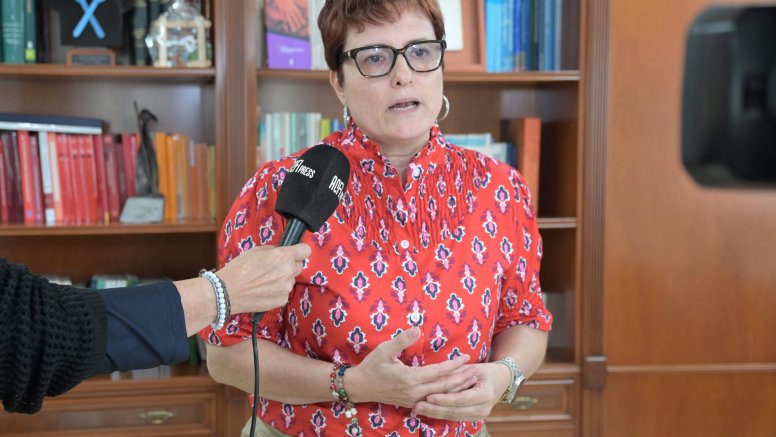
Intersindical Canaria has denounced "the situation of neglect and discrimination" suffered by school-aged minors in centers dependent on the Canary Islands Government's Ministry of Social Welfare.
As expressed in a statement by the Intersindical Canaria Personnel delegate in Social Welfare, Nazaret del Pino Alonso, the law is "clear" in "defining the first cycle of Early Childhood Education as a single educational stage," but in the Canary Islands "there are today first-class children in centers of the Ministry of Education, and second-class children in those dependent on Social Welfare."
While Education "boasts about the expansion of the 0-3 years cycle, the centers dependent on the Ministry of Social Welfare, Equality, Childhoods and Families of this Autonomous Community of the Canary Islands suffer from classroom closures due to lack of staff and management based on an obsolete regulation from 1994".
The administration "fails to comply with its own Decree 446/2023, which mandates managing these centers under educational criteria and not as mere custodial or care facilities," it recalled
Intersindical Canaria has warned of what it considers a situation "at a critical point," as in recent months, "several nursery schools in the Social Welfare network have been forced to close entire classrooms for days due to the lack of coverage of the Job Classification Plans (RPT)".
Unlike the education department centers, where substitutions and support "have more agile mechanisms," he criticized that "in Social Welfare, bureaucracy and lack of foresight leave families without service and children without their right to education on a recurring basis."Alonso believes it is "unacceptable" that the Ministry of Social Welfare continues to use Article 16 of an Order from September 1994 to **organize the schedules and operation** of these centers," a regulation issued more than 30 years ago that responds to "a welfare and child protection model that has been "legally superseded."
Decree 446/2023 establishes in its First Additional Provision that these centers must be managed according to the current educational curriculum (Decree 196/2022) but "the reality is a pedagogical contradiction" since educators are required to meet modern educational objectives while being imposed nursery school schedules and denied the support staff and preparation time that their colleagues in Education do have".
The same applies to cleaning staff, they have denounced, who have to do "the work of up to two colleagues on sick leave for months or kitchen staff replacing the center's cook with catering while having an updated reserve list".In addition to the violation of labor rights, Intersindical Canaria has warned of the **violation of children's rights** because "a child in a Social Welfare school does not receive the same amount of individualized attention nor has the same staff stability as a child in an Education school".In this regard, the union demands the "immediate intervention" of the Canary Islands Government to "unify the management conditions of all public nursery schools," regardless of the ministry to which they are attached; urgently update the RPTs to avoid the closure of classrooms due to a lack of support staff; and de facto repeal the application of the 1994 Order, adapting schedules and calendars to "the educational reality of the 21st century."
Add La Voz de Lanzarote as a preferred Google source.
Stay informed with the latest current news.