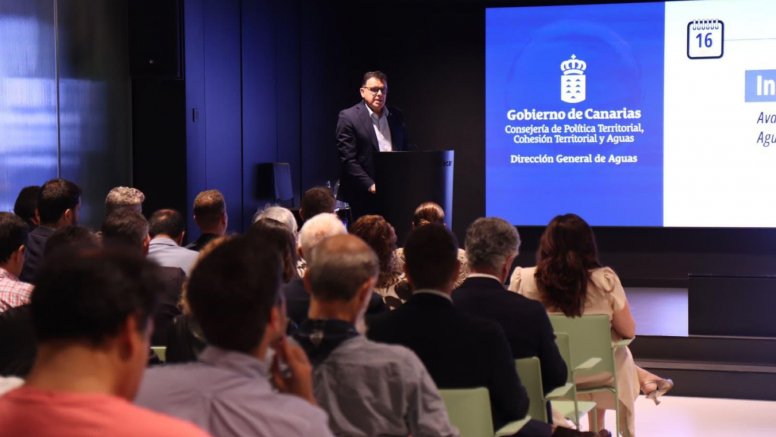
The Government of the Canary Islands reaffirmed this Thursday its commitment to innovation and inter-administrative cooperation as fundamental pillars to guarantee the sustainability of water in the archipelago. This was stated by the Minister of Territorial Policy, Territorial Cohesion and Water, Manuel Miranda, during the inauguration of the first edition of the INNOAGUA Canarias conference, organized by the General Directorate of Water in collaboration with the Canary Islands Technological Institute (ITC).
The meeting, which also included the CEO of the ITC, Guayarmina Peña, brought together specialists, administrations, organizations, and companies from the sector to share progress, projects, and innovative solutions in water management. Peña pointed out that "the collaboration between the ITC and the General Directorate of Water constitutes an example of inter-institutional cooperation aimed at strengthening the water resilience of the archipelago through technological solutions that promote a more digitized, efficient, and sustainable model."
During his speech, Manuel Miranda expressed his gratitude for the joint work of all the people and institutions that make it possible for the Canary Islands to continue advancing in water management, and he emphasized that "the progress achieved in these two years is the result of the shared effort of administrations, technicians, researchers, companies, and operators who, day after day, contribute to guaranteeing an essential resource for life and the sustainable development of our islands."
The councilor recalled that "just two years ago, the Canary Islands were in a worrying situation, with two islands—Lanzarote and Fuerteventura—in a water emergency, outdated hydrological plans, and an open file by the European Union with the risk of sanctions." "Today, thanks to the coordinated effort between administrations and technical teams, we have reversed that situation, updating the seven island hydrological plans and recovering the capacity for planning," he added.
Miranda expressly wanted to acknowledge "the involvement and commitment of the team at the General Directorate of Water, whose rigorous and constant work has been key to advancing the modernization of the water system and in coordination with island councils and local entities." He added that "the General Directorate of Water, the island councils, the ITC, the universities, and the entire Canary Islands water sector are demonstrating that cooperation and innovation are the way to ensure the future of water in the Canary Islands."
Throughout the day, some of the most relevant water innovation projects currently being developed in the Canary Islands were presented, focusing on the intelligent detection of leaks in distribution networks, the integration of renewable energies in desalination and purification processes, risk management in the agricultural use of reclaimed water, the measurement of energy efficiency and carbon footprint in hydraulic infrastructures, the study of emerging pollutants, and the development of digital tools for the management of critical equipment in emergency situations.
Miranda reiterated the importance of maintaining cooperation between administrations and the financial backing of the State, recalling that current planning estimates an investment of over 5 billion euros to guarantee the integral water cycle in the islands, of which 1.4 billion correspond to 127 works of general interest prioritized by the island councils.
He also insisted on the need to recover the hydraulic works agreement and to make effective the transfer of the 20 million euros committed in 2024, still pending, to address urgent needs of the Canary Islands' water system.
The INNOAGUA Canarias conferences aspire to consolidate themselves as a permanent meeting space to promote innovation, institutional cooperation, and efficient water management, in line with the objectives of the Canarian Agenda for Sustainable Development 2030 and the European guidelines for adaptation to climate change.
Add La Voz de Lanzarote as a preferred Google source.
Stay informed with the latest current news.