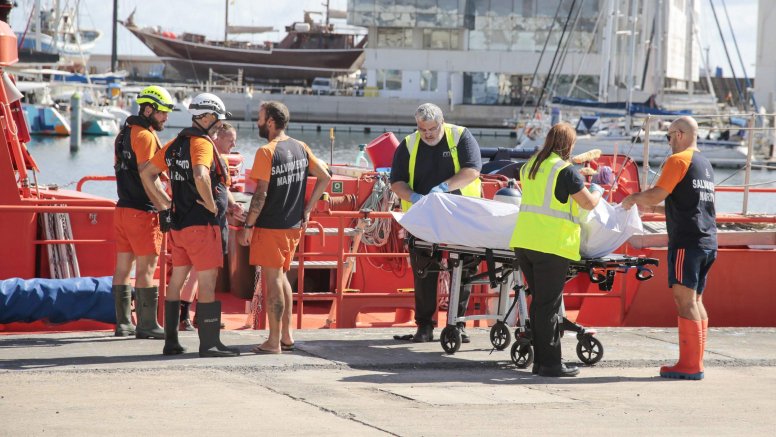
Alkhasoum Sow, from Senegal, has lost four family members at sea when they were trying to reach Spain in search of a better future and demands a solution to stop this drama that in 2024 has left 10,457 people dead, an average of almost 30 a day.
Sow told his story during the presentation held this Thursday in Madrid of the report Right to Life 2024, prepared by the collective Caminando Fronteras, which investigates the disappearances of migrants at sea on their way to Spain and which announced its balance for 2024 last December.
This representative of the searching families who mobilize to search for their loved ones disappeared on migratory routes has told of the losses of four members of his family, all young men who have left 9 orphaned children in total and their families broken with pain.
"I went to Senegal to visit other families and they were very sad, crying, children, women... we couldn't do anything. I get there and there are no words," he said.
In addition to the children who are left without parents, Sow has underlined the impact that these losses have on families, who have placed in the journey of their loved one the "hope" that he would find a job to help them, only to find out later that he "stays in the sea."
One of his relatives is his nephew: after learning that he had left his country, he learned of the shipwreck that occurred last September in El Hierro, which left fifty missing and nine corpses.
"I couldn't work, I couldn't do anything, I felt very bad," said Sow, who took several days to reach El Hierro from Figueras (Girona), where he resides.
When he arrived, they had already buried the rescued bodies, so they have done the DNA test and hope to recover his body. But of other of his relatives, on the other hand, he doesn't even know anything after two or three months since they left their country.
According to the Caminando Fronteras report, of the 10,457 people who lost their lives trying to reach Spain, 421 were women and 1,538 were children or adolescents, and the Atlantic route to the Canary Islands remains "the deadliest worldwide", with 9,757 victims, that is, 93% of the total.
In the presentation, which was introduced by the director of the Instituto Cervantes, Luis García Montero, and moderated by the actor Carlos Olalla, the researcher of the Caminando Fronteras collective Helena Maleno has reviewed some of the causes of these deaths and has underlined that in 69% of the tragedies analyzed there was a direct inaction of the search and rescue services.
Either because they were not activated, because there were delays or because of lack of coordination between countries, despite, in many cases, having the position of the shipwrecks.
For his part, the member of the QSD Global Foundation Paco Lobatón has explained some of the effects that the disappearances of people in general cause in the relatives of the victims, which include serious somatic alterations such as pain, sleep disorders, depression, panic, suicidal ideation, anxiety or rumination.
Also "anger and social distancing" comparable, he commented, to those suffered by the victims of other events such as wars, violence or sexual abuse.
"If these are the devastating effects in disappearances without apparent cause, it is not difficult to imagine what they can be when the cause of the disappearance is known and is in itself a traumatic event to the highest degree, as occurs with migrants victims of shipwrecks, hypothermia and drowning," he said.
Add La Voz de Lanzarote as a preferred Google source.
Stay informed with the latest current news.