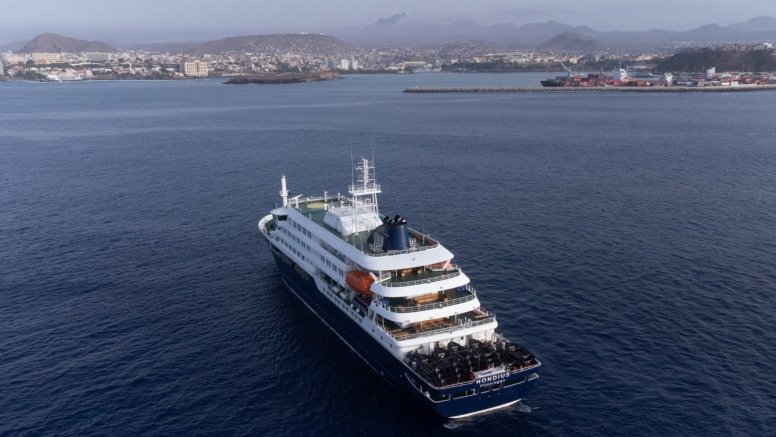
The Director-General of the World Health Organization, Tedros Adhanom, updated at noon this Thursday on the situation aboard the tourist cruise ship MV Hondius, operated by Oceanwide Expeditions and flying the flag of the Netherlands, affected by an outbreak of Andes hantavirus. Thus, he reported that five cases of passengers infected by this disease, the only variant that is transmitted between humans, have already been confirmed, and that another three remain under suspicion. This outbreak has claimed the lives, for the moment, of three people.
For the moment, the vessel that departed on March 20 from Argentina, has 147 people on board, according to the most recent data, is traveling towards the Canary Islands and will anchor off the coast of Tenerife, where the passengers will be transferred by tender boat to the secondary dock of Granadilla, ten minutes from Tenerife-South Airport.
The Minister of Health, Mónica García, has reported that the ship's stay in the Canary Islands "will be the minimum essential from a health and logistical point of view" and added that this "was planned from the beginning." At the same time, she has asked the Canarian leader, Fernando Clavijo, to "act with institutional responsibility," following his public criticism of the Government of Spain, and has insisted that she will not waste "a single minute on political noise."
For its part, the WHO has insisted that the risk for the Canary Islands population is "low", as it is for the general population, despite the seriousness of the situation. "We trust in Spain's capacity to manage this risk, and we are supporting them to do so," Adhanom defended during his speech, who praised the "generosity, solidarity" and the fulfillment of the moral duty of the Spanish president, Pedro Sánchez.
The Minister of Health, Mónica García, reported on Wednesday afternoon that exclusive means of transport would be made available to repatriate all people from the MV Hondius, unless their medical situation did not allow for that repatriation. In the case of the fourteen Spaniards, the objective is for them to be transferred on a military plane to Madrid, where they would complete the quarantine.
For the moment, the WHO has indicated that none of the passengers and crew on board the ship show symptoms of being infected. However, it has recalled that the incubation period of the Andes virus, "can be up to six weeks," so it is not ruled out that more cases may be reported.
The Spanish Health official added this Thursday that passengers will be evaluated from the ship itself and will only disembark "for their transfer or repatriation with protection equipment, a specific health operation and without contact with the population".
Disembarkation of three sick passengers in Cape Verde
After days of conversations, the Government of Cape Verde agreed to allow the three passengers with symptoms aboard the tourist cruise ship to disembark in Praia, on Santiago Island, from where they were transferred by medicalized planes to the Netherlands. Cape Verdean doctors boarded the ship to attend to the passengers with symptoms, while the WHO coordinated their evacuation.
One of these planes had to make a stop in Gran Canaria after detecting an electrical failure in the isolation bubble of one of the patients and left the island on Thursday morning. Health has defended that this operation was carried out following "all protocols".
According to the Spanish Ministry, on Thursday morning a second medicalized plane received the affected patient and the first plane left the island with the crew on board. The three patients are already in the Netherlands. They are a British citizen (56 years old), a Dutch citizen (41), and a German citizen (65), who have been transferred directly to specialized hospitals in Europe.
Of the passengers transferred by plane to the Netherlands, two are stable in the hospital and the third, asymptomatic, is in Germany.
Two doctors and two more experts, on board the cruise ship bound for the Canary Islands
The World Health Organization has reported that on board the tourist cruise ship bound for the Canary Islands is an expert from the organization itself, along with two doctors expert in epidemiology from the Netherlands, and a fourth professional from the European Centre for Disease Prevention and Control, who will remain on the ship until it reaches the islands.
Tedros Adhanom has indicated that these professionals are medically evaluating all passengers and crew and gathering information to assess the risk of infection on board. At the same time, he is preparing "an operational guide" that explains "step by step" how the disembarkation and transfer of all persons will take place.
In addition, passengers have been asked to remain in their cabins, which are quite spacious according to the images released in the ship's advertising campaigns and which are being disinfected. To which is added that, "anyone showing symptoms will be immediately isolated," added the Director-General of the WHO.
The Canary president, Fernando Clavijo, has already announced that the first transfer will be made by dinghies from the tourist cruise ship to then be transferred to the Airport.
From the first death to the disembarkation of 23 people in Santa Elena
The first deceased from this outbreak, a Dutch man, died on April 11 on the ship, although symptoms began on April 6. Samples were not taken from him then because the symptoms were similar to those of other respiratory illnesses. His wife, also Dutch and already with symptoms, left the ship in Saint Helena, part of the British Overseas Territories, on April 24 and from there flew by plane to Johannesburg, in South Africa.
The woman tried to catch a flight to Amsterdam, but the airline rejected her due to her health condition. On Thursday morning, the case of a KLM flight attendant became known, who has been admitted in the Netherlands after presenting hantavirus symptoms after having had "brief contact" with this passenger. The case of the second deceased was the first confirmed by hantavirus, after analyzing her samples at the National Institute for Communicable Diseases of South Africa.
The World Health Organization is monitoring all people who shared a flight with the deceased Dutch woman from hantavirus between Santa Elena and Johannesburg.
Like her, another 23 passengers disembarked on the Atlantic island and from there flew to Johannesburg. The WHO has reported that another passenger presented himself to the ship's doctor on April 24 and was evacuated on the 27th from Ascension Island to South Africa, where he remains in intensive care. His case was also confirmed as hantavirus.
The World Health Organization has reported that people from twelve different countries left the cruise ship two weeks ago on the island of Saint Helena. Specifically, citizens from Canada, Denmark, Germany, Netherlands, New Zealand, Saint Kitts and Nevis, Singapore, Sweden, Switzerland, Turkey, United Kingdom, and United States.
Possible origin of the focus
Tedros Adhanom has indicated that the origin of the outbreak is still being investigated, but they point out that the two people who died first and who were a couple had traveled through Argentina, Chile, and Uruguay before boarding the tourist cruise ship. Both had been on a birdwatching trip, with visits to sites where "the species of rat known to carry the Andes virus was present."
The World Health Organization is working with Argentine health authorities to decipher the couple's movements. At the same time, the Latin American country has sent 2,500 diagnostic kits to laboratories in five countries.
Add La Voz de Lanzarote as a preferred Google source.
Stay informed with the latest current news.